
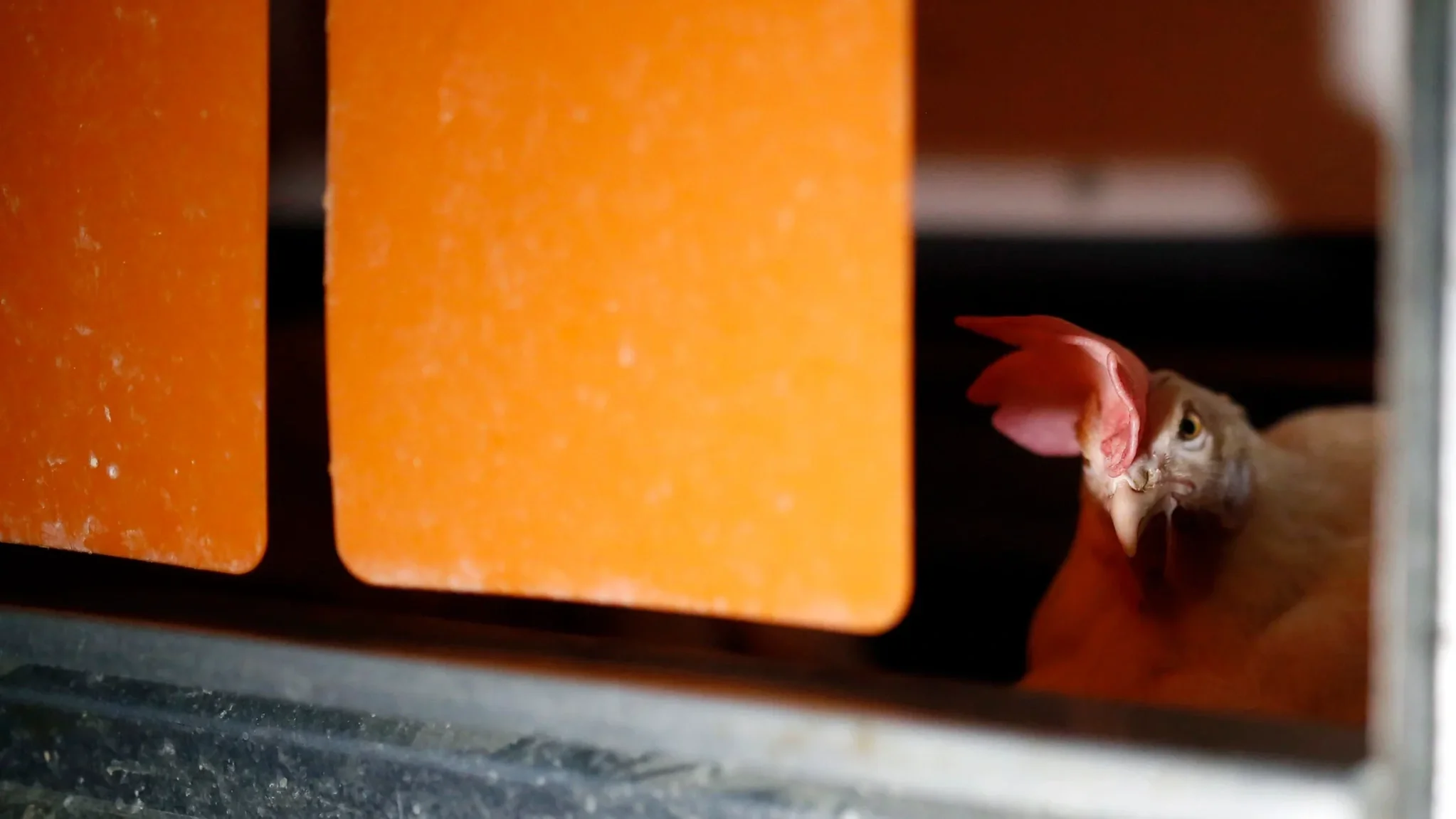
Motherhood in the Egg Industry
Photo credits: Andrew Skowron
A hen will growl, peck, and starve herself to protect her eggs. She will call to her chicks before they hatch and guide them from the moment they emerge. The egg industry is built on making sure none of that ever happens. From the breeding farm where her eggs are taken, to the hatchery where her chicks hatch alone, to the egg farm where her daughters lay without ever raising young, motherhood is severed at every stage.
Key Facts
A hen ovulates, forms an egg in her oviduct, and lays it as a complete reproductive product. Chickens do not menstruate. Eggs are not periods.
Fertilised eggs come from hens kept with roosters on breeding farms. These eggs go to hatcheries to produce chicks.
Unfertilised eggs are the table eggs sold for food, produced by hens kept without roosters.
Both kinds of eggs are products of the hen's reproductive system. The industry exploits that system at every stage.
Chickens’s ancestors laid far fewer eggs than a modern commercial hen. Estimates commonly cited by advocacy and poultry sources put free-living output at roughly 10 to 15 eggs per year, compared with roughly 300 eggs per year for modern hens used for eggs.
*On this page, we say "hens used for eggs" and "hens used for breeding" rather than "layer hens" or "breeding stock." These are mothers and would-be mothers, not production categories.
A Hen is a Mother
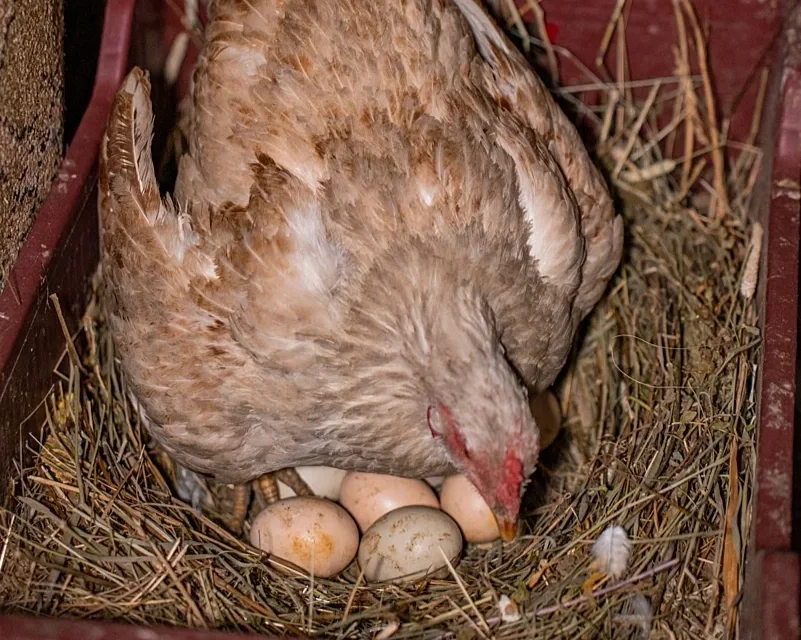
When a hen becomes broody, her entire behaviour shifts. She reduces normal foraging and dust bathing, presses her body flat against her eggs, pulls her feathers aside so her bare skin touches the shells, and stays.
She will sit for about 21 days. She turns the eggs with her beak, adjusts her weight to distribute heat evenly, barely eats, and becomes highly defensive if disturbed.
This is not malfunction. It is a powerful maternal state.
Inside the shell, the developing chick can already hear her. A broody hen vocalises to her eggs, and chicks learn to recognise maternal calls before they have ever seen light.
“The bond begins in the dark.”
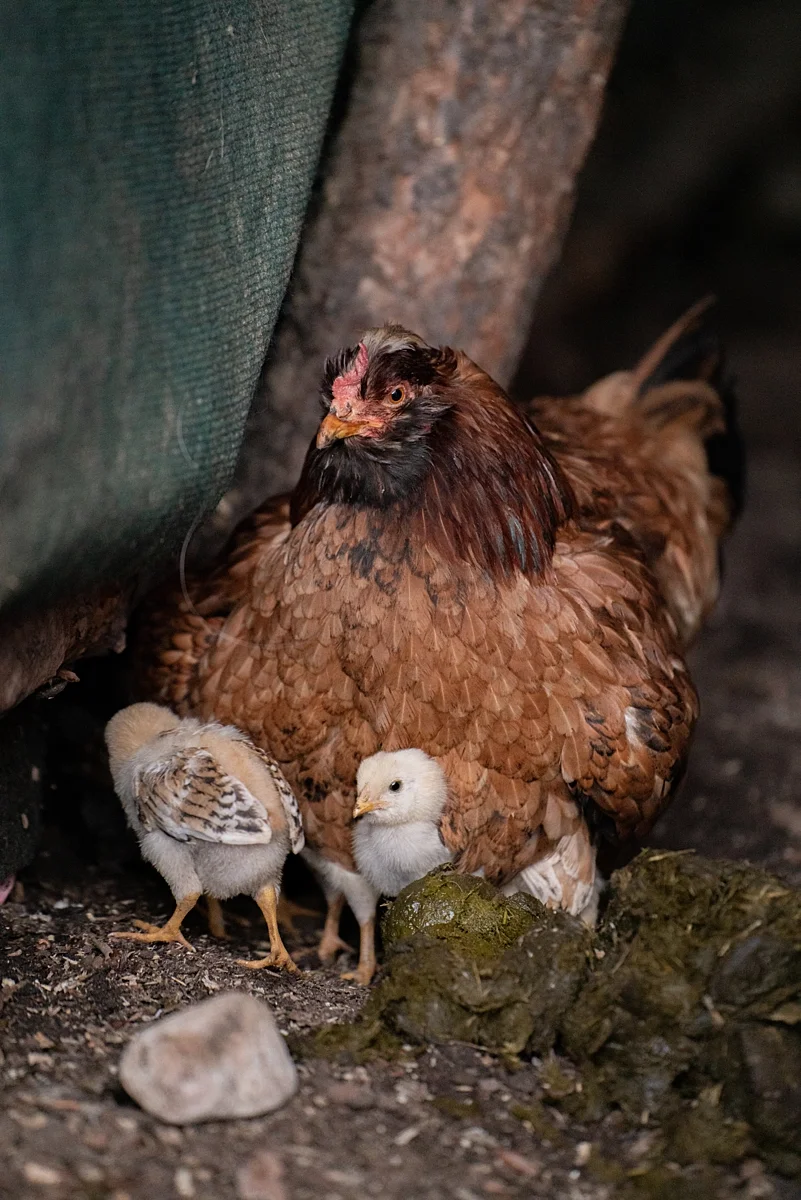
After hatching, the chicks imprint on her within hours. They press against her body for warmth. They follow her first steps. They learn what to eat by watching what she pecks at, where to sleep by settling under her feathers, and how to respond to danger by freezing when she gives an alarm call.
Research shows that chicks raised with a mother hen are less fearful, more behaviourally coordinated, and better buffered against stress. Chicks without mothers show higher fearfulness and less synchronised behaviour, and early-life stress in commercial systems is linked to welfare problems that can follow them through life.
A mother hen provides protection, social learning, food guidance, thermoregulation, and a stable rhythm of rest and activity.
When her eggs are taken, a broody hen does not simply move on. She returns to the empty nest. She searches. She calls.
On a breeding farm, that cycle repeats every day.

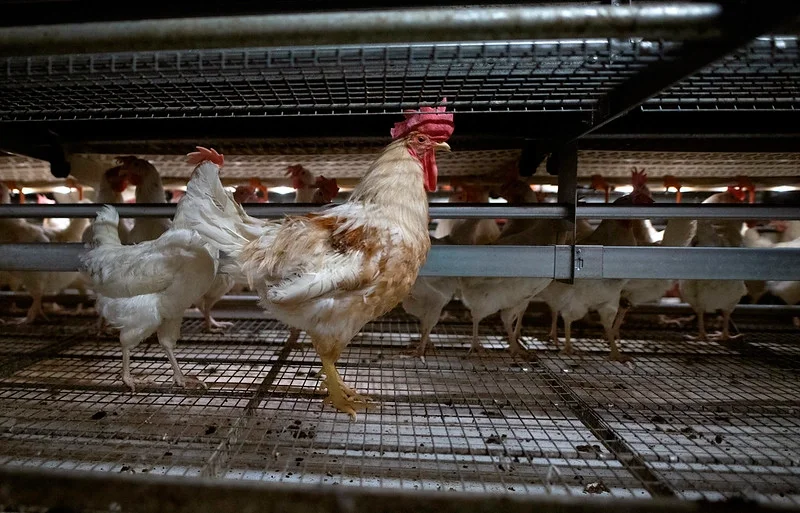
The fertilised eggs arrive at industrial hatcheries in stacked trays, thousands at a time. They are placed in large incubators that control temperature, humidity, and turning. No hen. No body warmth. No voice through the shell.
After about 21 days, the chicks hatch on metal or plastic surfaces. They are then removed from the hatcher and separated from the shells, usually onto conveyor systems. At that point they are wet, disoriented, and calling for a mother who is not there.
Within hours, still damp, they are sexed, sorted by hand or machine into male and female, vaccinated, and sometimes beak-trimmed. The males are killed because they have no commercial value in the egg industry.
When Mothers Are Replaced
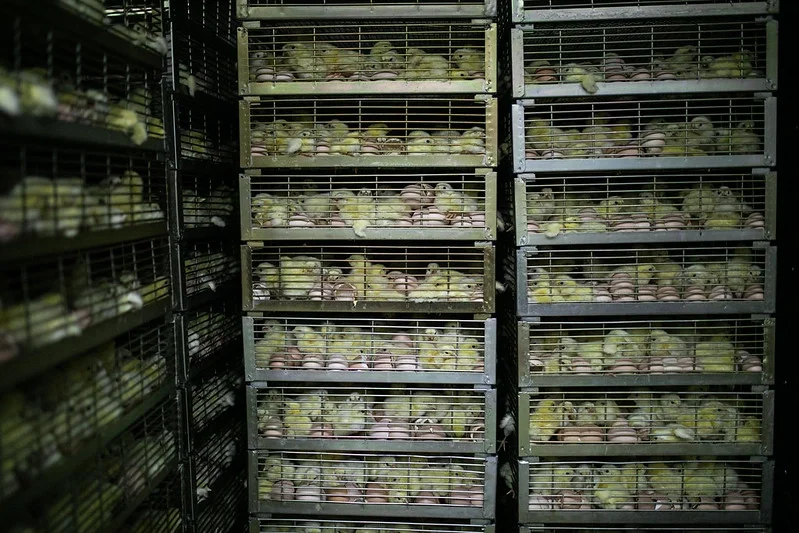
Industrial Hatchery [Photo Credit: Andrew Skowron]
Research shows that commercial hatchery processing can cause measurable stress responses in chicks and long-lasting effects on behaviour and welfare, including greater fearfulness and altered stress reactivity.
The female chicks who survive will grow into hens used for eggs. From the moment they can lay, their lives will be structured around one thing: producing eggs. Decades of aggressive breeding have made their bodies unable to stop. They will lay egg after egg, calcium leaching from their bones with every shell, until their output drops and they are replaced by younger hens.
None of them will ever meet their mother. None will ever raise a chick of their own.
The cycle begins again.
The egg industry is not only about eggs. It is about the systematic severance of a hen's most fundamental biological relationship.
A mother hen broods, protects, teaches, and comforts. She shapes her chicks' behaviour, reduces their fear, and buffers their stress. That relationship is real, measurable, and documented.
The industry is built on making sure it never happens.
Not in caged operations. Not in cage-free. Not in free-range. Not in organic.
The label changes. The structure does not.
What you can do
The egg industry depends on people not knowing about breeding farms, hatcheries, or the maternal lives hens are denied. Sharing this information is the most direct way to change that.
Share this page with someone who buys eggs and believes free-range is enough.
Learn more about the
Life cycle of a hen used for eggs →,
Chick culling →, and
The History of the Hen →.Support organisations working to end the commercial exploitation of hens.
The first step is knowing. Now you do.
Frequently Asked Questions
Don't hens just lay eggs anyway?
Hens do ovulate naturally, but a free-living hen lays far fewer eggs, roughly 10 to 15 per year. Commercial hens have been selectively bred to lay around 300. The volume is not natural. It is the result of decades of genetic selection that prioritises output over the hen's health.
Are eggs the same as periods?
No. Chickens do not menstruate. A hen ovulates: a yolk is released from the ovary, travels through the oviduct, gains albumen, membranes, and a shell, and is laid as a complete reproductive product. Calling eggs "periods" is biologically inaccurate and undermines the real issue, that the hen's reproductive system is being exploited for continuous production.
What is a breeding farm?
A breeding farm is where the mothers of future hens are kept. Hens are housed with roosters, typically around 11 hens per rooster, to produce fertilised eggs. Those eggs are collected daily, sent to hatcheries, and incubated in machines. The hen never broods her own eggs and never meets her chicks.
Why are breeding farms so poorly regulated?
In most jurisdictions, welfare legislation specifically covers hens on egg farms, not the hens used for breeding upstream. In the EU, welfare rules for hens on egg farms do not comprehensively cover hens used for breeding, hatcheries, or pullets. Breeding farms also operate under strict biosecurity, limiting independent research access. Welfare organisations have called for specific standards, but meaningful regulation has not followed.
What happens to male chicks?
Male chicks born in hatcheries are killed shortly after hatching, usually within hours. They do not lay eggs and are not the breed used for meat production.
Is free-range or organic any different on this point?
No. The breeding-farm-to-hatchery pipeline is the same across all commercial egg systems. Free-range, cage-free, organic, and conventional operations all source their hens from the same hatchery model. No commercial system allows hens to hatch or raise their own chicks.
Why does maternal deprivation matter?
Chicks raised without a mother show measurably higher fear and less coordinated behaviour, and early-life stress in commercial systems is linked to longer-term welfare problems. Maternal care shapes how a chick develops, copes with stress, and interacts with other birds for the rest of its life.
What does broodiness mean?
Broodiness is the natural maternal state in which a hen commits to incubating her eggs. Her hormones shift, she stays on the nest, reduces eating and movement, and focuses on keeping the eggs warm until they hatch. In commercial breeds, broodiness has been largely bred out because it interrupts egg production.
What about the roosters on breeding farms?
Roosters are kept solely to fertilise eggs. They are part of the same short-lived production system, kept for one cycle alongside the hens, then slaughtered.
-
Opening / thesis
Influences of Maternal Care on Chicken Welfare — review of maternal care, chick development, fear, synchrony, and welfare implications.
https://pubmed.ncbi.nlm.nih.gov/26742081/Commercial hatchery practices have long-lasting effects on laying hens' spatial behaviour and health — study on long-term welfare effects of hatchery conditions.
https://pubmed.ncbi.nlm.nih.gov/38117840/Effects of commercial hatchery processing on short- and long-term stress responses in laying hens — study on hatchery stress responses in chicks.
https://pubmed.ncbi.nlm.nih.gov/30787406/
Key facts: eggs, ovulation, fertilised vs unfertilised
Do chickens have a menstrual cycle? — overview of why chickens do not menstruate.
https://biologyinsights.com/do-chickens-have-a-menstrual-cycle/Reproductive system of hen — overview of ovulation and egg formation.
https://www.slideshare.net/slideshow/reproductive-system-of-hen/15347996An egg a day, oviposition explained — explanation of egg formation and laying.
https://layinghens.hendrix-genetics.com/en/articles/egg-day-oviposition-explained/The Anatomy and Function of a Hen's Reproductive System — anatomy and function of the hen reproductive tract.
https://de.slideshare.net/slideshow/the-anatomy-and-function-of-a-hen-s-reproductive-system/282419933?nway-=%2CCommon Consumer Misconceptions about Eggs — explanation of infertile commercial eggs.
https://ask.ifas.ufl.edu/publication/VM262Egg-STAT-ic About Eggs — USDA overview of egg production and egg types.
https://www.usda.gov/about-usda/news/blog/egg-stat-ic-about-eggsEarly detection of chicken egg fertility in ovo using optical sensing — USDA/NIFA project with data on table eggs vs hatching eggs.
https://portal.nifa.usda.gov/web/crisprojectpages/7002787-early-detection-of-chicken-egg-fertility-in-ovo-using-optical-sensing-...
Free-living hens / baseline output
Eggs: What Are You Really Eating? — advocacy source on natural egg output vs commercial laying.
https://freefromharm.org/eggs-what-are-you-really-eating/Egg Facts — sanctuary resource on chicken biology and egg output.
https://onelivingsanctuary.org/egg-facts
Mother hen / broody behaviour
Broodiness in Chickens: Signs, Treatment & Prevention — practical description of broodiness and behaviour changes.
https://poultrydvm.com/condition/broodinessTo be a chick mother — student review on maternal care in chickens.
https://stud.epsilon.slu.se/17055/1/Christenson_L_210707.pdfAcoustic Signals in Domestic Chicken (Gallus gallus) — evidence on maternal calls and chick responses.
https://ocivvlhqiwtxvnycqnia.supabase.co/storage/v1/object/public/new-kerko/OpenAlex-el/W2002109824/W2002109824-pdf/file.pdfNormal Behaviors of Chickens in Small and Backyard Poultry Flocks — behaviour overview including hen-chick interaction.
https://poultry.extension.org/articles/poultry-behavior/normal-behaviors-of-chickens-in-small-and-backyard-poultry-flocks/Influences of Maternal Care on Chicken Welfare — full-text review.
https://pmc.ncbi.nlm.nih.gov/articles/PMC4730119/
Breeder farms / hens used for breeding
CORAL - Parent Stock Layer Breeder — breeder management guide with production figures.
https://www.scribd.com/document/626639391/HN-MG-ParentStock-SuperNick-en-04-22-Print-X3Broiler breeder farms — USDA/APHIS breeder-farm fact sheet with farm size and hen-to-rooster ratio data.
https://www.aphis.usda.gov/sites/default/files/poultry10_dr_breeder.pdfBreeder Management — breeder management overview with production windows.
http://www.agritech.tnau.ac.in/expert_system/poultry/Breeder%20Management.htmlWelfare aspects in egg production — discussion of welfare problems and production priorities in egg genetics.
https://lohmann-breeders.com/lohmanninfo/welfare-aspects-in-egg-production/Production period (22–75 weeks) — production period resource for breeder hens.
https://hn-int.com/production-period-22-75-weeks/Effect of dietary calcium level on egg production and egg shell... — paper citing breeder production figures.
https://ojafr.ir/main/attachments/article/54/OJAFR,%20A%2001.pdf
Regulation / transparency / access
Public consultation on health and welfare aspects of genetic parameters... — EFSA consultation on breeder welfare.
https://www.efsa.europa.eu/en/efsajournal/pub/1670Scientific Opinion on welfare aspects of the management and housing of the grand-parent and parent stocks... — EFSA opinion on breeder welfare.
https://efsa.onlinelibrary.wiley.com/doi/abs/10.2903/j.efsa.2010.1667Welfare of laying hens - plain language summary — EFSA summary of laying hen welfare and evidence gaps.
https://www.efsa.europa.eu/en/plain-language-summary/welfare-laying-hensLaying Hens Welfare Recommendations — Eurogroup for Animals recommendations including breeder and hatchery gaps.
https://www.eurogroupforanimals.org/files/eurogroupforanimals/2022-10/Laying%20Hens%20Welfare%20Recommendations%20Eurogroup%20fo...Welfare issues in broiler breeders — breeder welfare paper discussing research and management gaps.
https://www.cabi.org/Uploads/animal-science/worlds-poultry-science-association/WPSA-italy-2009/86_welfare2009_dejong.pdf
Hatcheries / chick culling
Effects of commercial hatchery processing on short- and long-term stress responses in laying hens — hatchery stress study.
https://pubmed.ncbi.nlm.nih.gov/30787406/Commercial hatchery practices have long-lasting effects on laying hens' spatial behaviour and health — long-term hatchery welfare study.
https://pubmed.ncbi.nlm.nih.gov/38117840/Chicken or egg: Hatchery welfare issues for female layer chicks — overview of hatchery welfare problems.
https://onanimals.co.uk/2021/11/21/chicken-or-egg/The culling of male chicks — RSPCA explainer on male chick killing.
https://science.rspca.org.uk/documents/d/science/the-culling-of-male-chicks-information-sheet-april-2025Banning chick culling in the EU — European Parliament material on chick culling.
https://www.europarl.europa.eu/doceo/document/E-10-2024-001843_EN.htmlChick-killing ban: Where have all the cockerels gone... — foodwatch article on chick culling and bans.
https://www.foodwatch.org/en/chick-killing-ban-where-have-all-the-cockerels-gone
Donate
Your donation helps expose industry myths and moves people toward compassion.