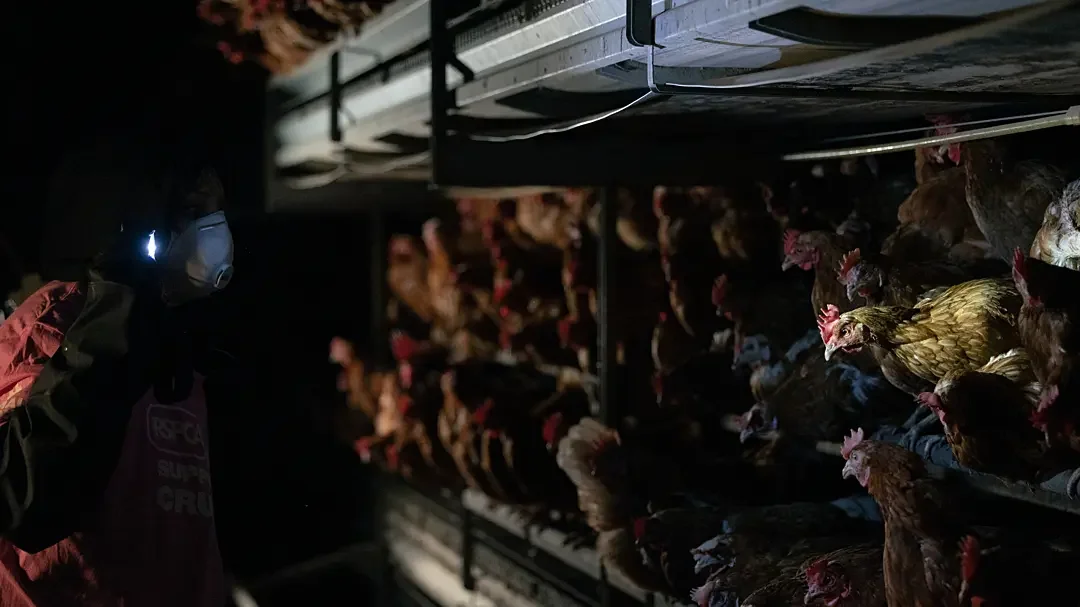
An investigator's light lives crowded with thousands of other hens inside a high-welfare egg farm. / @weanimals
For roughly a decade, major animal advocacy campaigns persuaded corporations to commit to sourcing cage-free eggs. US egg consumption rose from 256 eggs per person in 2015 to around 292 in 2019. The cage-free share of the market grew, but the total market grew with it. A veterinarian who investigated cage-free farms, an advocate who spent six years negotiating those corporate pledges, PETA, and a growing number of researchers are now asking the same question: did these campaigns move the system, or make it more durable? At Egg-Truth, we have always measured different things — not which cage a hen is in, but how many hens are in any system at all.
The campaigns measured one thing. Here is what they didn't.
First and foremost: this post is not an attack on the people who ran cage-free campaigns. We truly believe that they were — and are — motivated by a genuine desire to reduce suffering. The logic behind those campaigns was coherent.
Battery cages confine a hen in a space smaller than a sheet of paper. She cannot spread her wings, dust-bathe, nest, or move freely. Cage-free systems remove the cage. That is a real difference. Cage-free barns do improve some things. Hens can move more freely, access perches and “nests”, and research suggests this reduces certain forms of chronic behavioural frustration.
The campaign commitment could be announced, counted, and reported to funders. Hundreds of companies signed on. The cage-free share of the US egg market grew from a small fraction to a meaningful portion of total supply.
That was what the campaigns were designed to measure and by that measure, it moved.
What the campaigns were not designed to measure was egg consumption. They did not treat total hen population as a primary success metric. Whether the industry was getting smaller or larger was not the question the campaign was tasked with answering.
This does not look like a moral failing, but a design choice. And it is the choice several voices are now asking us to examine.
Egg consumption went up. The campaigns didn't ask why.
During the years when cage-free campaigns were most active, US per-capita egg consumption rose from 256 eggs per person in 2015 to around 292 by 2019-2020 — some of the highest levels on record. The cage-free share of the market grew. The market it was a share of also grew.
It has since fallen. But not because of advocacy. Repeated avian influenza outbreaks from 2022 onward devastated laying flocks, supply collapsed, and retail prices more than doubled in some markets. Demand pulled back. Now, as prices normalize and the flock rebuilds, USDA projects consumption recovering to around 270 in 2026. The dip was a price shock. The recovery proves it.

We are not saying cage-free campaigns caused consumption to rise. We are saying something simpler: whatever those campaigns did, they did not drive consumption down. And the data does not show that anything has.
Dr. Crystal Heath, a veterinarian who has investigated cage-free facilities including during avian influenza outbreaks, raises a more pointed concern: "Cage-free campaigns don't improve welfare and may even increase consumer trust and thus demand for eggs." The logic is uncomfortable but worth sitting with. If the campaign message is "cage-free is better," and consumers believe it, the result may be more people comfortable buying eggs — not fewer.
She also puts a number on what the egg industry gained. "There's a premium for cage-free eggs — $1.81 per dozen — but the cost of producing cage-free eggs is only about 19 cents more per dozen." The industry converted facilities under pressure from advocacy campaigns, then sold a premium product at significant margin. "They are making billions of dollars a year," she says, "and the demand for eggs has also increased."
Cage-free barns also introduce new welfare problems that battery cages do not. Keel bone fractures affect between 85 and 97 percent of hens in non-cage systems in some studies. Feather pecking has been reported in 80 to 94 percent of cage-free flocks in US research. Air quality is often worse. With higher ammonia concentrations than in caged systems and significantly more dust carrying pathogens. PETA's white paper describes the welfare picture plainly: "Cage-free housing systems shift, rather than eliminate, welfare burdens, improving some welfare outcomes while worsening others."
And some things do not change at all, regardless of the label. Male chicks are still killed at the hatchery. Hens are still bred to produce far more eggs per year than their bodies evolved to sustain. They are still slaughtered when production declines. Those facts apply under cage-free, organic, and free-range labels equally.
Some of the people who led those campaigns are now asking out loud.
This used to be a private conversation. It is now a public one.
Dr. Krista Hiddema spent six years leading Mercy For Animals Canada, personally negotiating cage-free commitments with dozens of corporations. In her September 2026 essay, she is direct about what she now thinks of that work:
"For six years, when I led Mercy For Animals in Canada, I personally negotiated countless corporate cage-free egg commitments. I sat across from companies and tried to persuade them to move away from battery cages. I believed in that work then. I don't anymore."

Dr. Krista Hiddema and Dr. Crystal Heath
She is careful to say she does not doubt the concern for animals that motivated those campaigns. But she argues that welfare campaigns have received "a disproportionate share of our funding, talent, and organizational capacity," leaving far less room to develop approaches aimed at reducing animal use rather than reforming how animals are kept. And she names the bigger structural question:
"Not everything that counts can be counted. And not everything that can be counted tells us whether we are winning. A cage-free commitment can be counted. But how do we quantify a change in society's understanding of and relationship to animals? How do we quantify the delegitimization of animal exploitation?"
She frames what the movement has missed as a question of power:
"Factory farming is not a technical problem. Factory farming is a power problem. And we will not engineer our way out of it."
Dr. Heath goes further on the economic argument. "We're doing free marketing for the animal exploitation industry," she says, "and that is so disturbing to me." Her point is not only that the campaigns failed to reduce consumption — it is that they may have actively helped the industry market a premium product with better public relations than ever before.
PETA, in its January 2026 white paper, reaches a similar conclusion from an institutional vantage point: "The well-intentioned move to compel the egg industry to switch from traditional battery cages to alternative cage-free housing systems has failed to achieve more than minimal improvements in hen welfare." The paper describes how cage-free certifications and labels "mislead consumers into believing that cage-free hens behave like hens in their natural environments," and argues that "animal welfare organizations that secure corporate cage-free commitments" play a role in perpetuating that fiction.
The concern is also being raised about what comes next. A 2026 analysis from within the effective altruism community questions whether the movement's tendency to pursue measurable "silver bullets" is crowding out harder, slower strategies. And in a development that would have seemed unlikely five years ago, an animal advocacy nonprofit is reportedly hiring staff to operate a commercial broiler farm — not to shut it down, but to test welfare technologies that can be sold to poultry companies for adoption at scale.
This is not infighting. It is a reckoning. And it is a reckoning that people outside the movement deserve to know about.
We always measured different things.
Egg-Truth was built around a different question. Not: which cage is she in? But: how many hens are in any system at all?
That means we watch different numbers:
Per-capita egg consumption — peaked near 292 in 2019-2020, dipped during the HPAI price crisis, already recovering to around 270 in 2026. The trend is not moving in our direction.
315 million hens used for table-egg laying hens in the US as of August 2026, up nearly 5% year-over-year. The flock is growing, not shrinking.
Plant-based egg alternatives, small in absolute terms, but growing significantly faster than cage-free shell eggs in certain channels, particularly foodservice.
Public understanding of what cage-free legally requires — still low; most people believe it means hens go outside and are not beak-trimmed. It means neither of those things.
A cage-free commitment changes one housing variable. It does not change the hatchery. It does not change the genetics. It does not change the slaughterhouse. It does not reduce the number of hens. PETA's conclusion in its white paper matches ours: "Anyone who believes hens' suffering is unacceptable should commit to supporting efforts to eliminate their exploitation for eggs in the first place."
That is not a reason to oppose cage-free housing. It is a reason to ask whether cage-free campaigns were ever designed to do what advocates hoped they would do.
The harder questions are also the more hopeful ones.
Asking whether a decade of cage-free campaigns moved the system is not the same as saying nothing can move it. It is the opposite.
Dr. Hiddema's essay does not end with despair. It ends with clarity about what she actually wants:
"I don't want better factory farms. I want fewer animals in that system. And ultimately, I want no animals in it at all."
She argues for approaches aimed at reducing how many animals are used, not just reforming the conditions they are kept in. Building political power. The kind that makes animal agriculture politically costly rather than merely commercially inconvenient. She draws an analogy to marriage equality in the United States: for decades, advocates endured setbacks while slowly changing public understanding and building legal and political support. Much of that work appeared ineffective right up until the moment it wasn't.
Dr. Heath's version of that argument is more direct: "Let's align our messaging with our real values and not tell ourselves a fake story in order to appease people. Let's start speaking the truth." Her call to action is the same as ours — "We should be telling Crumbl Cookies to remove eggs from your products altogether" — because that is the question that actually matters.
The information gap is real and it is closeable. Most people do not know what cage-free legally requires. Most people do not know that male chicks are killed at the hatchery on their first day of life. Most people do not know that the hen who laid their breakfast egg was slaughtered before she turned two. That is not a values problem. That is a knowledge problem. And closing it is where Egg-Truth believes it can do the most good.
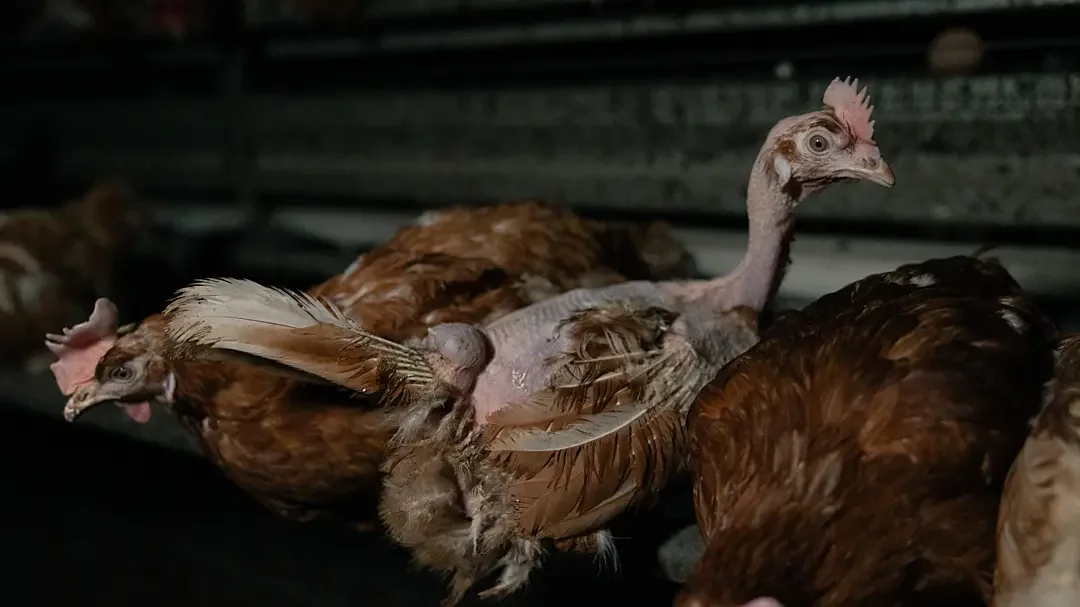
Hen with extreme feather loss in cage-free barn. /@weanimals
What you can do
Read our cage-free page for the full picture on what the label does and does not cover: egg-truth.com/cage-free
Replace eggs where you can. Fewer eggs consumed means fewer hens bred for the purpose. A guide to going egg-free is here: egg-truth.com/ditch-eggs
Support independent information. Egg-Truth is donor-funded. We do not take corporate money. We do not run corporate pledge campaigns. We measure what we think actually matters, and we publish what we find.
FAQ
Do cage-free campaigns help animals?
Cage-free housing does improve some welfare outcomes inside the barn. Hens have more freedom to move, nest, and flap their wings. But cage-free systems also introduce new harms including keel bone fractures (affecting 85–97% of hens in non-cage systems in some research), severe feather pecking, and worse air quality. More importantly, cage-free systems do not change what happens at the hatchery, how hens are bred, or when they are slaughtered — and the data does not show that cage-free campaigns reduced total egg consumption or total hen numbers.
Is cage-free better than battery cages for hens?
In some ways, yes. In others, no. Cage-free barns shift welfare problems rather than eliminate them. And some harms (like male chick culling, overbreeding, slaughter at end of lay) apply regardless of which housing system is used. For a full comparison of every label, see egg-truth.com/cage-free.
Did cage-free campaigns reduce egg consumption or hen numbers?
The campaigns were not designed to measure either. US per-capita egg consumption rose from 256 in 2015 to a peak of around 292 in 2019-2020. It fell to around 264 in 2025 — driven by repeated avian flu outbreaks, supply destruction, and retail prices that peaked above $3.50 per dozen. USDA projects recovery to around 270 in 2026 and 274 in 2027 as supply and prices normalize. The drop was not caused by advocacy, and it is not lasting. Per-capita consumption over the past 20 years is still up 15 percent according to PETA's 2026 analysis. The number of table-egg laying hens in the US is approximately 304 million out of 369 million total layers as of January 2025. The industry did not get smaller because of cage-free campaigns.
Didn't cage-free campaigns at least cost the industry money?
The industry would say the opposite. Cage-free eggs now carry a premium of around $1.81 per dozen, while the added cost of cage-free production is approximately 19 cents per dozen — Dr. Crystal Heath's synthesis of Egg Industry Center cost data and retail price comparisons. The companies that converted to cage-free housing under campaign pressure are now selling a higher-margin product with better public relations than before. Whether that counts as a win for animals is a question worth taking seriously.
What would actually help farmed hens?
Reducing total consumption (through plant-based alternatives, shifted cultural norms, and genuine demand reduction) addresses the system rather than one variable inside it. Building political power that makes large-scale animal agriculture politically costly is part of the picture too. So is closing the information gap: most people still don't know what cage-free legally requires, or what happens at the hatchery.
Is cage-free the same as humane, cruelty-free, or free-range?
No. Cage-free means the hen is not in a battery cage. It does not require outdoor access, a minimum space per bird, a flock size limit, or restrictions on beak trimming. Humane and cruelty-free are marketing terms, not legal standards. In the US and Canada, free-range requires some outdoor access but does not define how much or for how long. In the EU and UK, free-range has stricter rules on outdoor access and stocking density, but still does not address male chick culling, overbreeding, or early slaughter.
What can I do instead of buying cage-free?
Reduce or replace egg consumption. Eggs can be substituted in most cooking and baking, and the plant-based egg market is growing. Even consistent reduction contributes to lower demand. A full guide is at egg-truth.com/ditch-eggs.
-
Advocacy and movement analysis
Krista Hiddema, “The Future of Farmed Animal Advocacy,” September 2026:
https://blog.drkristahiddema.com/blog/2026/9/1/the-future-of-farmed-animal-advocacyDr. Crystal Heath, “Is Cage-Free Harm Reduction?” https://www.instagram.com/p/DbhnV_QTc3d/ ; https://www.instagram.com/p/DbizplKTvcb/; https://www.instagram.com/p/DbjBdaNTrnZ/; https://www.instagram.com/p/Dbj5cgvzY9x/; https://www.instagram.com/p/DbmFhhMBAPb/; https://www.instagram.com/p/Dbo1noYz7bW/; https://www.instagram.com/p/DTNvEGok-zW/
The Vegan Report, Episode 2957184, transcript:
https://rss.com/podcasts/veganreport/2957184/?tab=transcriptPETA, “The Failure of Cage-Free Housing Systems to Reduce Overall Hen Suffering,” January 2026:
https://www.peta.org/features/executive-summary-cage-free-white-paper/PETA, supporting documentation for the white paper:
https://www.peta.org/wp-content/uploads/2026/01/Support-for-White-Paper-Hen-Suffering-2026_FIN300-1.pdfCollectively Gary, “Factory Farming 2.0”:
https://collectivelygary.substack.com/p/factory-farming-20
Government and industry data
USDA National Agricultural Statistics Service, Chickens and Eggs, January 2025:
https://esmis.nal.usda.gov/sites/default/release-files/fb494842n/q524mj24t/z316rx705/ckeg0125.pdfUSDA National Agricultural Statistics Service, Chickens and Eggs publication archive:
https://esmis.nal.usda.gov/publication/chickens-and-eggsAmerican Egg Board, “Industry Data”:
https://www.incredibleegg.org/about-us/industry-data/Food and Agriculture Organization of the United Nations, Agricultural Production Statistics 2000–2022:
https://openknowledge.fao.org/server/api/core/bitstreams/fba4ef43-422c-4d73-886e-3016ff47df52/contentFood and Agriculture Organization of the United Nations, Agricultural Production Statistics 2023:
https://openknowledge.fao.org/bitstreams/df90e6cf-4178-4361-97d4-5154a9213877/downloadFAOSTAT, Crops and Livestock Products database:
https://www.fao.org/faostat/en/#data/QCLUSDA Livestock, Dairy, and Poultry Outlook: September 2026 https://www.ers.usda.gov/media/29662/ldp-m-387.pdf?v=36908
Welfare research and reviews
K. M. Hartcher and B. Jones, “The Welfare of Layer Hens in Cage and Cage-Free Housing Systems,” World’s Poultry Science Journal, 2018:
https://www.cambridge.org/core/journals/world-s-poultry-science-journal/article/welfare-of-layer-hens-in-cage-and-cagefree-housing-systems/35FB8DB602AF9AE7C44C00FA3A20D67BEggTrack, Welfare of Hens in Cage-Free Systems: Summary Review, 2024:
https://www.eggtrack.com/media/7457677/hen-welfare-in-alternative-systems-summary-review-2024.pdfPurdue University Extension, Behavioral Challenges and Welfare Consequences of Cage-Free Housing:
https://extension.purdue.edu/extmedia/AS/AS-694-W.pdfPennsylvania State University Extension, “Behavioral Challenges in Cage-Free Housing Systems”:
https://extension.psu.edu/behavioral-challenges-in-cage-free-housing-systems
Campaign and transition evidence
The Humane League, 2015 Accomplishments:
https://animalcharityevaluators.org/wp-content/uploads/2016/11/THL-2015-accomplishments-doc-2016.pdfOpen Philanthropy, evaluation of The Humane League:
https://web.archive.org/web/20251128192435/https://www.openphilanthropy.org/sites/default/files/The_Humane_League_08-22-16_(public).pdfUnited Egg Producers / Caputo et al., The Transition to Cage-Free Eggs:
https://unitedegg.com/wp-content/uploads/2023/02/Full-Report-Caputo-et-al.-2023-February-20.pdfEgg Industry Center, cage-free transition cost analysis:
https://www.eggindustrycenter.org/media/cms/Ibarburu_Prop12CostCF_800E51D54CF3D.pdf