Do Chickens Know They're Conscious? The Science That Changed Everything.
Researchers have now demonstrated that chickens show behaviour consistent with mirror self-recognition, a cognitive benchmark previously documented only in great apes, dolphins, elephants, and a handful of other species. They can count. They show empathy. They communicate with their chicks before they hatch. They dream. The science is extraordinary. What the industry does with it is not. Rather than prompting a moral reckoning with the egg and meat industries, these findings are being absorbed into production systems, repackaged as tools for efficiency, marketed as welfare improvements, and used to build better cages instead of opening them.
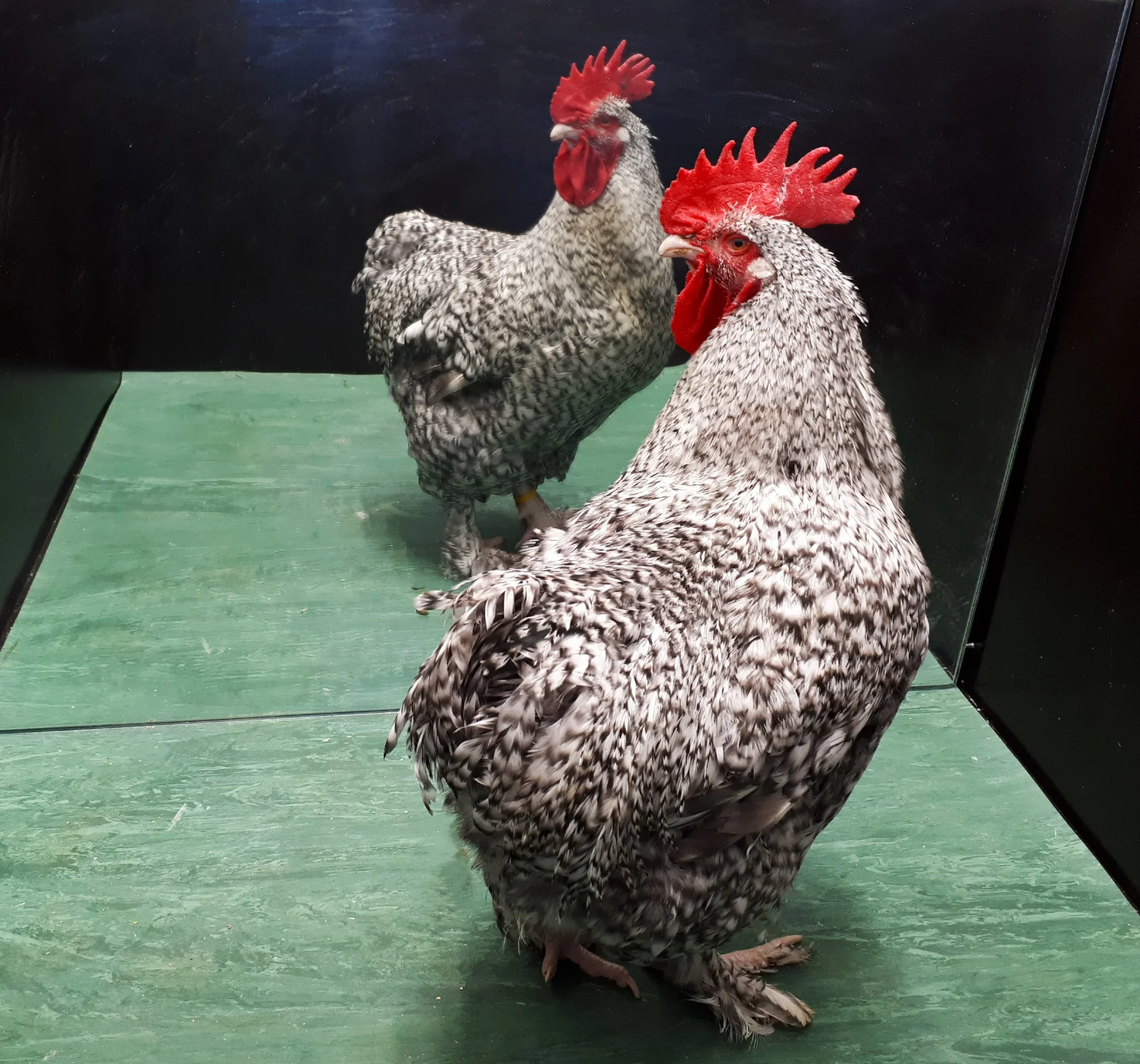
A rooster looks into a mirror © Photo: Sonja Hillemacher/University of Bonn
Do chickens recognise themselves in a mirror?
The short answer is: probably yes, under the right conditions.
Researchers at Ruhr University Bochum and the University of Bonn tested whether roosters could distinguish their own reflection from another bird. They didn't use the standard mark test, which was designed for primates. They used something smarter. They used the rooster's own instinct.
Roosters give alarm calls when a predator appears and other birds are nearby. They stay silent when alone. There's no point alerting a hawk to your location if no one benefits from the warning.
The team placed roosters in four conditions: alone, with a visible companion, with a companion hidden behind the mirror, and facing only the mirror. A hawk silhouette passed overhead in each condition. Roosters alarm-called most when a real companion was present. In front of the mirror, most stayed silent.
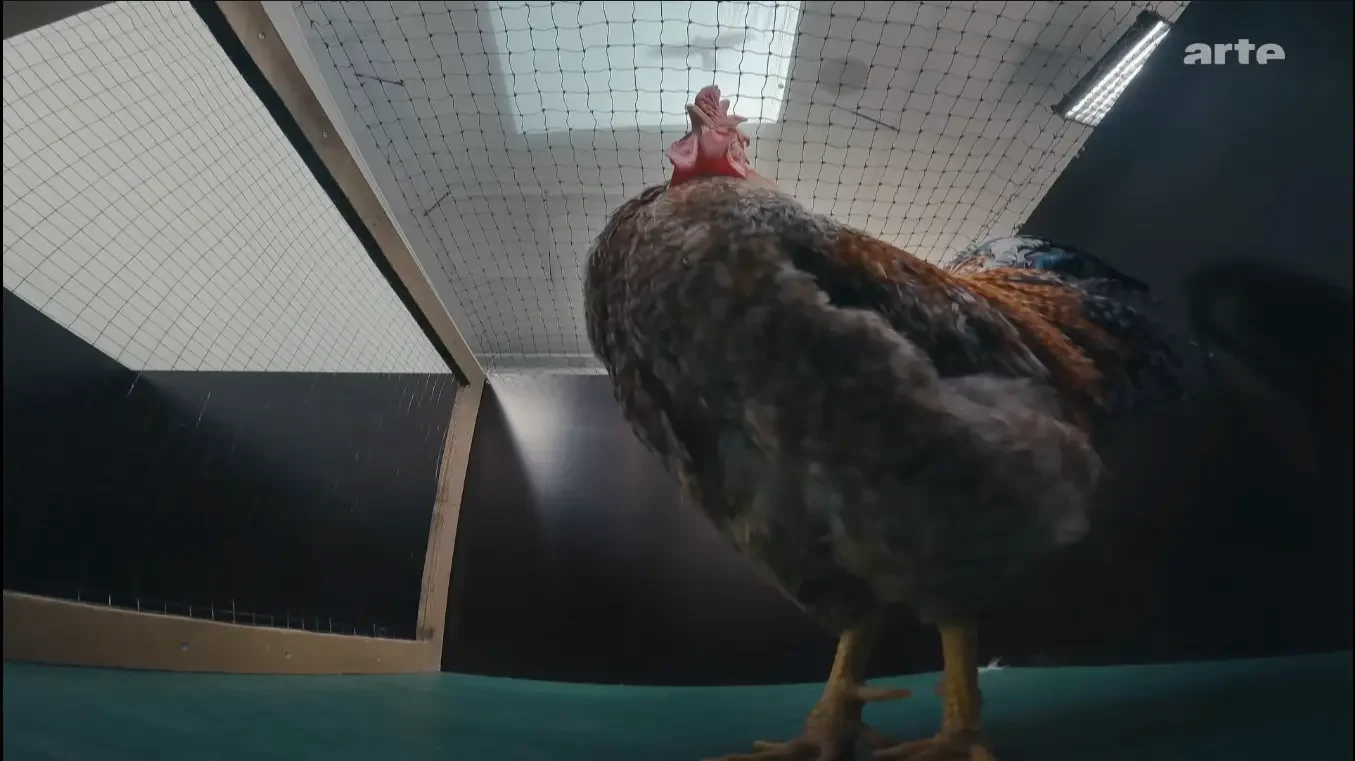
Researchers tested whether roosters could distinguish their own reflection from another bird.
Source: arte.tv
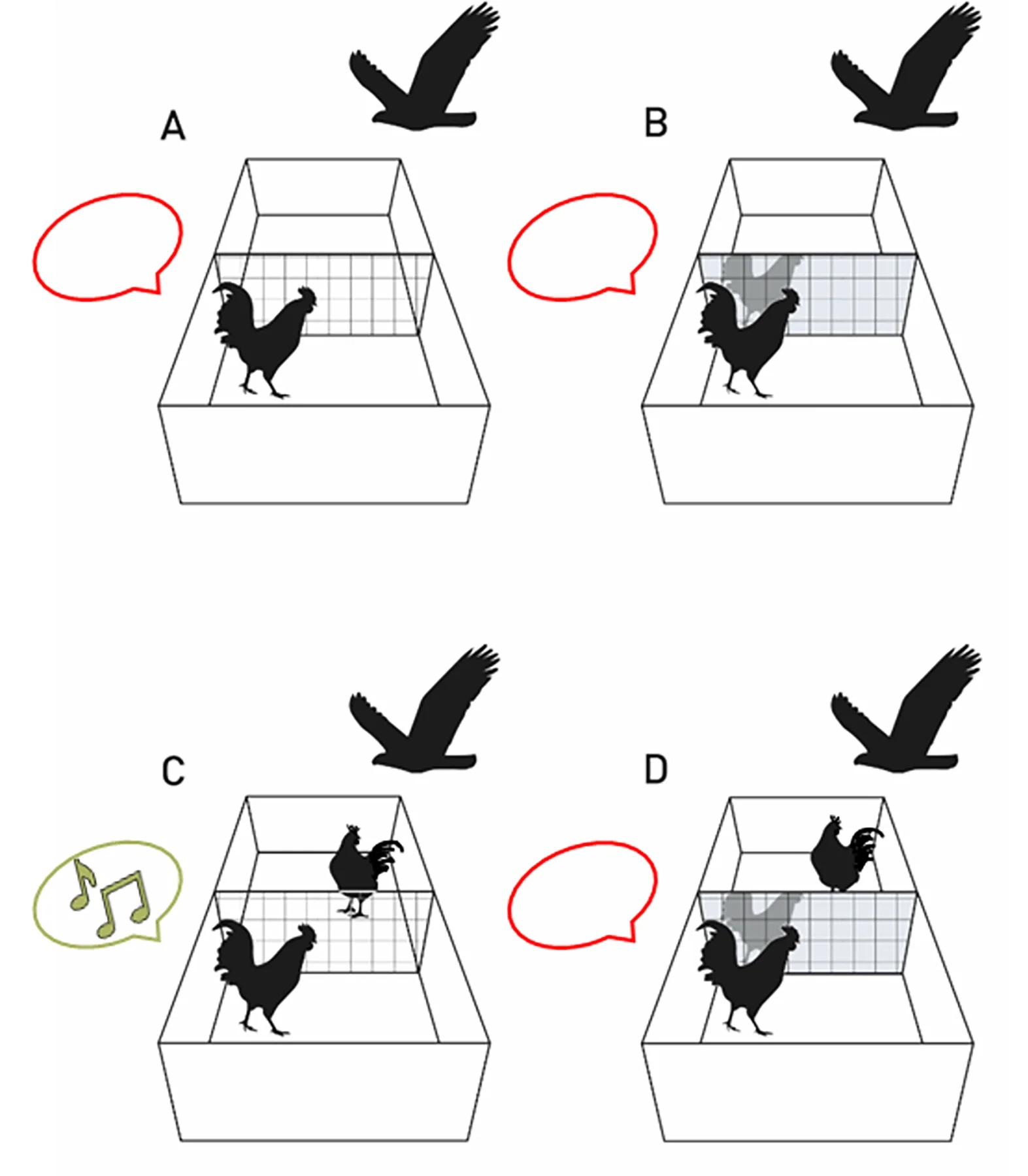
Graphical representation of the four conditions of the mirror-audience test and its outcome.
Source: “Roosters do not warn the bird in the mirror”
They did not treat their reflection as another rooster who needed warning. The researchers describe this carefully: roosters "possibly recognize their reflection as their own." The classic mark test did not produce strong evidence in this study. But the ecologically framed experiment did.
As Dr. Onur Güntürkün, who co-authored the study, explained: "If an animal recognizes itself in the mirror, it knows something about itself: that is me. It has a sense of self. And that is a cognitive trait that, we believe at least, could go along with consciousness."
"We did not expect chickens to show signs of self-awareness," he said. "That shows that we have been seriously underestimating chickens, and perhaps many other farmed animals, in their cognitive abilities."
What can chickens actually do?
The mirror test is the headline. But the body of evidence behind chicken cognition is far deeper than one experiment.
Lori Marino's 2017 review in Animal Cognition synthesised decades of peer-reviewed research into a single conclusion: chickens are cognitively, emotionally, and socially complex in ways comparable to many animals more widely recognised as intelligent.
Here's what the science shows.
-
Research by Giorgio Vallortigara and colleagues, published in Proceedings of the Royal Society B, shows that day-old chicks can discriminate between quantities, track how many objects move behind different screens, and approach the location with the larger number. These abilities appear within hours of hatching. They are not trained tricks.
-
Chickens can learn to identify letters, numbers, colours, and shapes. A hen named Lacey holds the Guinness World Record for the most identifications by a chicken in one minute. She correctly identified six letters, numbers, and colours from among distractors.
-
A study by Jo Edgar and colleagues at the University of Bristol, published in Proceedings of the Royal Society B, found that when chicks experienced mild distress (a brief air puff), their mothers' heart rates increased, their eye temperature dropped, they became more alert, and they produced more maternal clucking. The hens themselves were not experiencing the aversive event. Only their chicks were.
This is emotional contagion. A hen shares the distress of her chicks without experiencing it herself. That is a foundational form of empathy. In one of the most intensively farmed animals on earth.
-
Embryos vocalise inside the egg. Broody hens respond. Research shows that the acoustic world inside the egg shapes how the chick behaves after hatching: what to peck, when to rest, how to respond to threats. She is already participating in a communication system before she breaks the shell.
-
Chickens exhibit both non-REM and REM sleep similar to those found in mammals. Research on pigeons shows REM sleep activates brain regions linked to vision, movement, and emotion. Nobody knows what she dreams about. But she dreams.
-
Marino's review documents object permanence, transitive inference, social learning, self-control, and stable individual differences in behaviour. She is not interchangeable with the hen next to her. She never was.
Can AI decode what chickens say to each other?
At Dalhousie University in Canada, Dr. Suresh Neethirajan is doing exactly that.
His team records every cluck, murmur, and chirp. Cameras capture what the birds are doing when they vocalise. Thermal imaging shows body temperature and therefore stress levels. AI analyses the data to find patterns linking specific sounds to specific emotional states: frustration, contentment, fear, social recognition.
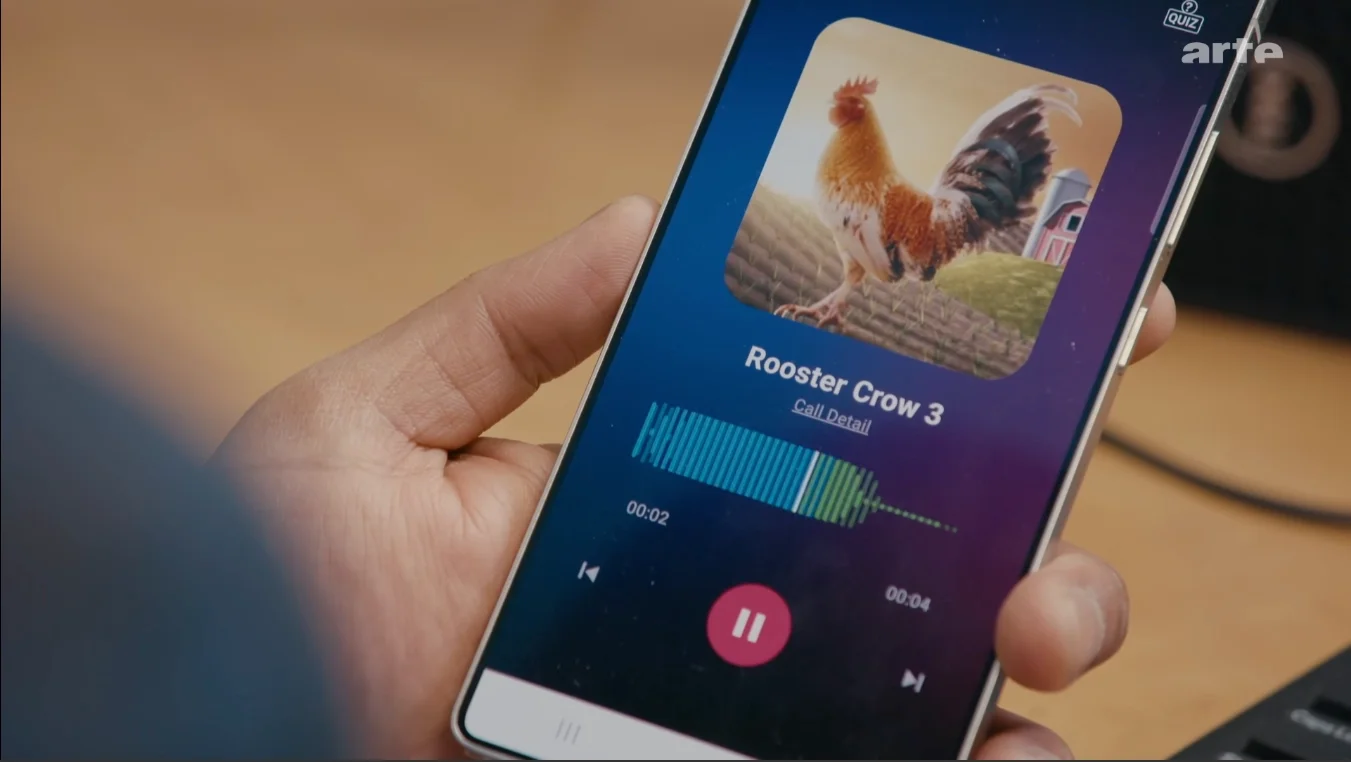
Dr. Suresh Neethirajan demonstrates his research.
Source: arte.tv
"We can listen to all the different sounds made in different situations and identify the emotions that accompany them," Neethirajan explained in the ARTE documentary.
The vision goes further. He believes that one day, software could translate a human phrase into a sound a chicken can understand. Cross-species communication. Not science fiction. Active research.
This work treats clucks as data. It assumes there is something worth decoding: a mind producing signals that carry meaning. That assumption is more radical than it sounds. For most of human history, chicken sounds were treated as noise. Neethirajan's lab treats them as language.
Which raises the question the documentary does not ask loudly enough.
How does the egg industry use the science of chicken consciousness?
Here is how the ARTE documentary frames the potential of this research:
"If farmers understood 'chicken,' they could shape conditions for their birds in ways that improve quality of life. A happy chicken is a productive chicken."
Read that again.
Scientists proved she recognises herself, counts, empathises, dreams, and communicates before hatch. The documentary's conclusion: understanding her better will make her more productive.
This is the welfare trap.
The welfare trap is the pattern by which scientific proof of animal sentience gets absorbed into production systems and converted into an efficiency argument. Instead of asking whether conscious beings should be caged, the system asks how understanding consciousness can improve the cage. The cage gets redesigned. It does not get opened.
It happened with enriched cages. The EU phased out barren battery cages and replaced them with "enriched" ones. Perches. Nest boxes. Litter areas. Industry materials connected these changes directly to better feed conversion and economic performance. The cage got a new name. The hen got the same life.
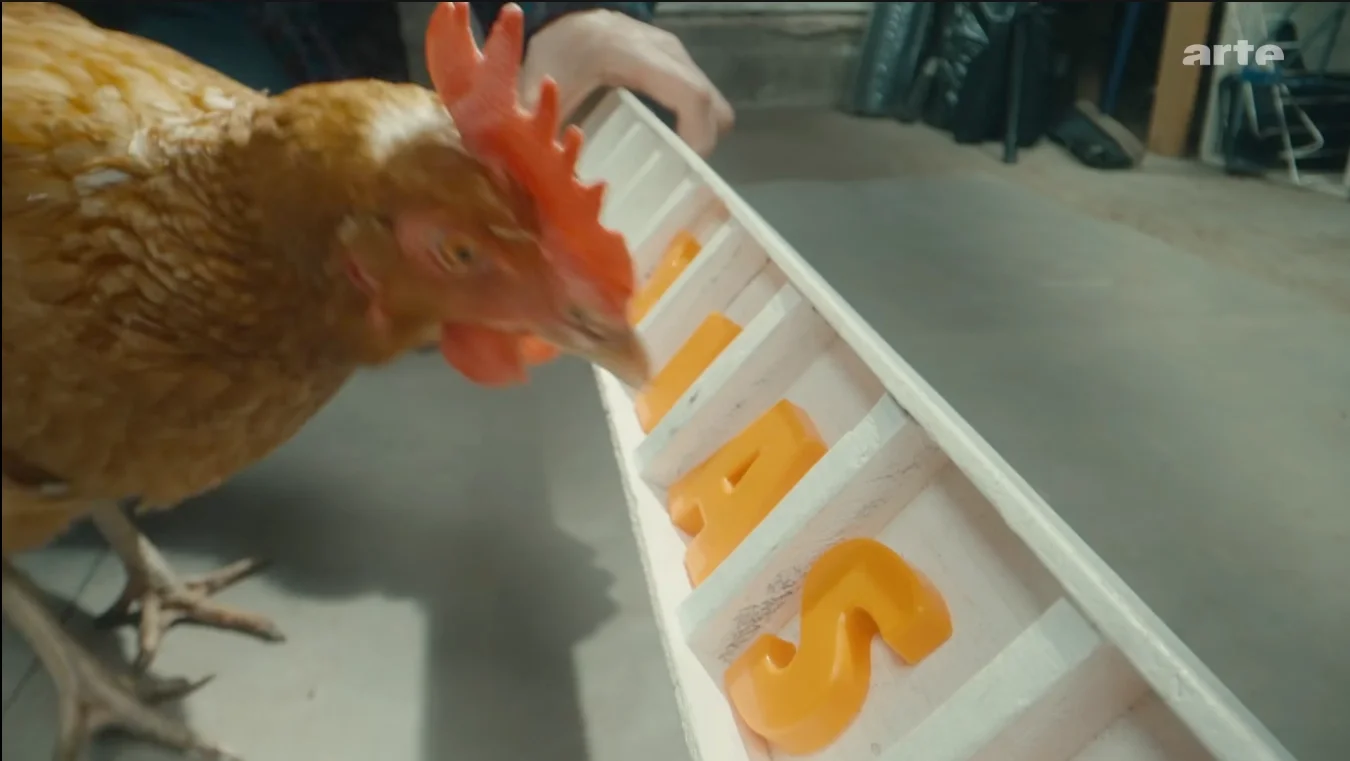
Veterinarian Emily Carrington demonstrates how her hens identify shapes.
Source: arte.tv
It happened with lobsters. When the UK legally recognised decapod crustaceans as sentient in 2021, lobster tanks did not disappear. The system shifted toward "more humane" handling language while keeping the exploitation intact.
The same pattern is now happening with chicken cognition research. The science proved she is a someone. The industry heard "someone" and thought: how do we make someone lay more eggs?
A system does not become ethical because the mind inside it is better understood. If anything, understanding intensifies the wrong. The exploitation is now imposed on a being whose inner life is richer than anyone previously admitted.
If you buy eggs at a supermarket, this applies regardless of the label. A small handful of multinational breeding companies, including ISA (Hendrix Genetics), Lohmann, and Hy-Line, supply most of the commercial hens used in egg production worldwide. The housing label changes the building. It rarely changes the hen: the same genetics, the same output targets, the same removal when her laying cycle ends.
If you've been buying free-range because you wanted to do the right thing: that instinct is correct. The problem is that the label was built to absorb it, not answer it.
How many chickens are affected?
According to FAO-derived estimates, approximately 33 billion chickens are alive worldwide at any given time.
Every one of them has the cognitive architecture the scientists in this documentary described. Every one of them can count. Can empathise. Can dream. Can communicate with her chicks before they hatch. And 33 billion of them are in systems designed to extract maximum output from bodies we now know contain minds.
The documentary called her "the crispy Sunday chicken." The science calls her a conscious being.
The system is not a welfare problem. It is a moral catastrophe. Improving the system does not fix a moral catastrophe. Ending it does.
What you can do about it?
The science is settled. The question is what you do with it.
Stop funding the system. Going egg-free is the most direct response to the evidence. Every egg requires a hen whose body and mind are exploited. The housing label changes the building. It rarely changes the hen.
Share the evidence. The science in this article lives in peer-reviewed journals most consumers will never find. Sharing it breaks the industry's greatest advantage: invisibility.
Question the welfare framing. When a brand says "improved welfare," ask: improved toward what end? If the answer involves productivity, the improvement is not for the hen. It is for the output.
A rooster looked into a mirror and knew it was him. The science is no longer the question. The question is whether we are willing to look at what we are doing to an animal who knows she exists.
FAQ
Do chickens pass the mirror test?
A 2023 study from Ruhr University Bochum, published in PLOS ONE, found results consistent with a form of self-recognition in roosters using an ecologically relevant alarm-call experiment. Roosters did not treat their reflection as another bird needing warning, a finding the researchers describe as "possibly" indicating self-recognition. The classic mark test did not produce strong evidence in this study, but the ecological approach suggests self-related processing that standard methods may fail to detect. The results challenge the assumption that self-awareness is absent in farmed birds.
Can chickens count?
Yes. Research by Giorgio Vallortigara and colleagues, published in Proceedings of the Royal Society B, shows that day-old chicks can discriminate between quantities, choose larger sets, and perform simple arithmetic-like operations. These are not trained tricks. They appear in chicks within hours of hatching.
Do chickens show empathy?
A study by Jo Edgar et al. at the University of Bristol, published in Proceedings of the Royal Society B, found that mother hens showed physiological distress responses (increased heart rate, temperature changes, alertness) when their chicks, not the hens themselves, experienced mild discomfort. This is emotional contagion, a foundational form of empathy.
Do chickens dream?
Chickens exhibit REM sleep, the sleep stage strongly associated with dreaming in mammals. While we cannot directly access their subjective experience, the neurological evidence supports the claim that chickens likely experience dream-like mental activity during sleep.
Do chickens communicate before hatching?
Yes. Embryos vocalise inside the egg and broody hens respond to these signals. Research shows that prenatal acoustic exchanges shape post-hatching behaviour, indicating that chicks begin participating in a communication system before they are born.
What is the welfare trap?
The welfare trap is the pattern by which scientific proof of animal sentience and cognition is absorbed by industry and redirected toward production efficiency rather than moral change. Instead of asking "should conscious beings be caged?" the system asks "how can understanding consciousness make caging more efficient?" The cage gets redesigned. It doesn't get opened.
Can scientists decode chicken language?
Dr. Suresh Neethirajan at Dalhousie University is using AI to analyse chicken vocalisations in context, matching sounds to emotional states like stress, contentment, fear, and social recognition. Full cross-species communication remains speculative, but the research has already identified meaningful patterns in how chickens use different calls.
Does the egg label matter if the genetics are the same?
For supermarket eggs, rarely. A small handful of multinational breeding companies supply most of the high-production hybrids used in commercial egg systems worldwide. Whether the carton says cage, barn, free-range, or organic, supermarket eggs almost always come from these engineered lines, the same body, the same 300+ egg annual output, the same calcium depletion. The housing label changes the building. It rarely changes the hen.
How many chickens are alive right now?
According to FAO-derived estimates, approximately 33 billion chickens are alive worldwide at any given time. This makes the chicken the most common bird on earth, and the most invisible.
-
Marino, L. (2017). "Thinking chickens: a review of cognition, emotion, and behavior in the domestic chicken." Animal Cognition, 20(2), 127-147. doi.org/10.1007/s10071-016-1064-4
Marino, L. (2017). Review summary. Kimmela Center for Animal Advocacy.wellbeingintlstudiesrepository.org/intell/3/
Tiemann, I., Brückner, G.M., Übel, R., & Güntürkün, O. (2023). "Roosters do not warn the bird in the mirror: The cognitive ecology of mirror self-recognition." PLOS ONE, 18(10), e0291416.doi.org/10.1371/journal.pone.0291416
Rugani, R. & Vallortigara, G. (2017). Numerical cognition in day-old chicks. Proceedings of the Royal Society B. royalsocietypublishing.org/doi/10.1098/rstb.2016.0509
Edgar, J., Paul, E., Sherwin, C., & Nicol, C. (2011). "Avian maternal response to chick distress." Proceedings of the Royal Society B. doi.org/10.1098/rspb.2010.2170
Edgar, J. et al. (2016). Further work on empathy and emotional contagion in mother hens.animalwelfare-science.net/uploads/1/2/3/2/123202832/jo_edgar_hen_empathy_2016.pdf
ARTE documentary: Dummes Huhn, keineswegs! Directed by Jeff Morales. arte.tv
Neethirajan, S. (Dalhousie University). AI decoding of chicken vocalisations. dal.ca/news/media/media-releases/2024/03/25/media_opportunity__fowl_language__dalhousie_university_researcher_uses_ai_to_crack_the_code_of_clucks_and_unravel_chicken_chatter_secrets__opening_the_door_to_an_improved_quality_of_life.html
European Commission. Animal welfare legislation: laying hens. food.ec.europa.eu/animals/animal-welfare/eu-animal-welfare-legislation/animal-welfare-farm/laying-hens_en
Lohmann Breeders. Welfare aspects in egg production. lohmann-breeders.com/lohmanninfo/welfare-aspects-in-egg-production/
Güntürkün, O. (Ruhr University Bochum). Press release: ego consciousness in feathered fowl.news.rub.de/english/press-releases/2023-10-26-biopsychology-ego-consciousness-feathered-fowl
Prior, H., Schwarz, A., & Güntürkün, O. (2008). "Mirror-induced behavior in the magpie." PLOS Biology.doi.org/10.1371/journal.pbio.0060202
Rattenborg, N.C. et al. (2009). Avian sleep and REM architecture. Neuroscience & Biobehavioral Reviews. pmc.ncbi.nlm.nih.gov/articles/PMC6560081/
Szymczak, J. et al. (1996). Sleep in chickens. Physiology & Behavior. doi.org/10.1016/0031-9384(96)00210-1
Guinness World Records. Most identifications by a chicken in one minute.guinnessworldrecords.com/world-records/770198-most-identifications-by-a-chicken-in-one-minute
Barrie 360. Chicken Guinness World Record coverage. barrie360.com/chicken-guinness-world-record/
UK Government. Lobsters, octopus, and crabs recognised as sentient beings.gov.uk/government/news/lobsters-octopus-and-crabs-recognised-as-sentient-beings
Prenatal vocalisation and neural development in birds. onlinelibrary.wiley.com/doi/10.1002/dneu.22091
Maternal care and chick development in domestic chickens. pmc.ncbi.nlm.nih.gov/articles/PMC4730119/
Ruhr University Bochum. When pigeons dream (REM sleep research). news.rub.de/english/press-releases/2023-06-06-neuroscience-when-pigeons-dream
Global chicken population estimates (FAO-derived). chickenfans.com/chicken-population-stats/thehumaneleague.org/article/how-many-chickens-are-in-the-world
Hendrix Genetics / ISA layer brands. layinghens.hendrix-genetics.com/en/our-brands/
FVE. Welfare in laying hen housing systems. fve.org/cms/wp-content/uploads/002-Welfare_friendly_systems_Laying-Hens-draft_adopted.pdf
Francione, G. (2008). Animals as Persons. Columbia University Press.
Donaldson, S. & Kymlicka, W. (2011). Zoopolis. Oxford University Press.