One in three adults now watches birds. Names them. Tracks their habits. Notices when they're gone. But the most common bird on the planet lives in a cage you'll never see, laying eggs you'll eat for breakfast. Nobody is watching her.
The Contradiction
96 million Americans watched birds last year. More than one in three adults. The number doubled in six years. They downloaded Merlin, submitted eBird checklists, spent weekends with binoculars pointed at feeders. Birding contributes $279 billion to the U.S. economy and supports 1.4 million jobs.
In Britain, over 700,000 people under 30 now regularly watch birds. A tenfold increase since 2018. In Canada, birdwatching tourism is a $2.4 billion market. In Australia, BirdLife has over 400,000 supporters. Across Europe, 24,000 people gathered for a single weekend count in 2024 and logged 3.57 million migrating birds.
Birding is no longer niche. It's a mainstream act of attention. People are learning to see birds. Really see them. To notice individuals. To name regulars. To track who comes back each spring.
And yet.
The most common bird in America is the chicken. 311 million laying hens are alive in the U.S. egg industry right now. Nobody knows a single one of their names.
No app tracks them. No webcam livestreams their behavior. No weekend count logs who's there and who isn't. The entire infrastructure of attention we've built for wild birds stops dead at the door of a laying facility.
That's not an accident. That's a system working exactly as designed.
As Manar Naboulsi wrote in Current Affairs: "When you look at an ordinary chicken with a bird-watcher's eyes, the full horror of factory farming becomes obvious."
The egg industry's business model depends on making sure you never look.
The Birder's Gaze vs. The Consumer's Gaze

A birder watches a bird and sees an individual. She arrived last Tuesday. She prefers the left side of the feeder. She chases off the juncos but tolerates the sparrows. She was here last year too.
This kind of attention is what researchers call individuation. You stop seeing "a bird" and start seeing this bird. A category becomes a someone.
The egg industry depends on the opposite. Deindividuation. Stripping every trace of individuality until what remains is a product, not a being.
Naboulsi captures this precisely: "The anonymous brown lumps our forks interact with contain nothing to recognize."
The industry doesn't just confine hens. It makes them unrecognizable. And it starts before you ever encounter the egg.
“Not ‘chicken.’ Which chicken? What kind?
Did you know there are dozens of breeds, each with different temperaments? Was she ever a stranger to you, or was she always a product?”
What a Hen Actually Is
-
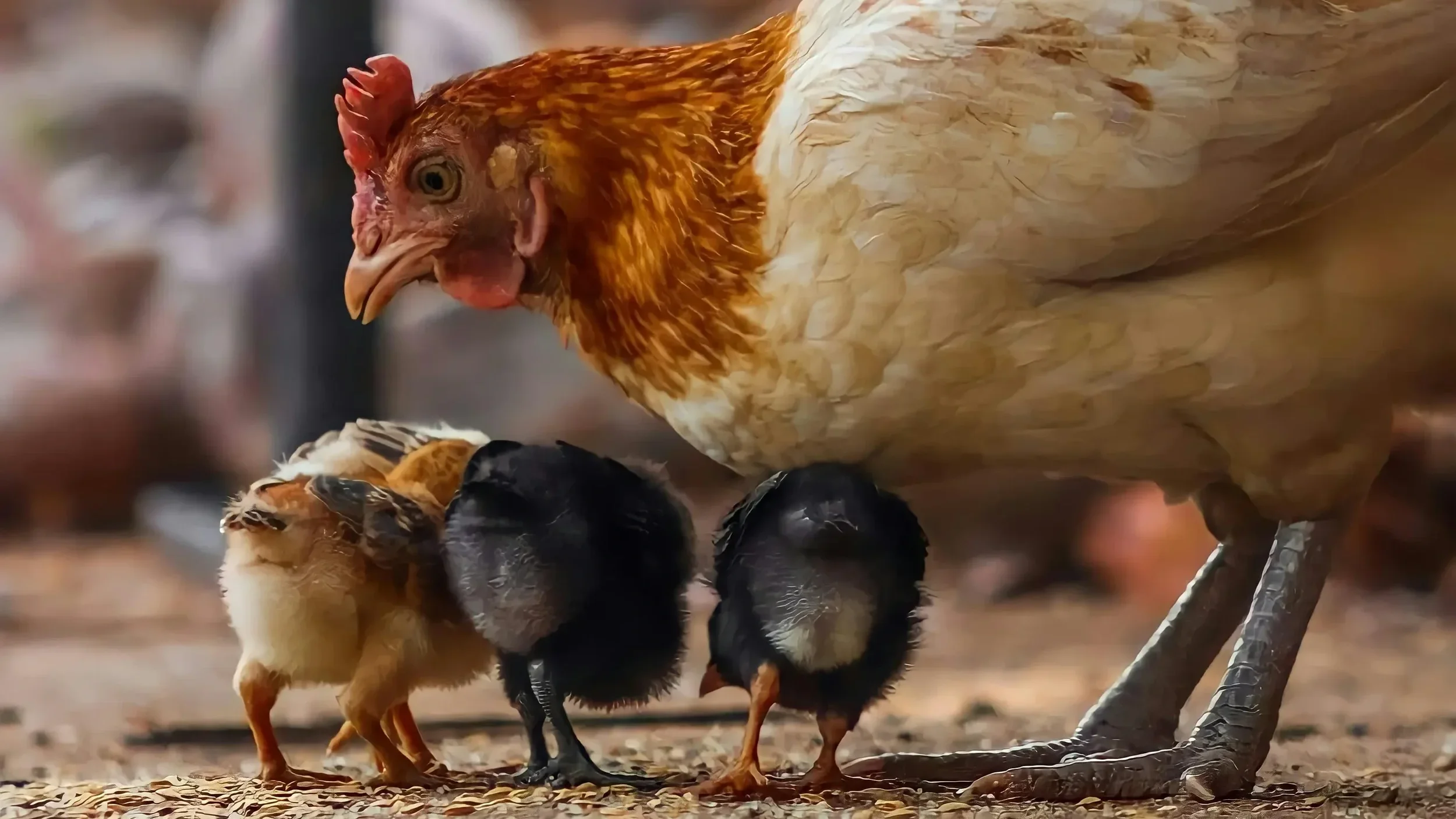
Week-old chicks who have never seen a face before already have neurons that fire selectively for face-like configurations. An innate, hard-wired face detection system (Kobylkov et al., 2024, Proceedings of the National Academy of Sciences). Adult chickens discriminate between individual humans and between individual roosters based on vocal and visual cues (Smith et al., 2016, Animal Behaviour). They use lateralized brain systems to track who's who in their flock (Vallortigara & Rogers, 2008, Philosophical Transactions of the Royal Society B).
In one study, chickens trained on average human faces later preferred the faces that humans also rated more attractive. They weren't just recognizing faces. They were reading them (Ghirlanda et al., 2002, Human Nature).
-
Chicks from different breeds show distinct temperaments from their first days of life. Differences in curiosity, fearfulness, and competitiveness that persist into adulthood (Rozempolska-Rucińska et al., 2020, Animals). Individual hens have consistent behavioral profiles that predict how they learn, how they solve problems, and how they respond to stress (de Haas et al., 2017, Behavioural Processes; Hernandez et al., 2017, Physiology & Behavior).
This isn't anthropomorphism. It's ethology. Chickens have personalities the way dogs have personalities. Stable, individual, measurable.
-
EEG-implanted laying hens spend roughly 18% of the dark period in REM sleep. The same sleep stage associated with dreaming in mammals (Putyora et al., 2023, Animals). Broader avian research confirms that birds, including domestic fowl, exhibit REM signatures consistent with memory consolidation and learning (Rattenborg et al., 2019, Frontiers in Neuroscience).
Researchers describe this carefully as "REM sleep consistent with dream-like processing." The subjective content can't be measured. The neural architecture is there.
-
Mother hens adjust their food-calling displays when their chicks peck at the wrong thing. If a chick goes for something unpalatable, the hen changes her signal to redirect it. Monitoring mistakes and correcting them in real time (Nicol & Pope, 1996, Animal Behaviour). Chicks raised by hens are less fearful, better at foraging, and show fewer behavioral problems than chicks raised without a mother (Edgar et al., 2016, Animals; Roden & Wechsler, 1998, Applied Animal Behaviour Science). Individual hens vary in their mothering style, and those differences shape their chicks' development (Christenson, 2021, Swedish University of Agricultural Sciences thesis).
-
The honest version: no study claims chickens experience grief the way humans do. But chickens separated from their flock show intense distress vocalizations followed by a marked decline into behavioral inactivity. A pattern that maps onto a clinical anxiety-to-depression continuum. This has been pharmacologically validated: the distress phase responds to anxiolytics, the depressive phase responds to antidepressants (Kim & Sufka, 2006, Pharmacology Biochemistry and Behavior). Prolonged separation produces sustained negative emotional states (Marino, 2017, Animal Cognition).
Researchers use the phrase "grief-like responses." The qualification is honest. The suffering is not in question.
Why You'll Never See Her
Of 311 million laying hens in the United States, roughly 180 to 190 million are still kept in cages. In the EU, 169 million. In Canada, about 10 million. In Australia, an estimated 9 million.
You will never see any of them.
Not because the farms are remote. Because the industry has built legal infrastructure specifically to prevent you from looking.
In the United States, at least ten states have passed ag-gag laws. Statutes that criminalize undercover recording or misrepresentation to gain access to animal agriculture facilities. Iowa's 2012 law made it a crime to enter a farm under "false pretenses." Federal courts struck it down as a First Amendment violation. The legislature passed revised versions.
In Canada, Ontario's 2020 Security from Trespass and Protecting Food Safety Act created "animal protection zones" on farms. It explicitly invalidated consent obtained under false pretenses. The law was drafted in direct response to undercover investigations. Courts struck down key provisions in 2024. Other provisions remain.
In Australia, federal law criminalizes using the internet or phone to incite trespass on agricultural land. Up to 12 months imprisonment. Queensland added its own penalties: up to a year in jail and fines over AU$60,000.
Compare this to birding. Apps. Livestreams. Webcams. Nature preserves. Guided walks. Government-funded surveys. Citizen-science platforms. A $279 billion economy built to help you see wild birds.
The egg industry built an entire legal apparatus to make sure you never see theirs.
The question isn't why you don't care about chickens. It's whether you were ever given the chance to.
Why We Built This Site
This is the first post on the new Egg-Truth.
We built this site the way a birding guide is built. Evidence first. The animals at the center. Research you can follow to the source. Every claim linked. Every statistic cited.
Because the egg industry's greatest achievement isn't the cage. It's the invisibility. The legal walls, the missing cameras, the labels designed to reassure instead of inform.
Our job is simple: make the invisible visible. The science is there. The footage exists. The data is public. Someone just has to put it where you can find it.
That's what this site does.
You learned the name of the bird at your feeder. You track when she arrives each spring. You notice when she's missing.
311 million hens are missing from your attention right now. Not because they're less interesting, less individual, or less alive. Because an industry worth billions made sure you'd never look.
Start looking.
-
Birdwatching Statistics
U.S. Fish & Wildlife Service, 2022 National Survey — 96.3 million birders https://www.fws.gov/story/2024-12/birdwatching-america
All About Birds / Cornell Lab — Merlin & eBird growth figures https://www.allaboutbirds.org/news/a-third-of-american-adults-are-birdwatchers-according-to-nationwide-survey/
Africa BirdLife — $279 billion economic contribution https://africanbirdlife.org.za/2026/01/05/united-states-birding-economy/
BBC / RSPB — 700,000+ UK birders under 30 https://www.bbc.com/news/articles/cdjpdm9v7gno
Grand View Research — Canada birdwatching tourism $2.4B https://www.grandviewresearch.com/horizon/outlook/birdwatching-tourism-market/canada
BirdLife Europe — EuroBirdwatch 2024, 24,614 participants https://www.birdlife.org/news/2024/10/11/eurobirdwatch-2024-birdwatchers-unite-for-nature-once-again/
BirdLife Australia — 400,000+ supporters https://birdlife.org.au/about/contact/
Chicken Cognition
Kobylkov et al. (2024) — Innate face selectivity, PNAS https://pubmed.ncbi.nlm.nih.gov/39316055/
Ghirlanda et al. (2002) — Face discrimination, Human Nature https://pubmed.ncbi.nlm.nih.gov/26192929/
Smith et al. (2016) — Individual recognition, Animal Behaviour https://www.sciencedirect.com/science/article/abs/pii/S037663571630033X
Vallortigara & Rogers (2008) — Lateralized social cognition, Phil. Trans. Royal Society B https://royalsocietypublishing.org/rstb/article/364/1519/965/57833/Lateralization-of-social-cognition-in-the-domestic
Marino (2017) — Comprehensive cognition review, Animal Cognition https://pmc.ncbi.nlm.nih.gov/articles/PMC5306232/
Putyora et al. (2023) — REM sleep in hens, Animals https://pmc.ncbi.nlm.nih.gov/articles/PMC10093027/
Rattenborg et al. (2019) — Avian REM, Frontiers in Neuroscience https://www.frontiersin.org/journals/neuroscience/articles/10.3389/fnins.2019.00567/full
Edgar et al. (2016) — Maternal care, Animals https://pubmed.ncbi.nlm.nih.gov/26742081/
Nicol & Pope (1996) — Maternal teaching, Animal Behaviour https://pubmed.ncbi.nlm.nih.gov/26742081/
Roden & Wechsler (1998) — Hen-reared vs. artificial, Applied Animal Behaviour Science https://www.sciencedirect.com/science/article/abs/pii/S0168159197000737
Christenson (2021) — Individual maternal variation, SLU thesis https://stud.epsilon.slu.se/17055/1/Christenson_L_210707.pdf
Edgar et al. (2011) — Maternal empathy response, Proc. Royal Society B https://faunalytics.org/avian-maternal-response-to-chick-distress/
Kim & Sufka (2006) — Anxiety-depression model, Pharmacology Biochemistry and Behavior https://pubmed.ncbi.nlm.nih.gov/17110794/
Rozempolska-Rucińska et al. (2020) — Breed temperament, Animals https://pmc.ncbi.nlm.nih.gov/articles/PMC7070742/
de Haas et al. (2017) — Personality and learning, Behavioural Processes https://pubmed.ncbi.nlm.nih.gov/27876641/
Hernandez et al. (2017) — Personality and stress physiology, Physiology & Behavior https://pubmed.ncbi.nlm.nih.gov/29051076/
Industry Data
United Egg Producers — 311 million U.S. hens, 38.7% cage-free https://unitedegg.com/facts-stats/
Egg Farmers of Canada — 26 million Canadian hens https://www.getcracking.ca/education/wp-content/uploads/sites/2/2024/10/Egg-Fact-Sheet.pdf
Compassion in World Farming / European Commission — 376 million EU hens https://www.compassionlebensmittelwirtschaft.de/media/5789260/egg-production-in-the-eu.pdf
Farm Transparency Project — 24.9 million Australian hens https://www.farmtransparency.org/kb/food/eggs
Ag-Gag Laws
Animal Legal Defense Fund — U.S. ag-gag tracker https://aldf.org/issue/ag-gag/
ACLU — Iowa ag-gag ruling
Ontario Government — Bill 156 text https://www.ontario.ca/laws/statute/s20009
Australian Criminal Code Amendment (Agricultural Protection) Act 2019 http://classic.austlii.edu.au/au/legis/cth/bill_em/ccapb2019461/memo_0.html
Queensland Agriculture Amendment Bill 2019 https://statements.qld.gov.au/statements/88185