Gerri's Story
“Saving Gerri was, hands down, the most humbling and inspiring thing I’ve ever done in my life”. - Georgia Rae Laidlaw Brown
Gerri on her day of rescue.
Saving Gerri was, hands down, the most humbling and inspiring thing I’ve ever done in my life.
And even as a long-term vegetarian (now vegan activist), I had no idea how intelligent and kind natured chickens could be.
The day we rescued Gerri was the day she was destined for the slaughterhouse. Her days as a commercial laying hen were over and the next step in the process was for her “to be finished” - an industry term that means: killed and sold to the public as meat!
Luckily for Gerri, and the other 200+ chickens with her that day, they were given a second chance and were re-homed.
Gerri’s life was brutal from the very beginning, and even years later I have trouble processing what had intentionally been done to her. The photo shown here is of Gerri on the day she was rescued. Until this time, she had never seen daylight, her wings and beak had been clipped and she had been laying eggs at the unnatural rate of approx. 340 eggs a year in caged isolation. This is a sad fact-of-life for chickens that is a well-kept secret from consumers.
Much of the language used to describe how animals are treated in factory farms is chosen to mislead the public and paint a picture that makes the whole process acceptable. Make no mistake, the words and images are carefully chosen. Words like, “welfare” are used to mask what is actually just varying degrees of deprivation and cruelty. The images of happy, healthy chickens we often see on egg boxes are a misrepresentation of the conditions in which chickens live. And this include eggs sold as “free-range” and “organic” which may be the most misleading of all.
But lately attitudes have been shifting. Thanks to many main-stream documentaries and under-cover videos on social media and elsewhere, more and more people are beginning to see what is going on. Every day the conditions that all animals endure on factory farms is being exposed and talked about and the truth is getting harder to hide.
Gerri gettin’ in to the cream cheeze!
So… a little more about Gerri. She is as hilarious as she is bold and brave. From her very first day with us, she has taken everything in stride. (Here she is, covered in vegan cream cheese after sharing a bagel with me!) Just look at her little face!
When we first rescued Gerri she was not going to be a house chicken. She is one today because that is what she wanted. Daily she would peck at our door asking to come inside and before we knew it, she was spending most of her day in the house with us. She does venture outside to sleep in her house, or at the bottom of the garden, and for the occasional stroll around the property.
Like many animals who are given the chance to live in a loving and nurturing environment, Gerri knows her name and she will come running to you when called. She also likes to hang out with her cat and dog siblings and enjoys napping in the dog bed.
Gerri and her canine siblings.
Also, like everyone, Gerri is an individual with personal likes and dislikes and that extends to her food preferences. Her favourite food is mashed potato, but her preferences can change depending on her mood. Of course, she has her organic corn and pellets, but she is also partial to hummus, tomatoes, blueberries, cashew nuts, jackfruit, but not yellow peppers… she can’t stand them and will spit them out!
Gerri is my daughter, and my best friend, and I really do love her very much! She is a huge part of our family and loved completely and equally alongside the other animals (and humans!) She’s very expressive, funny and will fuss around you for attention just like the dogs do.
Gerri scoping out her sleeping arrangements.
In fact, I haven’t met anyone that hasn’t been blown away with how clever and sweet natured Gerri is – and I truly believe that all chickens have this potential, if they are only given the chance.
Gerri inspires me every day and I’m honoured to share a little more about her life and her story as well as shedding a little light on the commercial egg industry that exploits these beautiful animals.
I would encourage everyone to consider giving up eggs and going vegan. And, if your situation is right for it, rescuing an ex-commercial laying hen. You can also make a difference by donating to the various chicken rescue organisations. As individuals we can each a make huge difference.
As for Gerri, her confidence and character grows daily and I hope that her story inspires people to see what wonderful friends and family members chickens can be!
For more images and videos etc. head to: Georgia Rae Laidlaw Brown.
To learn about the true lives of the billions of hens condemned to lay in commercial, egg farms around the globe, please visit: Egg-Truth
Georgia Rae Laidlaw Brown has been vegan for 3 years and is a trained Broadcast Journalist and PR Professional. She is vegan for the animals, but also for the environment, her health and future generations.
Sarah's Story
It's perhaps surprising that many people don't consider this question very often - perhaps because the suffering that exists in the egg industry is so hidden from us . . .
Sarah. Photo courtesy of: Little Oak Sanctuary
Hatching date: 1 November 2015 | Arrival date: May 2017
It's perhaps surprising that many people don't consider this question very often - perhaps because the suffering that exists in the egg industry is so hidden from us, and our direct experience with chickens and eggs, if we have any, is a far cry from what most chickens experience in the commercial egg industry.
Sarah is a hen who came to Little Oak Sanctuary in 2017. Her experience gives us a glimpse into what the 16 million hens experience each year in Australia in order to produce eggs for people. May is International Respect for Chickens month, the perfect time to share her story with you.
Born into the Australian Egg Industry, Sarah never knew her mother. Rather than entering the world under her mother's protective wings, Sarah hatched from her egg onto a wire tray, among thousands of other chicks.
Soon after hatching, Sarah and her sisters were sorted from their brothers, and any of their sisters who were sick or weak. As male chicks are not able to produce eggs, and are not suitable for meat production (the chickens bred for meat are an entirely different bird), they are considered waste products by the egg industry and killed by maceration or gassed the day they hatch, along with weak or sick female chicks.
Sarah and her sisters were then taken and placed beak first into a machine that cut their tiny beaks with a hot blade. This process is called "de-beaking", a practice aimed to reduce pecking between hens who are kept in situations where they cannot form natural hierarchies or move away from each other.
“
“Anything that is held in secret cannot be healed. The light cannot reach that which is locked away in the dark.””
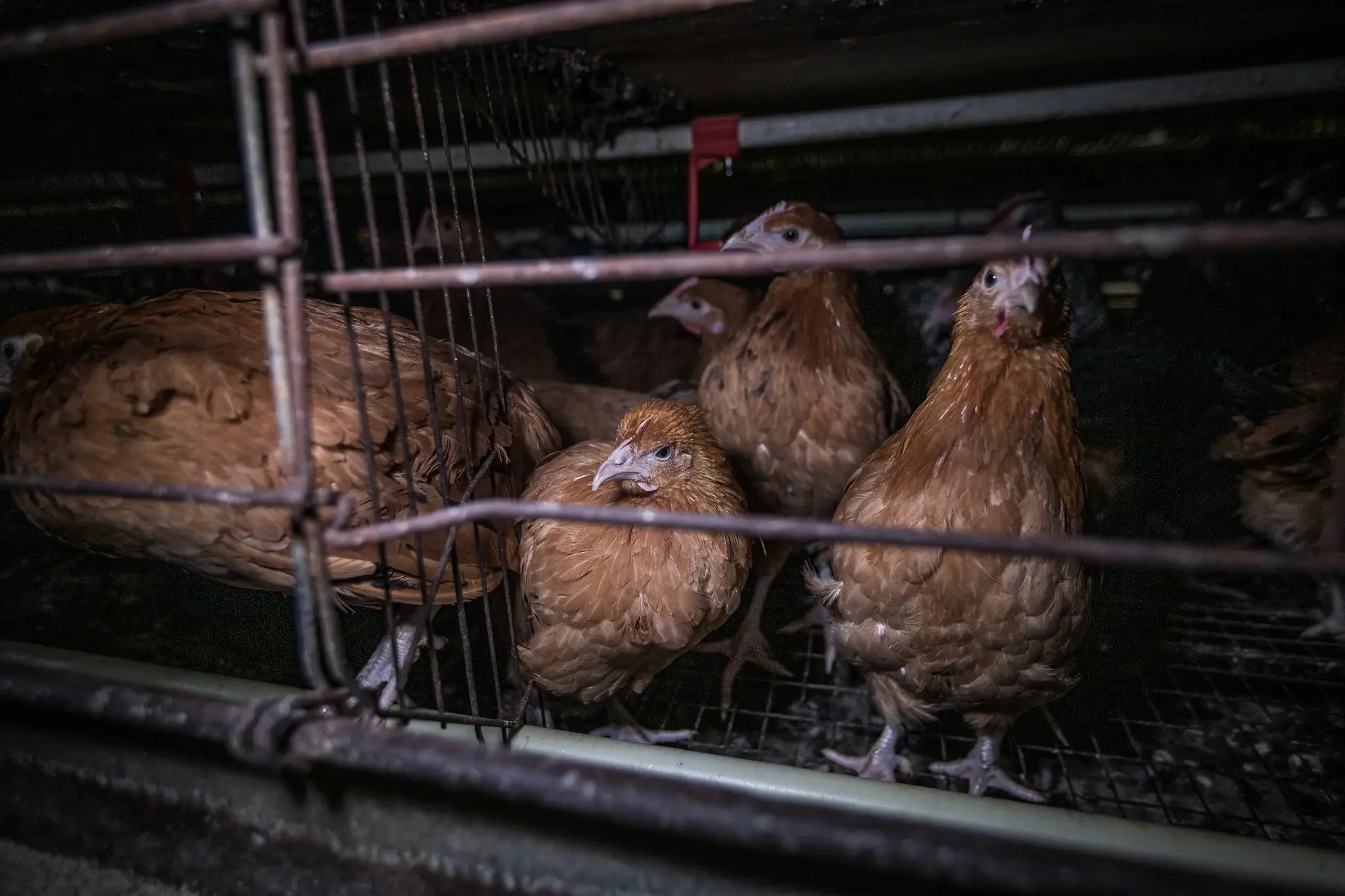
Once Sarah was old enough to start laying eggs, she was taken to a battery egg farm, like 9 million other hens each year in Australia. Many people don't realise that the majority of eggs produced by hens in battery cages are sold for use in cafes, restaurants and products that contain egg. Sarah then spent the next 12 months of her life in a small cage with 7 other hens. Denied everything a hen values, the ability to form a natural pecking order, nesting space, room to dust bathe and spread your wings, the chance to live your life.
Modern layer hens have been selectively bred so that they produce around 300,000 eggs per year at their peak level of production. Prior to human intervention, hens would naturally lay up to 15 eggs, once a year in spring - as a single clutch (like other birds!). This unnatural level of production we have thrust upon 'egg laying' hens taxes their little bodies tremendously and they are not able to maintain it for long - usually only around a year - before the level of laying reduces.
At this point they are considered 'spent' and are no longer commercially viable. In a process referred to as "depopulation" they will be taken from their cages, moved into small transport crates with around 5 other hens, and taken to slaughter, typically for pet food. Egg laying hens are not used for chicken meat, having been bred specifically to produce a huge number of eggs, rather than to grow large breast muscle.
Fortunately for Sarah, she and 29 of her sisters were spared from slaughter at this point, and found sanctuary at Little Oak. Sarah now spends her days advocating for her kind, enjoying the sunshine and wind through her feathers, dust bathing in the soil and perching on a roost - according to her flocks pecking order - at night.
You can spare the 16,000,000 hens like Sarah a lifetime of suffering - and her brothers who don't get to live past a day - by leaving eggs and egg products off your plate.
This article was re-published with the expressed permission of Little Oak Sanctuary.
Kate & James are the co-founders and operators of Little Oak Sanctuary in Australia. Kate works outside of her sanctuary to fund its operation. Kate is a professional photographer and business manager for a not-for-profit organisation in town whilst James is a musician who teaches and plays professionally. All positions at the sanctuary are unpaid and donations received go towards the animals and advocating for them.
British Columbia Hens Rescued
Earlier this year we conducted an interview with Jeff Regear, an animal rights activist, who along with several colleagues documented unspeakable cruelty on several egg farms in British Columbia, Canada.
Earlier this year we conducted an interview with Jeff Rigear, an animal rights activist, who along with several colleagues documented unspeakable cruelty on several egg farms in British Columbia, Canada. Upon entering these facilities they discovered manure pits beneath the rows of battery cages. Some of these mounds of manure were almost six feet high. And half-buried in those manure pits were hens who accidentally fell into the pits after having escaped their cages or were improperly handled by farm workers. These poor birds had been physically unable to extract themselves from the awful filth and had been left there to die.
The activists reported what they saw to the British Columbia SPCA (Society for the Prevention of Cruelty to Animals) and provided extensive photo and video evidence. It made national and international headlines, spurred on in part by a media blitz from PETA who had also received copies of the disturbing images. Since the airing of this story, the farms in question have been decommissioned as authorities continue to investigate. No charges have been laid as of this publishing date.
However, we have learned that several of the activists rescued some of the hens they found submerged in the muck. Meghan Beattie, of Vancouver Chicken Save and Board Member of Liberation BC, recently published a photo diary of the amazing recovery these hens have made since being rescued. We wanted to share this good news with our readers. Meghan has been kind enough to share her photos and personal thoughts with Egg-Truth (please see gallery further below).
"I don't know that I can put into words what this experience was like for me and how it changed me. And I won't try. I won't describe my journey, because it's not about me, it's about these sweet girls. Their lives and new freedom. I'll let these photos tell their story. But I will share this; I have so much respect and gratitude for the humans that led this rescue and invited me to join. This is at a battery cage farm in the Fraser Valley. Our plan going in was to just get footage, but when we arrived the doors were open. The chickens that had been in the battery cages were spent and had been taken to slaughter. Battery cage barns are set up in a way that the cages are above ground - so all the feces and filth falls to the lower, bottom level. When we saw the giant back doors wide open we peaked in and saw these babies. Many were running around, probably not realizing they could walk themselves right out. But then we saw others stuck in wet pools of fecal matter. Some still alive, some not... We took all the girls that were stuck to our vehicle - 21 in total - and we were going to go back for all the others but then an alarm went off and we had to leave them behind. One of our team took all 21 back to his house in Deep Cove. A couple days later we bathed them and, slowly but surely, with vet visits, medicine and lots of love and attention, most of them got stronger and healthier. Unfortunately, some girls died on that first night, and others succumbed to their wounds and broken bodies days and weeks into their new found freedom. But this story does have a happy ending. Even though almost half of these sweet girls passed away after their rescue, they died free birds. They died a less painful and lonely death than what they would have if we hadn't gone to that barn that night. The other 11 girls are thriving and will live out their lives safe, happy and free. As all earthlings deserve to do." - Meghan Beattie