Undercover Investigations, Egg Industry Juliane Priesemeister Undercover Investigations, Egg Industry Juliane Priesemeister

Dead Ones - Exposing the Truth for True Transformation

With the EU's unified trade area, consumers find it challenging to track the origins of the eggs they purchase, especially when used as ingredients. In May and June 2023, two undercover activists documented the grim reality of hens kept on a farm operated by the largest egg producer in Poland and the entire European Union – Fermy Drobiu Woźniak.

In the realm of animal welfare standards, the European Union (EU) has earned a reputation as a global leader. Yet, this reputation doesn't uniformly extend to the conditions of laying hens across EU member states. Within the EU's integrated trade zone, consumers encounter a formidable challenge – deciphering the origins of the eggs they buy, particularly when utilized as ingredients.

As consumers within the European Union grapple with the challenge of tracing the origins of the eggs they purchase, a chilling exposé has emerged. In May and June 2023, two dedicated undercover activists, Oksana and Sasha, embarked on a harrowing journey into the heart of the continent's largest egg producer – Fermy Drobiu Woźniak, nestled in Wioska, Poland. Their six-week odyssey within the sprawling facility, which boasted 'enriched cages' as a supposed improvement over battery cages, bore witness to unimaginable suffering. Their account sheds light on the stark realities of egg production—here is what they found:

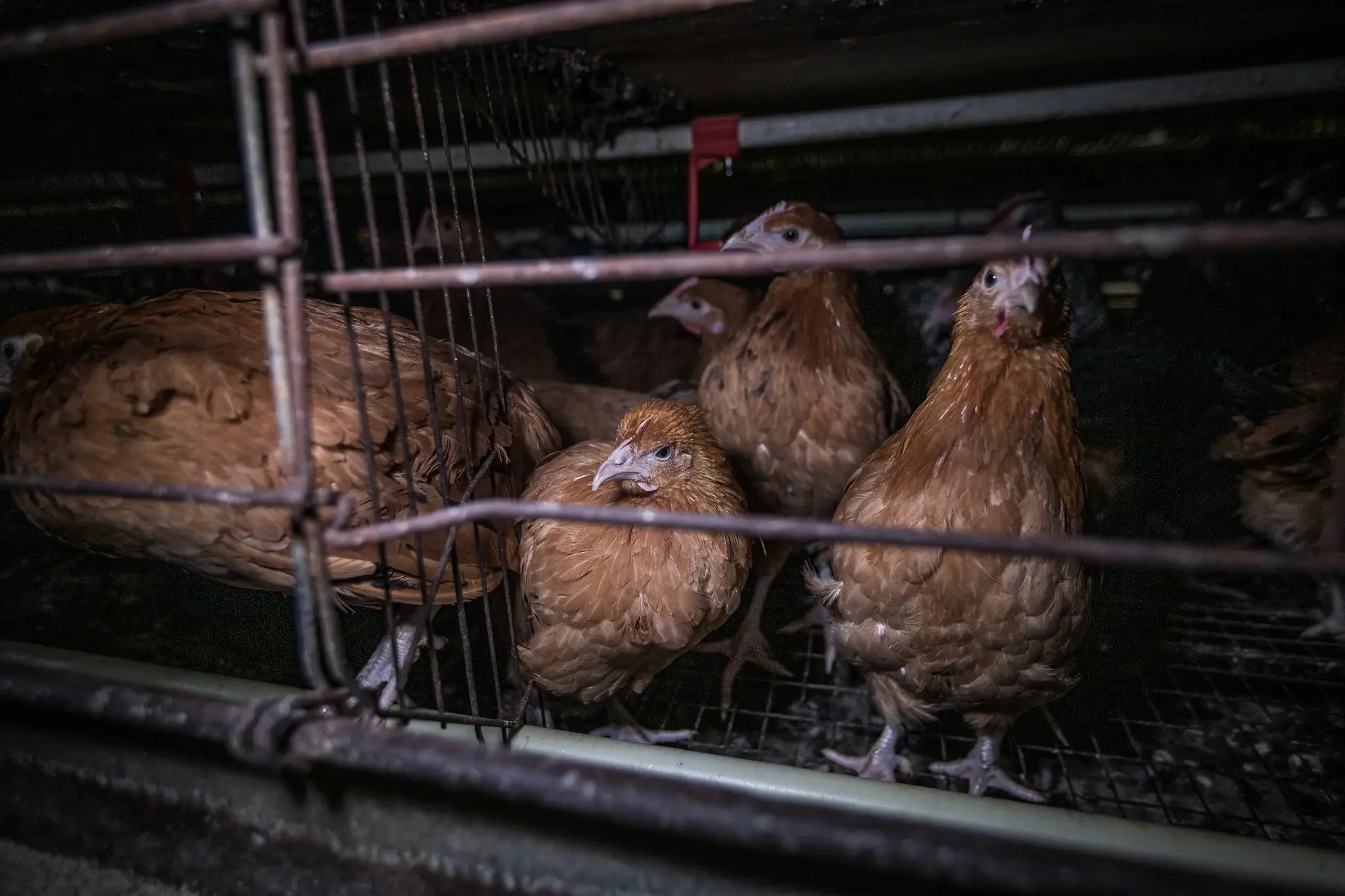
‘Enriched cages’ were introduced as an alternative to battery cages. But for hens, this transition has been far from liberating. They continue to suffer in cramped and unnatural environments.

Stress, aggression, cannibalism, cramped cages, unbearable heat, and swarms of fleas – these were the daily horrors revealed by the investigation.

  • Cramped Cages
    The cages on the farm were incredibly cramped, with hens barely having room to move. Hens had to squeeze through crowded spaces, making it impossible for them to spread their wings. The lack of space was agonizing for these birds.

  • Cannibalism and Feather Pecking
    Stress from overcrowding led to aggression among the hens. They fought for space and access to the nest, resulting in feather pecking and even cannibalism. Weaker hens were often pecked to death by their fellow birds.

  • Painful Deformities
    The mesh floor of the cages caused severe foot deformities in many hens. Their toes bent painfully in the opposite direction, causing excruciating pain. No help was provided, and they were left to suffer alone.

  • Slow and Inhumane Deaths
    Injuries from the metal perches were common, and hens trapped there were left to die slowly from hunger and thirst. There was no procedure to help injured or sick hens, and everyday veterinary care was nonexistent. Defective cages proved deadly for many.

Just a few of the many snapshots taken by Oksana and Sasha during their undercover investigation. Source: Otwarte Klatki

Fermy Drobiu Woźniak, being the largest egg producer in Poland and the EU, raises questions about the conditions for hens across the industry. Across the European Union, there are, in fact, significant disparities in laying hen welfare. While some countries have made strides in transitioning to more humane systems, others lag. For instance, while Germany keeps the majority of their hens in cage-free systems (>60%), the neighboring countries of Poland, The Czech Republic, and Slovakia still keep over 70% of laying hens in cages.

This map shows the dominant housing systems on commercial egg farms around the world (click on map to enlarge and zoom in). Source: welfareproject.org

A hen escaped the cages and stands in front of a pile of crushed eggs. Source: Otwarte Klatki

In our pursuit of ethical and humane eggs, the global landscape of egg production, as revealed in the linked map, sheds light on the challenges consumers face. This desire for better conditions for hens often remains unfulfilled, as demonstrated by the Polish undercover investigation. This investigation serves as a stark reminder that the transition from battery cages to ‘enriched cages’ may not always deliver the expected improvements for hens.

As consumers, we supported this transition with the hope of more ethical eggs, but it's crucial to consider whether we may have been inadvertently misled. We've explored the grim realities of these housing systems in prior posts, accessible here and here, offering an opportunity for us to reflect on our choices and demand genuine humane treatment for hens.

It's worth recognizing that the fight for improved conditions must go beyond the superficial shift from cages to 'cage-free.' It's an invitation to be more discerning when navigating the options on supermarket shelves. We understand that this can be challenging. It's a journey fraught with difficult decisions, and we've all been conditioned to believe in the status quo.

But let's take a moment to imagine this from the hen's perspective – a life filled with cramped spaces, aggression, and suffering. We believe that deep down, all of us share a common desire for a more compassionate world, not just for ourselves but for all living beings. The path to a cruelty-free life for hens, as well as a more compassionate world for all animals, begins on our plates. By embracing egg-free diets and supporting alternatives that respect the well-being of hens, we can take a significant step toward honoring their plea for a life free from suffering.

Please leave eggs off your plate.


Otwarte Klatki’s goal is to prevent animal suffering by introducing systemic social changes, documenting the conditions of industrial farming and education promoting positive attitudes towards animals.

Their latest investigation into Fermy Drobiu Woźniak can we found here (viewers discretion advised).


Juliane Priesemeister, Executive Director

Juliane worked almost a decade for an international corporation as an information designer. Generating compelling visual stories was her daily deed, but as much as she enjoyed the creative work the big corporation environment left her hungry for substance and impact.

When she started her yoga journey a few years ago the “do no harm” philosophy pushed her to align work with her personal ethics and values. Today she uses her omnibus skill set, including marketing communications, economics, and graphic design, to reveal the truth about the egg industry to consumers.

Read More
Egg Industry, Undercover Investigations Nigel Osborne Egg Industry, Undercover Investigations Nigel Osborne

What Happened in Winnipeg Should Be A Wake Up Call!

On April 1, 2021, workers at the Brady Municipal Landfill site in Winnipeg, Manitoba, Canada, discovered a very disturbing scene . . .

Thousands upon thousands of dead, egg laying hens litter the Brady Landfill, Winnipeg, MB, Canada. Note the dead pigs in the background. It is unclear where they came from and garnered no mention in media reports.

On April 1, 2021, workers at the Brady Municipal Landfill site in Winnipeg, Manitoba, Canada, discovered a very disturbing scene: tens of thousands of dead, egg-laying hens. Treated like trash, their broken and fragile bodies had been dumped at the site by an area egg farm. However, there appeared to be movement among the mass of contorted bodies - some of the hens were still alive! Shocked, the workers called a local farm sanctuary to inform them of what they saw and in hopes of having these few remaining souls rescued. Sadly, this was not the first time this had happened.

Ethics

News of this atrocity got out and was first reported by CTV News Winnipeg. Interestingly, the focus of the news report was not necessarily about the thousands of dead hens rotting in the open air, it was about the few who survived and were found writhing amongst the carnage. Make no mistake, the fact that still-alive hens were left to die a slow, painful death is a horror unto itself, but no less were the thousands of innocent ‘spent-hens’ who were killed and dumped like garbage simply because they were no longer profitable.

Above is a photo gallery of images taken from the Brady Landfill, April 1, 2021. Photo credit: The Good Place Farm Sanctuary.

A spokesperson from the Winnipeg Humane Society interviewed by CTV News was quoted as saying that these birds, “were among thousands of euthanized hens that were dumped at the landfill”. Euthanized? The definition of euthanasia is as follows: it is the practice of intentionally ending life to relieve pain and suffering. These hens were not euthanized, they were killed (gassed) to ensure profitability for the egg farm. Commercial hens have been genetically manipulated to lay an excessive number of eggs in their abbreviated life span of approximately 18 months. Once they reach the end of their laying cycle, their exhausted bodies can no longer lay the quantity or quality of eggs for the farmer to keep housing and feeding them, and must make way for younger pullets who have reached egg laying maturity. Thus, egg farms will “de-flock” their barns and kill the spent-hens (an industry term) either through on-site killing or sending them to slaughter. The natural life expectancy of a rescued commercial hen can be anywhere from 4-8 years, as can be testified to by many farmed animal sanctuaries, or longer if their bodies do not succumb to the common illnesses afflicting commercial hens such as ovarian cancer, osteoporosis, egg-yolk peritonitis or other diseases. In nature, their wild cousins can live 10-12 years.

A photo of “Penny”, a spent-hen rescued from the manure pits at an egg farm in British Columbia, Canada. Photo credit: Geoff Regier

How Did This Happen?

We interviewed Jen from The Good Place Farm Sanctuary (GPFS) to learn details of what happened.

A dump truck carrying thousands, perhaps tens-of-thousands, of “spent hens” arrived from an area egg farm. They were dumped at this municipal landfill to ultimately be moved into a pit. Workers, as on previous occasions, saw movement among the dead pile. Six hens on top were still alive. Jen and one of her volunteers arrived at the scene. One of the hens died on site and they managed to rescue five others. They searched the pile hoping to find others. But given the pile was many feet high over a vast area, there were no doubt alive birds near or at the bottom that could not be saved.

Jen and her volunteer were haunted by the possibility that they might miss one. After a period of time, the five they rescued were driven to a local vet. One of the hens, in particular, was in bad shape - they named her “Pearl”. She didn’t make it. The remaining four did and most ended up at several other sanctuaries (see footnote below).

Jen managed to reach out to the provincial vet responsible for farmed animals in Manitoba. Jen learned that a company was contracted by farms throughout the province who would conduct the mass killing of these birds using a mobile CO2 gas chamber. According to sources, this issue of still-alive hens being dumped at landfills had happened multiple times dating back to at least 2020. There was an investigation that year over a similar incident and recommendations were made to improve methods to ensure no hen came out of the chambers alive. Clearly, the issue was never resolved. Sources informed Jen at GPFS that the same thing happened approximately four days later after this particular incident. Landfill workers have said they often dread the days hens come to the facility because they would routinely see the same thing, over and over and over again. (Note: it is our understanding that municipal workers at this landfill have been reprimanded and instructed not to speak to anyone in the future on matters such as this.)

One of the rescued hens. Source: The Good Place: Farm Rescue & Sanctuary

Jen also observed that the pile of discarded hens at the Brady Landfill were likely not caged birds, but free-range or free-run. Jen noted that these hens did not have curled feet which comes from living on a wire floor in a cage for up to a year-and-a-half, as most hens do in Canada. The few they rescued didn’t seem skittish or afraid of her and her volunteer and seemed adept to walking on the ground. Caged hens are unfamiliar and unaccustomed to walking on the ground or interacting with people.

Another one of the rescued hens. Source: The Good Place Farm Rescue & Sanctuary

The “Manitoba Egg Farmers said it was "devastated" to hear about the five hens found alive”. “Devastated”? Why because the farm and/or the hired company failed to kill the few who survived which made its way to news reports? The Manitoba Egg Farmers, and Canada’s egg industry in general, kills millions upon millions of spent hens every year in addition to an equal number of male chicks who are useless to the egg industry as they don’t lay eggs. The egg industry IS a slaughter industry no different than meat or dairy production.

And herein lies the issue as it relates to the exploitation of egg laying hens: some of us (certainly not the egg industry) are not necessarily shocked or saddened to learn of thousands being killed in a story like this, we are saddened to learn that some were still alive. Think about this for a moment: is our empathy reserved largely for the suffering of those still alive, while ignoring the suffering of all those who were once confined and condemned to lay only to be killed and discarded like trash? Are not all the dead hens in this story entitled to the same moral concern as the ones found alive? Should we not be outraged and sickened by the massive dead pile? Absolutely!

Manure pits beneath the stacks of battery cages on an egg farm in British Columbia, Canada. Photo credit: Geoff Regier

Disease

A live market in New York City. Click on photo to enlarge.

In the sober new reality of global pandemics, our world needs to take a very hard look at the risk factors of animal agriculture and, in this case, the egg industry. Avian and swine flu, antibiotic resistance, zoonotic diseases such as SARS, MERS, AIDS, Ebola, and now Covid-19 are either caused directly, or indirectly, by intensive animal agriculture, stress imposed on natural ecosystems as a result of human encroachment, the harvesting of wildlife (ie. bush meat), and wet markets.

Yet despite all that we have learned, we still see scenes like the Brady Landfill playing out - thousands upon thousands of corpses from factory farms, rotting in the sun and out in the open? One thing most of us surely know from having been to a landfill or waste facility, there is a lot of wildlife that are attracted to these places: sea gulls, mice, rats, turkey vultures, raccoons, cats, dogs, and those predators preying on those scavenging the garbage. It is absolutely shocking that in a first world country like Canada, in the 21st century, dead farm animals would be dumped at a municipal landfill with the corpses of these animals free to come into contact with wildlife. And let’s not forget the municipal workers who are working at these facilities - what about the risk of exposure to them? All it takes is one pathogen to jump from animal to human. It has happened before and will, in all probability, happen again.

Propaganda

“We take accusations about animal cruelty very seriously”. How many times have you heard a PR person for an industry group say this every time a story emerges like this landfill story? Are they to be believed?

A screen shot from Manitoba Egg Farmers website depicts, ‘smiling, laughing’ people joyfully engaged in the business of egg production. A business that imposes untold misery and deprivation for the millions upon millions of hens exploited across Canada annually.

This is a standard reply designed to assuage public concern about animal welfare. The egg industry in Canada, and elsewhere, devote considerable sums of money to present an image of a clean, green and caring industry. They focus a lot of their efforts to remind consumers that they are feeding “you and your family” - sounds wholesome doesn’t it? Often they’ll recruit from their 1,200 members across Canada to profile a few of those who run and operate egg farms and portray them as ‘smiling, hard-working Canadians’ . . . . just like you! And if they are just like you they can’t be all bad, right? The focus of these carefully, crafted advertising campaigns are always on the family-run farms and invoke words like “community”, “care” and promote the healthful and nutritious aspects of eggs. Never do they focus on the hens and rarely show you inside an egg barn containing thousands of birds. And if they do, it is always of a barn that has been “de-flocked”, cleaned and re-populated with pullets who have just reached egg laying maturity and look clean, healthy and vibrant. Never will you see images or video of a barn 12-18 months afterwards. Why? Because it is not a pretty sight.

Generally speaking, the egg industry routinely anthropomorphizes animals when it comes to their consumer packaging and advertising campaigns by using cartoon depictions exhibiting human like qualities and facial expressions. This is true for Canada as it is for many countries around the world like the United States, United Kingdom, the European Union, etc. This is done in an effort to depict the industry as benign or harmless. Words like “Happy”, “Farm Fresh”, “Organic”, “Local” are ubiquitous.

The fact is, egg farming is a slaughter industry - it is violent and bloody. Male chicks are shredded alive shortly after hatching, females are often de-beaked, vaccinated against high risk diseases as a result of high stocking densities, endure many illnesses along the way, and then slaughtered after 18 months. Sometimes they are killed on site, dumped in a pit and buried, or incinerated.

Canada’s egg industry does not want you to know any of this because they know the average Canadian would be appalled at this kind of animal cruelty. Nonetheless, it is how commercial hatcheries, egg farmers, and the industry as a whole, can maximize profitability. And let’s be clear, all egg farming associations, whether provincial or federal, exist to promote the financial sustainability and profitability of their members first and foremost. And, part of that mandate, requires them to market and promote what they do in the most sanitized and favourable light possible.

The photo gallery below shows what the Egg Farmers of Canada publishes on their website and accompanying photos of the reality on Canadian egg farms:

Conclusion

Don’t trust anything the egg industry says. At least, view what they say with deep suspicion. It is in their interest to keep information like this out of view from Canadians. Even now, animal agriculture has succeeded in enacting legislation like Bill 156 in Ontario. And now Manitoba is considering the same thing - and you can be assured that the Manitoba Egg Farmers are in favour. Bill 156 in Ontario was lobbied for very hard by the animal agriculture sector. They’ll tell you it is about “protecting the food supply”, and ensuring that “food biosecurity” is a priority or by “protecting the property rights of farmers”. While this sounds reasonable, it is really about eliminating these kinds of videos and stories getting out. Why? Because it hurts business. And as the Premier of Ontario has often said, “Ontario is open for business”. It appears this is certainly true - but in the end, it is the animals who will pay the price.

But there is an alternative to all of this. There are so many cruelty-free, delicious and affordable egg-free alternatives available. And the great news is these alternatives are readily available in most grocery stores and health food stores across Canada! So please consider leaving eggs off your plate. Compassion is never the wrong thing.

And please consider contacting your area MP or MPP to tell them that you oppose any type of ag-gag legislation:

Search for your Canadian Member of Parliament.

Search for you Member of Provincial Parliament:

British Columbia
Alberta
Saskatchewan
Manitoba
Ontario
Quebec
New Brunswick
Nova Scotia
Prince Edward Island
Newfoundland & Labrador


Support Farm Sanctuaries Not Animal Farmers

If you would like to support the rescue of egg laying hens, please consider becoming a volunteer, or offering financial support to The Good Place Farm Sanctuary. And if you want to help one of the organizations who rescued the hens from the Brady Landfill, consider a donation to:

Rainbow Ranger Station (who rescued “Piper”)

Ledwich Family Farm (who took in “Karen”)

The Little Red Barn Sanctuary (who took in “Star”).

Or, consider supporting any number of farm sanctuaries around the world. Our “Resources” page has a very comprehensive list of sanctuaries, large and small, across the globe.


Footnote:

Dead pigs are visible in the background. Click on photo to enlarge.

We reached out to the Canadian Pork Council asking for comment on the dead pigs visible in the background of the photo of the pile of dead hens. A excerpt from their response is below.

To highlight, the CPC says, “mortalities are an unfortunate part of food production”. Unfortunate because they couldn’t profit from the ones that died? All animals face “mortality” in the food system. Mr. Ross the ED of the Canadian Pork Council goes on to say that the $83/tonne fee to dump dead pigs is the same as commercial garbage. We have reduced living beings to “commercial garbage” like tin cans, plastic containers, paper, and discarded cardboard.

“ . . . mortalities are an unfortunate part of food production . . . The disposal of mortalities is regulated by the Province of Manitoba. One approved option is to utilize the Brady Landfill . . . animal disposal arrangements must be made in advance and are subjected to an $83/tonne fee. This is the same fee applied to commercial garbage disposal.”
— John Ross Executive Director Canadian Pork Council

Nigel_headshot_ET.png

Nigel Osborne is the Executive Dir. of Egg-Truth. Nigel has years of experience related to animal rights and on-line advocacy. Nigel's extensive background in the publishing, outdoor advertising, printing and web design industries over the last 25 years provides him with a strong, creative acumen and business management experience. Through Egg-Truth.com and it's social media channels, Nigel seeks to increase awareness among the public about global egg production, expose the conditions for the billions of hens condemned to laying every year, and reveal the true impact of egg consumption on human health.

Read More
Egg Industry, Undercover Investigations Nigel Osborne Egg Industry, Undercover Investigations Nigel Osborne

Confessions of an Ad Agency Insider

It was about 25 years ago. Right around the time that eggs were declared "poison in a shell" . . .


It was about 25 years ago. Right around the time that eggs were declared "poison in a shell", that, almost overnight, cholesterol became the scapegoat for seemingly everything from heart disease to dandruff.

This was a huge problem for the Canadian Egg Marketing Board and they were my client so this became a huge problem for me. I worked for an advertising agency at the time that counted several marketing boards (milk, chicken and egg) among their clients.

When the news hit that eggs were going to be the death of us all, we sprung into action. One of the first things we did was fund a study at a local university. This study, not surprisingly, concluded that eggs, eaten in moderation (which translated to one a day) posed no health risk and was even beneficial.


So, what propaganda does the egg industry rely on to promote their commercial interests? . . . the red herring is a misplaced focus on elevated fasting levels of LDL cholesterol as the main or only harmful effect of dietary cholesterol”. The real concern is how, and when, blood cholesterol levels are measured as an indicator of health concerns.
— Dr. J. David Spence, Professor of Neurology and Clinical Pharamcology, Western University, Canada

Armed with these "facts", we proceeded to discredit every other study published on the subject. We had an "expert" scientist on the payroll and we made a lot of noise. The truth about eggs and health were never questioned....it didn't matter. Sales were going to be affected and that had to be stopped. This fear of falling revenues was responsible for a lot of very questionable, hanging-by-a-thread-of-truth marketing. And I was responsible for a lot of it. It wasn't just eggs, the dairy industry was notorious for disseminating half-truths cloaked in clever marketing messages, too.

The AEB (Amercian Egg Board) claims about egg safety found to be patently false, misleading, and deceptive by the U.S. Court of Appeals.

I remember sitting around a boardroom table trying to figure out a way to increase sales of fluid milk in a declining market threatened almost daily by the emergence of damaging science and the launch of plant-based milk alternatives. We came up with what we called the "drop" campaign. We knew that trying to get people to drink more milk by the glassful would be a hard sell, but if we could convince people to use a 1/4 cup here and a tablespoon there, they would still have to purchase it in larger volume packaging and we could slow the decline in sales.

The American Board’s primary purpose is to market and promote increased egg consumption to the consumer on behalf of its members - the egg farmers of America.

Canada’s new food guide drops dairy as a food group and introduces plant-based sources to obtain protein. While eggs and some dairy remain in the “protein” category, they are significantly reduced relative to previous decades of food guides.

The idea was to come up with a dozen or so food items, like pancakes, mac'n cheese and scrambled eggs, that were objectively better when made with dairy milk than, say, water! Sounds easy, right? We hired a professional chef and proceeded to taste test the recipes made with dairy milk, and, with what we laughed at at the time, water. Here's the problem. There was almost no difference except for the embarrassing "never to leave this room" realization that more than a few dishes made with water were preferred in blind taste tests to the same dish made with dairy milk! Not really sticklers for truth in advertising, we proceeded with the campaign and, no doubt, convinced a whole lot of people that these dishes are infinitely better, both from a taste point-of-view, and nutritionally, when made with milk - even if it was only 1 tablespoon of milk! It may seem like a small thing...making pancakes with milk instead of water, but it was part of a larger problem of ignoring the facts to safeguard the profits. And animal welfare was never an issue. Not discussed even once. This willingness to ignore what doesn't serve the bottom line is finally starting to crumble. Canada's new Food Guide is hard proof of this. And no doubt the marketing boards I once willingly mislead the public for are now very, very scared. I couldn't be happier.


Anonymous_head_shot.jpg

This blog post was submitted by “Janet”, whose name and identity has been concealed upon request. “Janet” was an Account Manager and Copywriter at an ad agency in Toronto hired by the Canadian Egg Farmers.

Read More
Undercover Investigations, Egg Industry Nigel Osborne Undercover Investigations, Egg Industry Nigel Osborne

Hens To Slaughter

On September 19th, 2018, I attended a vigil to bear witness to egg-laying hens brought to slaughter at Maple Lodge Farms in a suburb of Toronto, Canada (the 4th largest city in North America).

On September 19th, 2018, I attended a vigil to bear witness to egg-laying hens brought to slaughter at Maple Lodge Farms in a suburb of Toronto, Canada (the 4th largest city in North America).

Prior to this I decided to take a look at their website for research purposes. Immediately upon landing on their homepage, visitors are met with imagery intentionally designed to invoke the bucolic days and by-gone era of the “family farm”. This is an often used marketing strategy to assuage concerns consumers might have as it relates to animal welfare and environmental issues in animal agriculture.

Maple Lodge Farm’s home page.

In reality, Maple Lodge Farms (“MLF”) is one of the largest processing facilities in North America. It is, by all definitions, a “factory farm” facility. MLF slaughters approximately 500,000 birds a day - that is 182,000,000 chickens and egg-laying hens per year. Their products are sold across Canada and they are a leading processor of Halal chicken (which means the birds cannot be stunned before their throats are cut).

False Advertising

MLF also promotes in virtually all of it’s advertising that their products are “Proudly Raised On Local Ontario Family Farms”. But is this true? No - at least not on the night I was there. Every truck that arrived between 6pm and 9pm came from Pennsylvania and Ohio. Members of Brampton Chicken Save, who attend these vigils weekly, have indicated they have also seen trucks routinely come from New York State, as well.

So why are American egg farms sending their spent hens to Canada? I can only offer speculation. On the face of it, it would seem to be more economically viable to send spent hens to a facility stateside. Spent hens are slaughtered for products like dog food or low-grade, processed chicken filler. It even appears that, “the meat industry has . . . . convinced the US government to dump this meat which should only be consumed by non-humans or be turned into pet food or compost, into the National School Lunch Program”. In other words, the U.S. government is feeding slaughtered hens to children while subsidizing the industry at taxpayers’ expense. (Side note: Given that hens have the highest prevalence of spontaneously occurring ovarian cancer of any species in the world, it is very conceivable that American children are actually eating food processed from birds afflicted with cancer.)

Above gallery: photos of truck license plates showing where the hens arrived from.


So again, why are American hens coming to Canada for processing? It may simply be because the supply exceeds the demand for hens produced from the U.S. egg industry despite a percentage destined for school lunch programs. It would seem U.S. egg farms, who cannot find a local processor to take their birds, have two choices: either dispose of spent hens on-site when their laying cycle comes to an end and they are replaced by new layers, or sell them to a foreign market like Canada.

The latter appears to be the case, at least from some farms that reside in border states like Ohio, Pennsylvania and New York where the cost of transport can be kept to a minimum. And this begs another question: What is MLF paying for these birds? Are they paying very little relative to what they would pay Canadian egg farmers? Or are they paying absolutely nothing beyond the cost of transport? This seems more plausible as it would benefit the farms that do not have to invest in maceration or gassing equipment to dispose of their hens. Some of these farms may also be prohibited from dumping or incinerating dead (or near-dead) hens on site due to environmental restrictions. These U.S. egg farms are probably glad MLF are taking them off their hands. And if this is true, then MLF’s margins are probably better than what they enjoy from spent hens arriving from Canadian farms.

Transport

So how do the rules around the transport of egg-laying hens apply when these animals are transported across international borders? In Canada, the CFIA (Canadian Food Inspection Agency) stipulates poultry can be transported for no more than 36 hours without food or water. However, the clock doesn’t start ticking until the trucks cross the Canadian border. If a trip from the Windsor/Detroit or Buffalo/Ft. Erie border takes 3 or 4 hours they are well within the window. But, neither the CFIA, Maple Lodge Farms, nor any other Canadian authority have jurisdiction stateside. How long the hens are on a truck before they reach the Canadian border is anyone’s guess.

So let’s look at what the distance and travel time is direct between a farm in Medina, Ohio to Maple Lodge Farms slaughter facility (see map below). Let’s also assume the truck loaded all the hens from only one farm in Ohio (so no other stops or pickups were made) and there were no delays at the border or as a result of traffic on either side. From Ohio it would take anywhere between 5 to 6 hours. Realistically you could add a one hour delay at the border and anywhere between 1 to 2 hours for traffic snarls and congestion (certainly on the Canadian side where the truck must travel all 400 series highways) as well as at least one pit stop for the driver (add 30 minutes). That equals anywhere between 7.5 to 8.5 hours and 310 miles or 500 kilometres.

Map of route distance and time between Medina, OH and Brampton, Ontario.

And what about Pennsylvania? It would appear to be closer to 8.5 to 9.5 hours with a distance of 370 miles or 600 kilometres. Both of these trips are within the window required by the CFIA. That said, both of these journeys would be further and longer than most trips hens would typically endure from farms located within the densely populated Southern Ontario region. Regardless, and as pointed out previously, this supply of American spent hens is not in keeping with MLF’s advertised pledge to Canadian consumers of “Proudly Raised On Ontario Family Farms”.

It can easily be argued that what Canadians are entitled to and should receive, are assurances that the food they purchase and consume are done so according to the rules and regulations put in place by Canadian-taxpayer-funded agencies whose job is to ensure compliance. No matter how inadequate those rules might be at times. There is no way to ensure that compliance, as it relates to transport, is being adhered to regarding animals coming from the United States. The CFIA has no jurisdiction over egg farms nor over transport companies in the United States. And likewise, the USDA has no jurisdiction over processors in Canada. It is a grey area that really needs some light shined on it.

Map of route distance and time from central Pennsylvania and Brampton, Ontario

The Hens

When the trucks arrived at the gate for MLF, and even before you can see the hens, the smell of urine and feces is pronounced. The hens arrive crammed into very low profile transport crates which are overcrowded. The birds are typically wide-eyed and alert which is understandable given their harrowing journey. Most suffer from extreme feather loss having been confined in tiny cages for up to two years. Some prolapses are visible on some of the birds and some open wounds can be seen - injuries likely due to rough handling when plucked from their battery cages and stuffed into the crates. Time is money and quick loading is the order of the day. I did not see any dead birds on arrival, however, in more extreme weather conditions (especially in the winter) D.O.A.’s are routine.

There is a genuine sadness in my heart when I look at these poor creatures up close. My empathy takes over as I know what awaits them mere minutes away. Much of the world does not look at these poor birds like the beloved companion animals so many of us are familiar with. Nonetheless, I have yet to find or hear a morally consistent argument that can successfully rationalize that they are any different than our beloved dogs and cats.

I feel a bit angry to be honest because I so desperately want to focus on them, to stare into their eyes deeply, to reach out and touch them and give them one brief moment of compassion. Yet, to get the photos I need to share with readers, I almost have to put that aside and concentrate on trying to focus the camera within the two minutes we are allowed to stop the trucks before they disappear behind the gates. I wish I had just a few more minutes. Below is a gallery of some of those photos, not just of the hens but of the facility and the compassionate group of people who continuously come out night after night to bear witness.

Animal Welfare

Maple Lodge Farms’ reputation is not a good one when it comes to animal welfare. In May of 2014, two convictions were registered for offences under the Health of Animals Act. Specifically, MLF was charged by the CFIA for, “ . . . violations (that) involved injury or undue suffering of chickens caused by undue exposure to weather or inadequate ventilation during transportation.” Also, as reported by The Toronto Star, and many other regional and national news organizations in Canada at the time, Maple Lodge Farms “will have to spend at least $1 million over three years to ensure compliance with federal rules after an Ontario judge convicted it of causing undue suffering to the birds.”

However, the monetary penalties incurred by a company the size of MLF is hardly a deterrent. So much so, that less than one year later, Maple Lodge Farms was implicated in yet further animal cruelty (see video below) and while they were on probation from the previous convictions.

It is important to note that spent hens processed in Canada are required to be put through CAS systems (Controlled Atmosphere Stunning) prior to being processed. This renders the birds senseless and/or unconscious prior to being hung upside down on shackles and sent down the line. The stunning requirement is mandated because a hen’s body is so exhausted, depleted of calcium and nutrients that their bones are exceedingly brittle and at risk of breaking if handled while conscious. And this in turn would inflict further pain and suffering for these birds. It also spares workers from experiencing the endless damage they would undoubtedly inflict on these poor creatures if they were live hung.

Conclusion

There is no doubt that these matters as it relates to transport, duration and processing are all very complicated indeed. However, there is one way to make all of this simply disappear - going egg-free. If these animals are not selectively bred, if they are not confined, if they are not transported, and if they are not slaughtered, there is no issue. Each and everyone one of us can undo all the harm these industries inflict on these animals - just don’t buy their products. It truly is up to each and every one of us. There are so many egg-free, delicious alternatives out there. Any doubts about how animals are treated in our food system can be mitigated (or eliminated) by not eating them and/or their eggs or by-products.

I would encourage any curious-minded and reasonably compassionate person, whether you are vegetarian, vegan or not, to come out to a vigil . . . . look the animals in the eyes near their time of death. As Tolstoy once said, “When the suffering of another creature causes you to feel pain, do not submit to the initial desire to flee from the suffering one, but on the contrary, come closer, as close as you can to her who suffers, and try to help her.”

People like the folks from Brampton Chicken Save, are trying to help them. Will you join us? There is no doubt there is a Save Movement near you.

Read More
Chickens, Undercover Investigations Nigel Osborne Chickens, Undercover Investigations Nigel Osborne

British Columbia Hens Rescued

Earlier this year we conducted an interview with Jeff Regear, an animal rights activist, who along with several colleagues documented unspeakable cruelty on several egg farms in British Columbia, Canada.

Earlier this year we conducted an interview with Jeff Rigear, an animal rights activist, who along with several colleagues documented unspeakable cruelty on several egg farms in British Columbia, Canada. Upon entering these facilities they discovered manure pits beneath the rows of battery cages. Some of these mounds of manure were almost six feet high. And half-buried in those manure pits were hens who accidentally fell into the pits after having escaped their cages or were improperly handled by farm workers. These poor birds had been physically unable to extract themselves from the awful filth and had been left there to die.

The activists reported what they saw to the British Columbia SPCA (Society for the Prevention of Cruelty to Animals) and provided extensive photo and video evidence. It made national and international headlines, spurred on in part by a media blitz from PETA who had also received copies of the disturbing images. Since the airing of this story, the farms in question have been decommissioned as authorities continue to investigate. No charges have been laid as of this publishing date.

However, we have learned that several of the activists rescued some of the hens they found submerged in the muck. Meghan Beattie, of Vancouver Chicken Save and Board Member of Liberation BC, recently published a photo diary of the amazing recovery these hens have made since being rescued. We wanted to share this good news with our readers. Meghan has been kind enough to share her photos and personal thoughts with Egg-Truth (please see gallery further below).

"I don't know that I can put into words what this experience was like for me and how it changed me. And I won't try. I won't describe my journey, because it's not about me, it's about these sweet girls. Their lives and new freedom. I'll let these photos tell their story. But I will share this; I have so much respect and gratitude for the humans that led this rescue and invited me to join. This is at a battery cage farm in the Fraser Valley. Our plan going in was to just get footage, but when we arrived the doors were open. The chickens that had been in the battery cages were spent and had been taken to slaughter. Battery cage barns are set up in a way that the cages are above ground - so all the feces and filth falls to the lower, bottom level. When we saw the giant back doors wide open we peaked in and saw these babies. Many were running around, probably not realizing they could walk themselves right out. But then we saw others stuck in wet pools of fecal matter. Some still alive, some not... We took all the girls that were stuck to our vehicle - 21 in total - and we were going to go back for all the others but then an alarm went off and we had to leave them behind. One of our team took all 21 back to his house in Deep Cove. A couple days later we bathed them and, slowly but surely, with vet visits, medicine and lots of love and attention, most of them got stronger and healthier. Unfortunately, some girls died on that first night, and others succumbed to their wounds and broken bodies days and weeks into their new found freedom. But this story does have a happy ending. Even though almost half of these sweet girls passed away after their rescue, they died free birds. They died a less painful and lonely death than what they would have if we hadn't gone to that barn that night. The other 11 girls are thriving and will live out their lives safe, happy and free. As all earthlings deserve to do." - Meghan Beattie

Read More

Stories of An Undercover Investigator

I am a former whistleblower who worked with Mercy For Animals. During my time undercover, I worked for Canadian egg barns.

"Emily" was a whistleblower for Mercy For Animals.

"Emily" was a whistleblower for Mercy For Animals.

I am a former whistleblower who worked with Mercy For Animals. During my time undercover, I worked for Canadian egg barns.

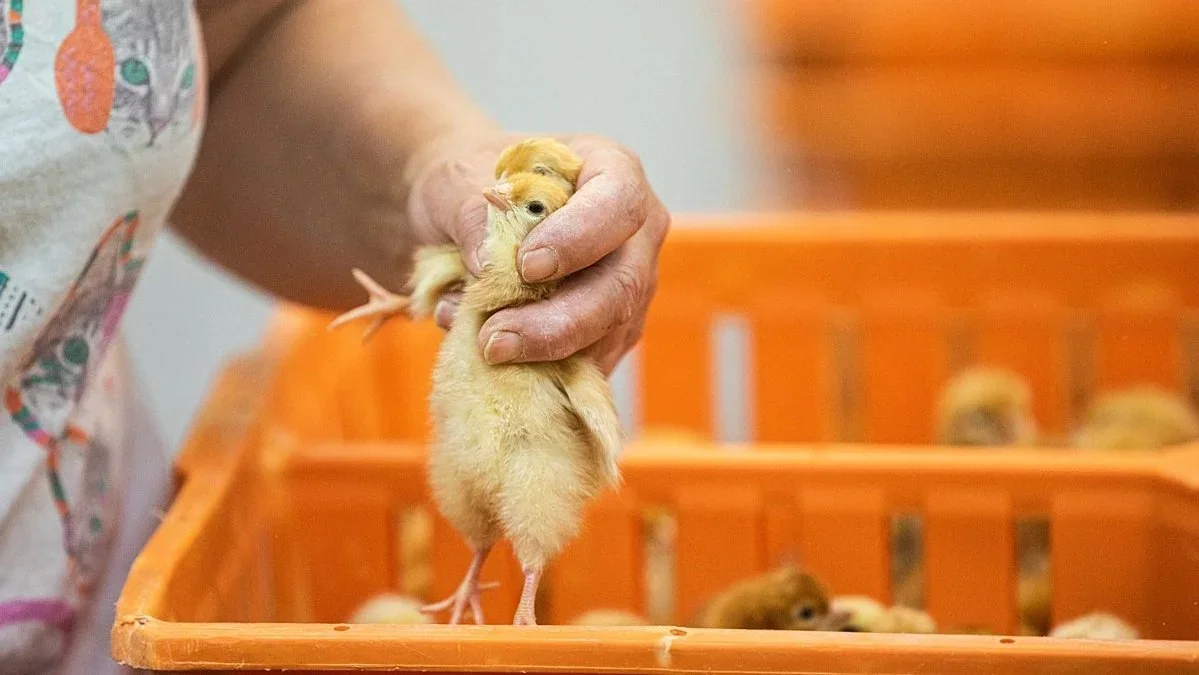
The first egg barn I worked at was a pullet barn (pullets are young egg laying hens who have not yet started egg production). Baby chicks would live at the pullet farm from approx. 0-24 weeks, until they were ready to start egg production. Hatchery trucks would show up with crates of newly-hatched, day-old, de-beaked chicks; they would be unloaded off the trucks and transferred directly to battery cages. The chicks were so tiny we had to lay out newspaper over the bottom of the cages so they wouldn’t get caught in the wire, and each cage was stocked with about 45 chicks in each cage.

Typical pullet barns.

I remember how heartbreaking it felt to put these chicks into barren cages, where they would spend their entire, miserable lives. The chicks did not know what to make of these strange, foreign environments and many got tangled in the cage wire. Every day I walked the barns, I found birds trapped or mangled in the cage wire, or painfully run over by automatic feeders’ setup in the barn. Since the softest place to sleep in the cage was on top of the feed, many of these babies fell asleep in the feed troughs, and then got run over by the automatic feeders which moved up and down the barns. Some died instantly, and others had to be euthanized because they were mangled from being run over by the heavy factory equipment.

Pullet cages.

After the chicks were put into cages, mortality spiked for the first week. Over a 3-day period, I counted over 1,000 dead baby chicks.

Often injured or failing chicks will be dumped in garbage bags, dumpsters or incinerators.

Death did not come quickly, or painlessly, though. Careless farm workers smashed the heads of sick and injured chicks against hard objects to kill them; they used whatever surface was available, from buckets to feed troughs. Many times, this was done ineffectively and did not kill the chicks, it only mangled them. Sometimes, they were thrown into garbage bags to die while they were still alive and suffering. If the chicks were not killed properly, they would be thrown into an incinerator on the farm to slowly and painfully burn to death.  

In one instance, I noticed the supervisor hadn’t correctly killed a chick. I immediately pointed this out to him, and then went to go do a job in another barn. When I got back I found out the chicks he was working with had been taken to the incinerator. I asked him if he had properly killed the chick and he just shrugged. The peeping of that chick still haunts me to this day, because I feel she was most likely thrown alive into the incinerator.

An injured baby chick tries to escape an incinerator. Photo credit: Anonymous for Animal Rights.

As the birds grew, we separated them into cages with fewer numbers, so eventually each cage was stocked with about 7-8 birds, which is standard in the egg industry. Each hen would have no more than a regular size piece of paper to live out her entire life. As someone who had always felt a deep connection with animals and had done rescue work with battery hens before becoming a whistleblower, it felt truly awful to be in these environments, witnessing so much suffering and cruelty on a daily basis.

A typical battery cage (Australia). Photo credit: Jo-Anne McArthur/We Animals

Occasionally, chicks daringly escape their cages and have a chance to stretch their limbs; they would run around on the barn floors, sometimes in packs of 2 or 3. I would see them scurrying together across the barns, running as fast as they could – for a few moments, maybe they felt free. Eventually, workers caught them and put them back into cages, where there was no space to run around. As the chicks grew, the space in their cages shrunk, until there was barely enough room to stretch their wings.

While working at this egg barn, there was a pre-announced inspection by the provincial egg board. I watched as the inspector walked through a barn of 100,000 chicks in less than 10 minutes and then walked into the office to tell jokes with the barn staff.

A mother hen and her baby chicks.

After about a month of working in the pullet barn, it was time to say goodbye. I remember walking out of the pullet barn and looking back at the hens in cages one last time; I felt a profound sense of sadness that this would be their lives and everything they would ever know. They would never be free; they would never get a chance to feel the sun, walk on grass, be loved, or enjoy life; they were stuck in windowless barns, crammed into cages with no stimulation. When their egg production declined, they would be ripped out of their cages, crammed into transport crates, and mercilessly killed.

In nature, mother hens will sit on eggs until they hatch; she will even sing songs to her unborn chicks. When they hatch, she keeps them close under her wings and protects them. However, that is totally the opposite experience of chicks raised for the commercial egg industry, where they are treated as mere egg-producing machines.

Please, don’t support this animal abuse; the only chance to free hens and other animals from the inherent cruelty of the animal agricultural industry is for people to adopt a compassionate vegan diet. With so many amazing products and support groups available, it’s never been easier to be vegan. Your health, the environment, and most of all the animals, will thank you.

Read More
Egg Industry, Undercover Investigations Nigel Osborne Egg Industry, Undercover Investigations Nigel Osborne

Egg Industry's Shocking Cruelty Exposed!

Animal rights activists in Canada have exposed shocking cruelty and abhorrent conditions on several egg farms in British Columbia, Canada. National media outlets have picked up on this story including CTV News and CBC News.

Animal rights activists in Canada have exposed shocking cruelty and abhorrent conditions on several egg farms in British Columbia. National media outlets have picked up on this story including CTV News and CBC News.

Egg-Truth was granted an interview with one of the animal rights activists involved in documenting conditions on these farms.


Interview with Jeff Rigear

ET: Good evening Jeff, thanks for agreeing to an interview.

Jeff: You're very welcome, my pleasure.

ET: What made you choose this particular farm or was it random?

Jeff: They were completely random. There were actually 3 farms involved. We wanted to get a good sample of the industry because, of course, every time the Canadian public gets a glimpse into the animal ag industry, whether it is egg farming or other types of animal agriculture, they’ll always say this is an isolated incident. So, we selected 3 farms, and all 3 were chosen randomly. There were hen’s dead or dying in the manure pits, dead or dying hens in the cages and in various forms of decay.

ET: So you found hens dead or dying in the manure pits of just one farm or all of them?


Jeff: All of them. Alive and dead in all three.

ET: How many birds do you estimate were in these sheds, roughly? 5, 10, 15,000?

Jeff: I estimate maybe around 20,000.

ET: Per shed?

Jeff: Yes, per barn.

ET: And how many of you were there that entered these facilities?

Jeff: There were up to four people including myself.

ET: From the media reports published thus far or the video that PETA has shared, is there anything that hasn’t been disclosed or documented that you’d like to make the public aware of?

Jeff: I’d want people to be aware that what you see in the videos and images is common practice. I’d want people to know that beyond hens being left to drown in their own excrement hens are dying in other excruciating ways even on the very best egg farms. For example, there were hens dying on these farms from prolapses or from being egg bound – this is not unique to the facilities we documented. I can only imagine how excruciating it would be to die like that. And I can tell you from experience this is extremely common for animals that have been genetically selected to lay 300+ eggs a year. So the issue goes far beyond one farm doing a poor job. The industry is just inherently cruel.

A hen suffering from a prolapse.


ET: And this is the constant refrain that we hear from the egg industry marketing boards and public relations people. They always frame these exposes as being an “isolated incident” that “this is the exception not the rule”, that they “have high standards” and they are “very disturbed and upset by what they’ve seen”. But when whistleblowers constantly choose facilities at random and consistently reveal these conditions without exception, it’s pretty hard to credibly use these excuses. How would you rate this facility relative to others you have been in?

Jeff: Average.

ET: Did the same company own these farms you went in to or were they separate entities?

Jeff: I believe they were separate entities; at least they appeared to be registered under different names. So I assume they all had different owners.

ET: Were these facilities battery cage facilities or enriched cage facilities?

Jeff: They were battery cages or what the industry calls “conventional”.

ET: Looking at those manure pits, how long do you think since they were last cleaned? There were picture of you standing next to 5’ and 6’ mounds of manure?

Image shows accumulated manure in pits are approximately five to six feet high.


Jeff: I feel I don’t have a good handle on how long it would take for what I saw to accumulate. I would guess a year perhaps, but I’m really not sure. I haven’t worked on an egg farm that long to know. I’ve been in lots of egg farms for shorter periods of time.

ET: Are the feces accumulating in these pits accumulating from just the bottom row of cages or is this also coming from those rows stacked on top as well. And if so, are the birds in the upper rows urinating or defecating on the birds below and eventually working its way to the pits?

Jeff: Partially they are. They’re called a-frame battery cages. They are kind of like a stair, so it partially overlaps the cage below. So a bird at the back of the cage may be getting some excrement and urine on them.

ET: How many rows of cages were there?

Jeff: I think there were at least 3 aisles with cages on either side.

ET: Stacked how many rows high?

Jeff: Three.

ET: There was a recent case in the U.S. where the FDA recalled millions of eggs due to a salmonella case from one particular farm. On this farm it was cited that the source of the salmonella was rodent and insect infestation and uncleanliness. From the pictures and video, these farms looked like there was quite an infestation of insects, was that in fact the case here and did you see rodents?

Egg-laying hens routinely endure painful injuries.


Jeff: Oh yeah, there was quite an infestation. It was teaming with maggots and other insects. Rodents were all over the place; you had to be careful not to step on them. It was crazy!

ET: And this was in the manure pits or up above in the barns themselves?

Jeff: Both.

ET: You had a mask and breathing apparatus on during your time in the barns?

Jeff: I did. Once, the breathing mask broke so I was not wearing one when I was at one of the farms. But most of us were wearing something.

ET: How bad was the ammonia in the barns, were there any monitors to keep track of the level of ammonia or toxic gases?

Jeff: I didn’t see any. However, I can tell you that the ammonia is so strong it makes your eyes water in the manure pit and up above where the hens are caged as well.

ET: How do you think the birds got trapped in the manure pits? Was it careless handling when the birds were loaded/unloaded in or out of the cages by workers or did they simply fall out somehow?

Jeff: Careless handling. With the farm that had the highest number of hens living in the manure pit, I believe, had been emptied by chicken catchers from, (according to CTV News), Elite Farm Services. However, some of the hens clearly had been down there before the chicken catchers came because there was a large accumulation of dried manure built up on their legs and feet. So I have to imagine, because there were 50-60 live birds down there that they would have escaped during handling when the catchers emptied the cages.

A dead hen left to decay inside a cage with still living hens.


ET: Do you know of any brands or retailers who carry the eggs harvested from these farms?

Jeff: No I don’t. I believe, however, there is only one egg packing plant here in B.C. called Golden Valley Eggs. I know the same owners of Gray Ridge farms in Ontario own it.  When I worked in the packing plant in Ontario, for example, the eggs come from the farms and get sorted by size, quality and colour and go on to be sold in many places and under different brands. The same is true out  here. So, it is quite possible these eggs end up virtually everywhere out west.

ET: So what you’re saying is that these farms you went in to supply the one packing facility that in turn distributes to a broad variety of brands and retailers?

Jeff: Yes.

ET: Has the BC SPCA or other law enforcement group interviewed you thus far?

Jeff: I filed the complaint. I initially made the call and submitted a witness statement. And I think on that basis they raided one of the farms owned by Jaedel Enterprises the same or next day. But there hasn’t been a formal witness interview yet.

ET: Are you worried about reprisals from anyone for being a whistleblower?

Jeff: No, not really.

ET: Describe the sensory experience of being in these sheds with 20,000 hens. It must have been deafening and the smell overwhelming?

Jeff: It’s loud; you can see the air is just full of particulate matter, mostly dried chicken excrement. The dust is airborne and really thick. There is a really powerful stench of ammonia. This is egg farming, this experience is exactly like the other farms I’ve worked in. 

ET: Were the vents and air circulation systems working in the sheds to mitigate these gases and airborne particles?

Jeff: If they were, they weren’t working very well. However, they may not be on all the time so maybe they just weren’t on during the time I was in there. But if they were working, they weren’t doing a very good job.

ET: Jeff thanks for your time. We really appreciate it!

Jeff: Thank you!


Photo and images courtesy of: Jeff Rigear, PETA

Read More