Egg Industry, Undercover Investigations Nigel Osborne Egg Industry, Undercover Investigations Nigel Osborne

What Happened in Winnipeg Should Be A Wake Up Call!

On April 1, 2021, workers at the Brady Municipal Landfill site in Winnipeg, Manitoba, Canada, discovered a very disturbing scene . . .

Thousands upon thousands of dead, egg laying hens litter the Brady Landfill, Winnipeg, MB, Canada. Note the dead pigs in the background. It is unclear where they came from and garnered no mention in media reports.

On April 1, 2021, workers at the Brady Municipal Landfill site in Winnipeg, Manitoba, Canada, discovered a very disturbing scene: tens of thousands of dead, egg-laying hens. Treated like trash, their broken and fragile bodies had been dumped at the site by an area egg farm. However, there appeared to be movement among the mass of contorted bodies - some of the hens were still alive! Shocked, the workers called a local farm sanctuary to inform them of what they saw and in hopes of having these few remaining souls rescued. Sadly, this was not the first time this had happened.

Ethics

News of this atrocity got out and was first reported by CTV News Winnipeg. Interestingly, the focus of the news report was not necessarily about the thousands of dead hens rotting in the open air, it was about the few who survived and were found writhing amongst the carnage. Make no mistake, the fact that still-alive hens were left to die a slow, painful death is a horror unto itself, but no less were the thousands of innocent ‘spent-hens’ who were killed and dumped like garbage simply because they were no longer profitable.

Above is a photo gallery of images taken from the Brady Landfill, April 1, 2021. Photo credit: The Good Place Farm Sanctuary.

A spokesperson from the Winnipeg Humane Society interviewed by CTV News was quoted as saying that these birds, “were among thousands of euthanized hens that were dumped at the landfill”. Euthanized? The definition of euthanasia is as follows: it is the practice of intentionally ending life to relieve pain and suffering. These hens were not euthanized, they were killed (gassed) to ensure profitability for the egg farm. Commercial hens have been genetically manipulated to lay an excessive number of eggs in their abbreviated life span of approximately 18 months. Once they reach the end of their laying cycle, their exhausted bodies can no longer lay the quantity or quality of eggs for the farmer to keep housing and feeding them, and must make way for younger pullets who have reached egg laying maturity. Thus, egg farms will “de-flock” their barns and kill the spent-hens (an industry term) either through on-site killing or sending them to slaughter. The natural life expectancy of a rescued commercial hen can be anywhere from 4-8 years, as can be testified to by many farmed animal sanctuaries, or longer if their bodies do not succumb to the common illnesses afflicting commercial hens such as ovarian cancer, osteoporosis, egg-yolk peritonitis or other diseases. In nature, their wild cousins can live 10-12 years.

A photo of “Penny”, a spent-hen rescued from the manure pits at an egg farm in British Columbia, Canada. Photo credit: Geoff Regier

How Did This Happen?

We interviewed Jen from The Good Place Farm Sanctuary (GPFS) to learn details of what happened.

A dump truck carrying thousands, perhaps tens-of-thousands, of “spent hens” arrived from an area egg farm. They were dumped at this municipal landfill to ultimately be moved into a pit. Workers, as on previous occasions, saw movement among the dead pile. Six hens on top were still alive. Jen and one of her volunteers arrived at the scene. One of the hens died on site and they managed to rescue five others. They searched the pile hoping to find others. But given the pile was many feet high over a vast area, there were no doubt alive birds near or at the bottom that could not be saved.

Jen and her volunteer were haunted by the possibility that they might miss one. After a period of time, the five they rescued were driven to a local vet. One of the hens, in particular, was in bad shape - they named her “Pearl”. She didn’t make it. The remaining four did and most ended up at several other sanctuaries (see footnote below).

Jen managed to reach out to the provincial vet responsible for farmed animals in Manitoba. Jen learned that a company was contracted by farms throughout the province who would conduct the mass killing of these birds using a mobile CO2 gas chamber. According to sources, this issue of still-alive hens being dumped at landfills had happened multiple times dating back to at least 2020. There was an investigation that year over a similar incident and recommendations were made to improve methods to ensure no hen came out of the chambers alive. Clearly, the issue was never resolved. Sources informed Jen at GPFS that the same thing happened approximately four days later after this particular incident. Landfill workers have said they often dread the days hens come to the facility because they would routinely see the same thing, over and over and over again. (Note: it is our understanding that municipal workers at this landfill have been reprimanded and instructed not to speak to anyone in the future on matters such as this.)

One of the rescued hens. Source: The Good Place: Farm Rescue & Sanctuary

Jen also observed that the pile of discarded hens at the Brady Landfill were likely not caged birds, but free-range or free-run. Jen noted that these hens did not have curled feet which comes from living on a wire floor in a cage for up to a year-and-a-half, as most hens do in Canada. The few they rescued didn’t seem skittish or afraid of her and her volunteer and seemed adept to walking on the ground. Caged hens are unfamiliar and unaccustomed to walking on the ground or interacting with people.

Another one of the rescued hens. Source: The Good Place Farm Rescue & Sanctuary

The “Manitoba Egg Farmers said it was "devastated" to hear about the five hens found alive”. “Devastated”? Why because the farm and/or the hired company failed to kill the few who survived which made its way to news reports? The Manitoba Egg Farmers, and Canada’s egg industry in general, kills millions upon millions of spent hens every year in addition to an equal number of male chicks who are useless to the egg industry as they don’t lay eggs. The egg industry IS a slaughter industry no different than meat or dairy production.

And herein lies the issue as it relates to the exploitation of egg laying hens: some of us (certainly not the egg industry) are not necessarily shocked or saddened to learn of thousands being killed in a story like this, we are saddened to learn that some were still alive. Think about this for a moment: is our empathy reserved largely for the suffering of those still alive, while ignoring the suffering of all those who were once confined and condemned to lay only to be killed and discarded like trash? Are not all the dead hens in this story entitled to the same moral concern as the ones found alive? Should we not be outraged and sickened by the massive dead pile? Absolutely!

Manure pits beneath the stacks of battery cages on an egg farm in British Columbia, Canada. Photo credit: Geoff Regier

Disease

A live market in New York City. Click on photo to enlarge.

In the sober new reality of global pandemics, our world needs to take a very hard look at the risk factors of animal agriculture and, in this case, the egg industry. Avian and swine flu, antibiotic resistance, zoonotic diseases such as SARS, MERS, AIDS, Ebola, and now Covid-19 are either caused directly, or indirectly, by intensive animal agriculture, stress imposed on natural ecosystems as a result of human encroachment, the harvesting of wildlife (ie. bush meat), and wet markets.

Yet despite all that we have learned, we still see scenes like the Brady Landfill playing out - thousands upon thousands of corpses from factory farms, rotting in the sun and out in the open? One thing most of us surely know from having been to a landfill or waste facility, there is a lot of wildlife that are attracted to these places: sea gulls, mice, rats, turkey vultures, raccoons, cats, dogs, and those predators preying on those scavenging the garbage. It is absolutely shocking that in a first world country like Canada, in the 21st century, dead farm animals would be dumped at a municipal landfill with the corpses of these animals free to come into contact with wildlife. And let’s not forget the municipal workers who are working at these facilities - what about the risk of exposure to them? All it takes is one pathogen to jump from animal to human. It has happened before and will, in all probability, happen again.

Propaganda

“We take accusations about animal cruelty very seriously”. How many times have you heard a PR person for an industry group say this every time a story emerges like this landfill story? Are they to be believed?

A screen shot from Manitoba Egg Farmers website depicts, ‘smiling, laughing’ people joyfully engaged in the business of egg production. A business that imposes untold misery and deprivation for the millions upon millions of hens exploited across Canada annually.

This is a standard reply designed to assuage public concern about animal welfare. The egg industry in Canada, and elsewhere, devote considerable sums of money to present an image of a clean, green and caring industry. They focus a lot of their efforts to remind consumers that they are feeding “you and your family” - sounds wholesome doesn’t it? Often they’ll recruit from their 1,200 members across Canada to profile a few of those who run and operate egg farms and portray them as ‘smiling, hard-working Canadians’ . . . . just like you! And if they are just like you they can’t be all bad, right? The focus of these carefully, crafted advertising campaigns are always on the family-run farms and invoke words like “community”, “care” and promote the healthful and nutritious aspects of eggs. Never do they focus on the hens and rarely show you inside an egg barn containing thousands of birds. And if they do, it is always of a barn that has been “de-flocked”, cleaned and re-populated with pullets who have just reached egg laying maturity and look clean, healthy and vibrant. Never will you see images or video of a barn 12-18 months afterwards. Why? Because it is not a pretty sight.

Generally speaking, the egg industry routinely anthropomorphizes animals when it comes to their consumer packaging and advertising campaigns by using cartoon depictions exhibiting human like qualities and facial expressions. This is true for Canada as it is for many countries around the world like the United States, United Kingdom, the European Union, etc. This is done in an effort to depict the industry as benign or harmless. Words like “Happy”, “Farm Fresh”, “Organic”, “Local” are ubiquitous.

The fact is, egg farming is a slaughter industry - it is violent and bloody. Male chicks are shredded alive shortly after hatching, females are often de-beaked, vaccinated against high risk diseases as a result of high stocking densities, endure many illnesses along the way, and then slaughtered after 18 months. Sometimes they are killed on site, dumped in a pit and buried, or incinerated.

Canada’s egg industry does not want you to know any of this because they know the average Canadian would be appalled at this kind of animal cruelty. Nonetheless, it is how commercial hatcheries, egg farmers, and the industry as a whole, can maximize profitability. And let’s be clear, all egg farming associations, whether provincial or federal, exist to promote the financial sustainability and profitability of their members first and foremost. And, part of that mandate, requires them to market and promote what they do in the most sanitized and favourable light possible.

The photo gallery below shows what the Egg Farmers of Canada publishes on their website and accompanying photos of the reality on Canadian egg farms:

Conclusion

Don’t trust anything the egg industry says. At least, view what they say with deep suspicion. It is in their interest to keep information like this out of view from Canadians. Even now, animal agriculture has succeeded in enacting legislation like Bill 156 in Ontario. And now Manitoba is considering the same thing - and you can be assured that the Manitoba Egg Farmers are in favour. Bill 156 in Ontario was lobbied for very hard by the animal agriculture sector. They’ll tell you it is about “protecting the food supply”, and ensuring that “food biosecurity” is a priority or by “protecting the property rights of farmers”. While this sounds reasonable, it is really about eliminating these kinds of videos and stories getting out. Why? Because it hurts business. And as the Premier of Ontario has often said, “Ontario is open for business”. It appears this is certainly true - but in the end, it is the animals who will pay the price.

But there is an alternative to all of this. There are so many cruelty-free, delicious and affordable egg-free alternatives available. And the great news is these alternatives are readily available in most grocery stores and health food stores across Canada! So please consider leaving eggs off your plate. Compassion is never the wrong thing.

And please consider contacting your area MP or MPP to tell them that you oppose any type of ag-gag legislation:

Search for your Canadian Member of Parliament.

Search for you Member of Provincial Parliament:

British Columbia
Alberta
Saskatchewan
Manitoba
Ontario
Quebec
New Brunswick
Nova Scotia
Prince Edward Island
Newfoundland & Labrador


Support Farm Sanctuaries Not Animal Farmers

If you would like to support the rescue of egg laying hens, please consider becoming a volunteer, or offering financial support to The Good Place Farm Sanctuary. And if you want to help one of the organizations who rescued the hens from the Brady Landfill, consider a donation to:

Rainbow Ranger Station (who rescued “Piper”)

Ledwich Family Farm (who took in “Karen”)

The Little Red Barn Sanctuary (who took in “Star”).

Or, consider supporting any number of farm sanctuaries around the world. Our “Resources” page has a very comprehensive list of sanctuaries, large and small, across the globe.


Footnote:

Dead pigs are visible in the background. Click on photo to enlarge.

We reached out to the Canadian Pork Council asking for comment on the dead pigs visible in the background of the photo of the pile of dead hens. A excerpt from their response is below.

To highlight, the CPC says, “mortalities are an unfortunate part of food production”. Unfortunate because they couldn’t profit from the ones that died? All animals face “mortality” in the food system. Mr. Ross the ED of the Canadian Pork Council goes on to say that the $83/tonne fee to dump dead pigs is the same as commercial garbage. We have reduced living beings to “commercial garbage” like tin cans, plastic containers, paper, and discarded cardboard.

“ . . . mortalities are an unfortunate part of food production . . . The disposal of mortalities is regulated by the Province of Manitoba. One approved option is to utilize the Brady Landfill . . . animal disposal arrangements must be made in advance and are subjected to an $83/tonne fee. This is the same fee applied to commercial garbage disposal.”
— John Ross Executive Director Canadian Pork Council

Nigel_headshot_ET.png

Nigel Osborne is the Executive Dir. of Egg-Truth. Nigel has years of experience related to animal rights and on-line advocacy. Nigel's extensive background in the publishing, outdoor advertising, printing and web design industries over the last 25 years provides him with a strong, creative acumen and business management experience. Through Egg-Truth.com and it's social media channels, Nigel seeks to increase awareness among the public about global egg production, expose the conditions for the billions of hens condemned to laying every year, and reveal the true impact of egg consumption on human health.

Read More
Philosophy, Egg Industry, Chickens Nigel Osborne Philosophy, Egg Industry, Chickens Nigel Osborne

The Cambridge Declaration on Consciousness

We have decided to publish, in it’s entirety, The Cambridge Declaration on Consciousness (“CDC'“). What is this declaration and what does it mean?

Photo credit: We Animals

We have decided to publish, in it’s entirety, The Cambridge Declaration on Consciousness (“CDC'“).

What is this declaration and what does it mean? This was a document signed in 2012 by “an international group of prominent scientists, led by computational neuroscientist and neurophysiologist Dr. Philip Low, . . . . . in which they are outlining convergent evidence indicating that non-human animals have the neuroanatomical, neurochemical, and neurophysiological substrates of conscious states along with the capacity to exhibit intentional behaviors, and consequently discarding the notion that humans are unique in possessing the neurological substrates of consciousness. Stephen Hawking was the guest of honor at the signing ceremony”.1

The CDC, in essence, rejects the view of French philosopher René Descartes (1596 - 1650) in which he, “maintained that animals cannot reason and do not feel pain; animals are living organic creatures, but they are automata, like mechanical robots. Descartes held that only humans are conscious, have minds and souls, can learn and have language and therefore only humans are deserving of compassion.”2

Reading Descarte’s views on animals may come as a surprise to many. Anyone who has ever interacted with nonhuman animals knows they are conscious, they do feel pain and have emotions - this observational evidence is easily and quickly discernible. Nonetheless, Descartes’ views heavily influenced humanities perspective of non-human animals including within the scientific and legal communities for centuries. It is fair to say that this view of non-human animals pre-existed Descartes, it was those ancient philosophers who provided Descartes with the foundation he needed.

As such, Steven Wise, an Amercian legal scholar and head of the NonHuman Rights Project, once said, “For four thousand years, a thick and impenetrable legal wall has separated all human from all nonhuman animals. On one side, even the most trivial interests of a single species — ours — are jealously guarded. We have assigned ourselves, alone among the million animal species, the status of "legal persons." On the other side of that wall lies the legal refuse of an entire kingdom, not just chimpanzees and bonobos but also gorillas, orangutans, and monkeys, dogs, elephants, and dolphins. They are "legal things." Their most basic and fundamental interests — their pains, their lives, their freedoms — are intentionally ignored, often maliciously trampled, and routinely abused.”

This is why the CDC is such an important moment in science and for nonhuman animals. It is a formal rebuke of centuries of collective cognitive dissonance among the sciences and moral philosophy. Disciplines, ironically, in which one might consider cognitive dissonance antithetical to the intellectual rigours and disciplines of reason and logic required by these otherwise noble human pursuits.

But what also caught our eye upon reading the CDC, is the following sentence: “Birds appear to offer, in their behavior, neurophysiology, and neuroanatomy a striking case of parallel evolution of consciousness.”

Please read the declaration. We also provide a link to download the declaration as a PDF.


The Cambridge Declaration of Consciousness

On this day of July 7, 2012, a prominent international group of cognitive neuroscientists, neuropharmacologists, neurophysiologists, neuroanatomists and computational neuroscientists gathered at The University of Cambridge to reassess the neurobiological substrates of conscious experience and related behaviors in human and non-human animals. While comparative research on this topic is naturally hampered by the inability of non-human animals, and often humans, to clearly and readily communicate about their internal states, the following observations can be stated unequivocally:

  • The field of Consciousness research is rapidly evolving. Abundant new techniques and strategies for human and non-human animal research have been developed. Consequently, more data is becoming readily available, and this calls for a periodic reevaluation of previously held preconceptions in this field. Studies of non-human animals have shown that homologous brain circuits correlated with conscious experience and perception can be selectively facilitated and disrupted to assess whether they are in fact necessary for those experiences. Moreover, in humans, new non-invasive techniques are readily available to survey the correlates of consciousness.

  • The neural substrates of emotions do not appear to be confined to cortical structures. In fact, subcortical neural networks aroused during affective states in humans are also critically important for generating emotional behaviors in animals. Artificial arousal of the same brain regions generates corresponding behavior and feeling states in both humans and non-human animals. Wherever in the brain one evokes instinctual emotional behaviors in non-human animals, many of the ensuing behaviors are consistent with experienced feeling states, including those internal states that are rewarding and punishing. Deep brain stimulation of these system in humans can also generate similar affective states. Systems associated with affect are concentrated in subcortical regions where neural homologies abound. Young human and nonhuman animals without neocortices retain these brain-mind functions. Furthermore, neural circuits supporting behavioral/electrophysiological states of attentiveness, sleep and decision making appear to have arisen in evolution as early as the invertebrate radiation, being evident in insects and cephalopod mollusks (e.g., octopus).

  • Birds appear to offer, in their behavior, neurophysiology, and neuroanatomy a striking case of parallel evolution of consciousness. Evidence of near human-like levels of consciousness has been most dramatically observed in African grey parrots. Mammalian and avian emotional networks and cognitive microcircuitries appear to be far more homologous than previously thought. Moreover, certain species of birds have been found to exhibit neural sleep patterns similar to those of mammals, including REM sleep and, as was demonstrated in zebra finches, neurophysiological patterns, previously thought to require a mammalian neocortex. Magpies in particular have been shown to exhibit striking similarities to humans, great apes, dolphins, and elephants in studies of mirror self-recognition.

  • In humans, the effect of certain hallucinogens appears to be associated with a disruption in cortical feedforward and feedback processing. Pharmacological interventions in nonhuman animals with compounds known to affect conscious behavior in humans can lead to similar perturbations in behavior in non-human animals. In humans, there is evidence to suggest that awareness is correlated with cortical activity, which does not exclude possible contributions by subcortical or early cortical processing, as in visual awareness. Evidence that human and nonhuman animal emotional feelings arise from homologous subcortical brain networks provide compelling evidence for evolutionarily shared primal affective qualia.

We declare the following: “The absence of a neocortex does not appear to preclude an organism from experiencing affective states. Convergent evidence indicates that non-human animals have the neuroanatomical, neurochemical, and neurophysiological substrates of conscious states along with the capacity to exhibit intentional behaviors. Consequently, the weight of evidence indicates that humans are not unique in possessing the neurological substrates that generate consciousness. Nonhuman animals, including all mammals and birds, and many other creatures, including octopuses, also possess these neurological substrates.”

* The Cambridge Declaration on Consciousness was written by Philip Low and edited by Jaak Panksepp, Diana Reiss, David Edelman, Bruno Van Swinderen, Philip Low and Christof Koch. The Declaration was publicly proclaimed in Cambridge, UK, on July 7, 2012, at the Francis Crick Memorial Conference on Consciousness in Human and non-Human Animals, at Churchill College, University of Cambridge, by Low, Edelman and Koch. The Declaration was signed by the conference participants that very evening, in the presence of Stephen Hawking, in the Balfour Room at the Hotel du Vin in Cambridge, UK. The signing ceremony was memorialized by CBS 60 Minutes.

Download: The Cambridge Declaration on Consciousness.pdf

Footnotes:

  1. http://www.rawscience.tv/the-cambridge-declaration-on-consciousness/

  2. http://www.animalethics.org.uk/descartes.html


Nigel_headshot_ET.jpg

Nigel Osborne is the Executive Dir. of Egg-Truth. Nigel has years of experience related to animal rights and on-line advocacy. Nigel's extensive background in the publishing, outdoor advertising, printing and web design industries over the last 25 years provides him with a strong, creative acumen and business management experience. Through Egg-Truth.com and it's social media channels, Nigel seeks to increase awareness among the public about global egg production and expose the conditions for the billions of hens condemned to laying every year.

Read More
Egg Industry, About Us, Cage-free Eggs Nigel Osborne Egg Industry, About Us, Cage-free Eggs Nigel Osborne

Our Position on Cage Free Initiatives

Single-issue campaigns, such as cage-free initiatives, have long been a focus of many animal rights organizations like HSUS.

Photo credit: HSUS

The Humane Society of the United States recently announced what they claim is a huge victory for caged hens in the state of Washington.


Single-issue campaigns, such as cage-free initiatives, have long been a focus of many animal rights organizations like HSUS. There is no doubt living on litter (assuming it is dry and properly cycled) vs. a wire floor for 18 months is less cruel. However, some “free-range” environments still use metal or wire flooring to allow urine and faeces to pass through into the manure pits below (see image below). Nonetheless, caged environments generally tend to provide hens the living space of about 8.5” x 11”. Cage-free environments could potentially give a hen about the equivalent of 12” x 12”.

The method of housing depicted above is considered by many as “free-range”.

However, what is the data showing us as to the effectiveness of these campaigns and are they really a victory for hens forced to endure endless egg laying?

Flock sizes and egg consumption in the U.K., Canada and the United States in 2017 and 2018 are at their highest levels in history and will continue to grow due to demand. As the general public are largely ignorant of standard practices in the egg industry, cage-free initiatives wrongly focus public attention on only one of the many cruel aspects of egg production - the laying phase. Given the general public already does not see the same moral imperative on the issue of egg laying hens with, say, animals used for meat, cage-free initiatives reinforce this false notion and helps to remove any ethical concerns the public may have once had about eggs. And if you doubt this, just read some of the comments on HSUS’s Facebook page as it relates to this “victory” (see below).

Comment_1.png
Comment_2.png
Comment_4.png
Comment_5.png

And the reality is, for cage-free farms to remain economically competitive in the early days of transition, they will have to increase their stocking densities and/or increase the number of hens per barn. And these hens will still be subject to many of the same illnesses and disease that afflict caged hens. And possibly a few more they wouldn’t have had in a caged environment.

The argument that "cage-free" will increase the price of eggs and thus drive down consumption is not necessarily supported by the data. Once large food retailers and restaurants like McDonald's finally convert their massive, global supply chains to cage-free, the price gap between cage-free and caged eggs will ultimately narrow at the hand of market pressures until there is virtually little to no difference once adjusted for inflation.

Reducetarianism and flexitarianism are also contributing to the increase in egg consumption as consumers seek out protein alternatives for meat. While plant-based proteins are part of those alternative choices, so too are eggs. Single-issue campaigns have not been effective thus far for hens forced to lay eggs. Had they been then we would see egg consumption trending lower, not at an all-time high with projected demand going down, not up. And given that egg production, qualitatively and quantitatively, is the most cruel form of animal agriculture on the planet, this is not good news in terms of reducing overall animal suffering. If egg consumption is at historic highs and will continue to go up, so too will maceration, debeaking, vaccinations, transport and slaughter.

Follow Your Heart’s “VeganEgg”.

Follow Your Heart’s “VeganEgg”.

We believe the animal rights movement has reached a tipping point. And with the myriad of plant-based alternatives and compassionate choices available, the time has come for a much bigger focus on the care tradition and advocating for leaving all animal foods, including eggs, off our plates. Unfortunately, large animal rights organizations like HSUS and others have not evolved their strategies.

Cage-free legislation is not a victory for animals. It is an anthropocentric justification to make us feel better that we are achieving a measure of success when all the metrics point in the other direction.

Note: this post was updated on May 22 to include a photo of free-range hens on a perforated steel flooring.


Nigel_headshot_ET.jpg

Nigel Osborne is the Executive Dir. of Egg-Truth. Nigel has years of experience related to animal rights and on-line advocacy. Nigel's extensive background in the publishing, outdoor advertising, printing and web design industries over the last 25 years provides him with a strong, creative acumen and business management experience. Through Egg-Truth.com and it's social media channels, Nigel seeks to increase awareness among the public about global egg production and expose the conditions for the billions of hens condemned to laying every year.

Read More
Health Nigel Osborne Health Nigel Osborne

Eggs Over (dis-)Easy?

(The USDA has been) warning egg producers against the illegal use of false or misleading advertising . . .

In this eight-minute video from Nutrition Facts, consumerist collusion between the USDA and the egg industry are revealed via documents sourced through the Freedom of Information Act. Warning egg producers against the illegal use of false or misleading advertising, the USDA repeatedly advises substitution for the words "safe", "healthy", and "nutritious":

It is no surprise that egg yolks are high in cholesterol, and that eggs are calorie bombs given that their evolutionary purpose is to feed a growing embryo. It is also no surprise that those with a vested financial interest in the production of eggs would seek to ameliorate any negative connotation with their brand or product. What is surprising is the level of self-awareness these companies seem to have about the atrocities they're committing, not only with regard to the health of the humans consuming eggs but also the treatment of the hens to whom they owe their livelihood. What's also surprising is that taxpayers are helping foot the bill for their own manipulation.

A review by the U.S. Federal Trade Commission deems advertising by the egg industy is “false, misleading or deceptive”.

These documents between the USDA and egg companies demonstrate that the federal government has a hand in shaping public perception, re-framing words ("healthy" is now "nutritionally-dense"; "safe" is now "fresh") in what I can only describe as a blatant attempt to pull the wool over our eyes. What's in it for them? What is the financial or moral hook on which the USDA is hanging its cap? Surely fielding such questions and offering alternative verbiage carries a cost to the USDA, an organization so woefully understaffed that poultry farm inspections were given over to farm employees in 2014 due to nationwide USDA inspector shortages.  

Denial is a powerful thing, and cognitive dissonance can only be stomached for so long. With these ideas in mind, I had wrongfully assumed that industrial agriculturalists as a whole had all but gone numb to the idea of psychological nuance, patting themselves on the back for a bottom line honestly achieved through good ol' fashioned farm work. Sure you gotta make the cartoon chicken look happy and the farm in the background blood-free. Consumerists can get "overwhelmed" otherwise... but to have the blatant suggestion that advertising should not depict scenes that are "too industrial"--battery cages, large warehouses filled with eggs, machinery, etc.--demonstrates that their willingness to manipulate the psyche of the consumer precedes their concern with demonstrating sterility and mechanized efficiency, reducing hens to units on a Henry Ford production line.

Wow. The fact that these companies are still having to mitigate consumer feelings for the hen after all that commodification and utilitarian production speaks volumes to the innate strength of empathy in avian-human connection. I guess that's the silver lining here. Bottom line, egg consumption can lead to heart disease, and perhaps even worse, heart dis-ease: that achy feeling that creeps in when empathy is swallowed by dissociation.

This blog post is re-published with the permission of Elizbeth M. Burton-Crow, Ph.D.


Elizabeth_Burton-Crow.jpg

Egg-Blog contributor: Elizabeth M. Burton-Crow, Ph.D. currently works at the Depth Psychology Program, Pacifica Graduate Institute. Elizabeth does research in Philosophy of Science, Ecopsychology, and Trans-species Ethics. Her current project is 'Poultry, Parrots, and People: Exploring Psyche Through the Lens of Avian Captivity'. Dr. Crow is also a facuity member of The Kerulos Center for Nonviolence

Read More
Philosophy, Chickens Nigel Osborne Philosophy, Chickens Nigel Osborne

Learning How to Speak Bird

Did you know that in this very moment, there are tens of billions of birds held in captivity?

Photo credit: We Animals Media

Did you know that in this very moment, there are tens of billions of birds held in captivity? Worldwide, “commercialized” chickens alone outnumber us by a ratio of nearly seven to one. That’s seven chickens for every human on the planet, more if you consider apartment hens and backyard flocks, a growing trend in many cities and suburban areas.

Despite its astounding prevalence, avian captivity as a phenomenon remains all but invisible, something most people hardly even think about, let alone talk about.  (And frankly, those with a vested interest in maintaining the status quo would prefer to keep it that way.)

An eleven-year-old me and my first “pet” rooster, Bonnie. Roosters like Bonnie are perhaps the most invisible captive birds in modern society, with the majority silenced shortly after leaving the shell. Those remaining survivors are often labeled nuisances and banned in municipalities, and some find themselves shredded alive for bloodthirsty sport. A lucky few find their way to loving flocks or to sanctuary

The deafening silence surrounding bird captivity is what inspired me to find my voice and more recently, to undertake a five-year study on “Poultry, Parrots, and People” in order to delve into the psychological aspects of bird confinement.  What I discovered is that while the motivations underlying avian captivity are as varied as the species we keep, most share one theme in common: commodification at the expense of the birds.

Parrots, for example, are often sought for their beauty and companionship—aesthetic friendship for purchase at a pretty price.  Yet beauty fades and relationships are complicated, leaving many parrots left to languish alone—or worse.  By contrast, the chickens, ducks, geese, and other species we refer to collectively as “poultry” are not considered in post-industrialist society as individuals at all so much as means to an end: feathers, eggs, and flesh measured most efficiently in dollars per pound.  The end result is the same for poultry as it is for parrots—or worse.

Psychology informs us that commodification is, in essence, a form of objectification, a psychological projection that inflicts harm on an unfathomable scale, both to birds and to us as their captors. Peeling back this Cartesian projection reveals its irrational nature, for humanity’s collective lack of consideration for living, breathing birds is a strange paradox given that our affinity for avian beings is an ancient one, steeped in rich symbolic potency informed by the experiences of countless generations. So why is there currently such a wide schism between our perception (and treatment) of the birds we encounter in day-to-day life and those of our imagination, the sacred metaphorical images that speak in the universal language of the archetypes?

Perhaps in holding the tension of these opposing forces, we have forgotten a third thing, the one at the heart of the matter: The birds themselves.

Meet Pimento at the age of one month, a young Ameraucana chicken who would later grow into a brave and beautiful hen. Pimento stars in the 30-minute film “A Bird Tail”, which chronicles her adventures living in a diverse, multi-species flock.

In my experience, if you spend enough time with a bird, you will begin to see the true colors of their character.  They are nothing short of magnificent, far brighter than any feather.  The birds i’ve known are sparkling and imaginative and playful, sometimes generous, always curious, and oftentimes rude.  They are individuals with their own personalities, just like you and me.  (I guess it turns out the species divide might just be another one of those pesky psychological projections.)

Cocoa awaits the results of her X-ray, and the news is not good. Modern “layer” hens have genomes that have been manipulated by humans to ramp up egg production year-round. Instead of the dozens of eggs laid annually by her wild ancestors, today’s hen can lay hundreds and as you can imagine, this wreaks havoc upon their reproductive systems. On Cocoa’s X-ray, we discovered 1) an ectopic egg stuck inside her abdomen and 2) that we were too late to save her.

With these newly-honed avian eyes I can see it is no longer enough to speak about birds; we need to learn to speak with them, to include their voices in the conversation.  This realization inspired me to create the short film “A Bird Tail”, narrated from the perspective of a backyard Ameraucana hen named Pimento, one of the many avian loves of my life.  I invite you to watch the film, to get to know Pimento and to fall in love with her, too.

Because isn’t Love the most motivating force of all, stronger than psychological projections like objectification and speciesism?  Surely our love for all living things compels us to take flight in the face of immeasurable odds, to get our hands dirty, to learn how to speak for (and to!) Birds and other animals—beginning with telling the Egg-Truth about eggs, for instance.

So I implore you, dear reader, to seek your catalyst.  Find not only your voice but the courage to wield it, to crow until you’re blue in the face, until you’re absolutely certain you’ve woken every

Sleeping

Neighbor.

Billions of silenced birds depend upon it.


Elizabeth_Burton-Crow.jpg

Egg-Blog contributor: Elizabeth M. Burton-Crow, Ph.D. currently works at the Depth Psychology Program, Pacifica Graduate Institute. Elizabeth does research in Philosophy of Science, Ecopsychology, and Trans-species Ethics. Her current project is 'Poultry, Parrots, and People: Exploring Psyche Through the Lens of Avian Captivity'. Dr. Crow is also a facuity member of The Kerulos Center for Nonviolence

Read More
Chickens, Undercover Investigations Nigel Osborne Chickens, Undercover Investigations Nigel Osborne

British Columbia Hens Rescued

Earlier this year we conducted an interview with Jeff Regear, an animal rights activist, who along with several colleagues documented unspeakable cruelty on several egg farms in British Columbia, Canada.

Earlier this year we conducted an interview with Jeff Rigear, an animal rights activist, who along with several colleagues documented unspeakable cruelty on several egg farms in British Columbia, Canada. Upon entering these facilities they discovered manure pits beneath the rows of battery cages. Some of these mounds of manure were almost six feet high. And half-buried in those manure pits were hens who accidentally fell into the pits after having escaped their cages or were improperly handled by farm workers. These poor birds had been physically unable to extract themselves from the awful filth and had been left there to die.

The activists reported what they saw to the British Columbia SPCA (Society for the Prevention of Cruelty to Animals) and provided extensive photo and video evidence. It made national and international headlines, spurred on in part by a media blitz from PETA who had also received copies of the disturbing images. Since the airing of this story, the farms in question have been decommissioned as authorities continue to investigate. No charges have been laid as of this publishing date.

However, we have learned that several of the activists rescued some of the hens they found submerged in the muck. Meghan Beattie, of Vancouver Chicken Save and Board Member of Liberation BC, recently published a photo diary of the amazing recovery these hens have made since being rescued. We wanted to share this good news with our readers. Meghan has been kind enough to share her photos and personal thoughts with Egg-Truth (please see gallery further below).

"I don't know that I can put into words what this experience was like for me and how it changed me. And I won't try. I won't describe my journey, because it's not about me, it's about these sweet girls. Their lives and new freedom. I'll let these photos tell their story. But I will share this; I have so much respect and gratitude for the humans that led this rescue and invited me to join. This is at a battery cage farm in the Fraser Valley. Our plan going in was to just get footage, but when we arrived the doors were open. The chickens that had been in the battery cages were spent and had been taken to slaughter. Battery cage barns are set up in a way that the cages are above ground - so all the feces and filth falls to the lower, bottom level. When we saw the giant back doors wide open we peaked in and saw these babies. Many were running around, probably not realizing they could walk themselves right out. But then we saw others stuck in wet pools of fecal matter. Some still alive, some not... We took all the girls that were stuck to our vehicle - 21 in total - and we were going to go back for all the others but then an alarm went off and we had to leave them behind. One of our team took all 21 back to his house in Deep Cove. A couple days later we bathed them and, slowly but surely, with vet visits, medicine and lots of love and attention, most of them got stronger and healthier. Unfortunately, some girls died on that first night, and others succumbed to their wounds and broken bodies days and weeks into their new found freedom. But this story does have a happy ending. Even though almost half of these sweet girls passed away after their rescue, they died free birds. They died a less painful and lonely death than what they would have if we hadn't gone to that barn that night. The other 11 girls are thriving and will live out their lives safe, happy and free. As all earthlings deserve to do." - Meghan Beattie

Read More

Stories of An Undercover Investigator

I am a former whistleblower who worked with Mercy For Animals. During my time undercover, I worked for Canadian egg barns.

"Emily" was a whistleblower for Mercy For Animals.

"Emily" was a whistleblower for Mercy For Animals.

I am a former whistleblower who worked with Mercy For Animals. During my time undercover, I worked for Canadian egg barns.

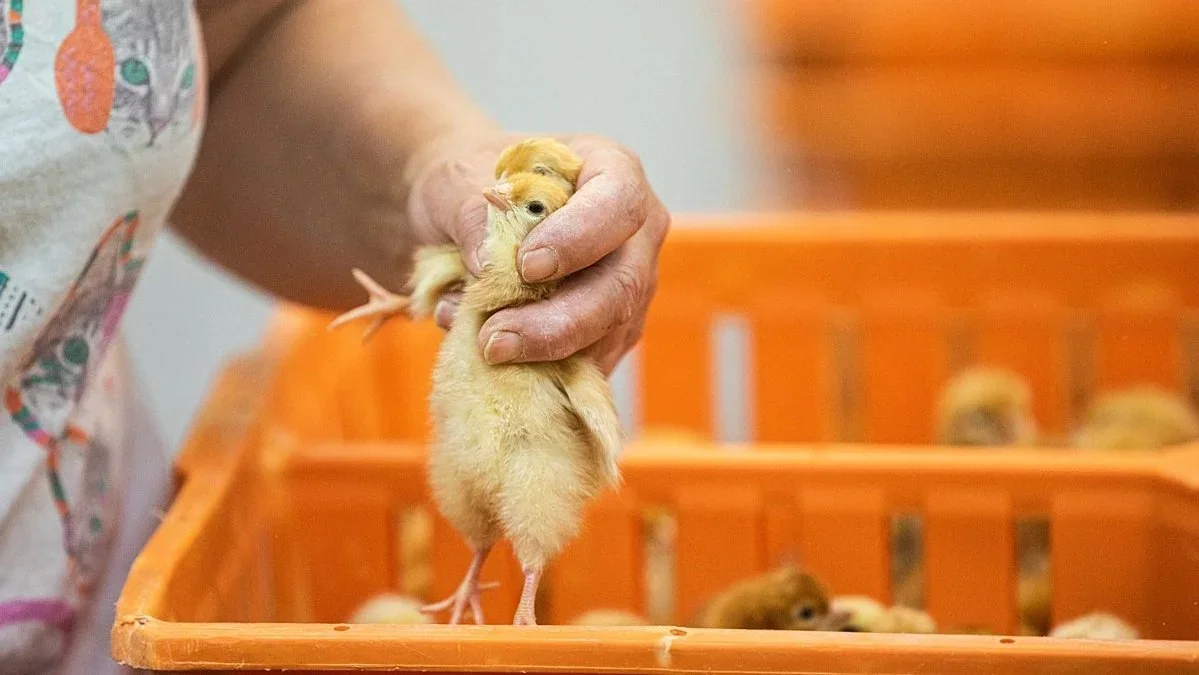
The first egg barn I worked at was a pullet barn (pullets are young egg laying hens who have not yet started egg production). Baby chicks would live at the pullet farm from approx. 0-24 weeks, until they were ready to start egg production. Hatchery trucks would show up with crates of newly-hatched, day-old, de-beaked chicks; they would be unloaded off the trucks and transferred directly to battery cages. The chicks were so tiny we had to lay out newspaper over the bottom of the cages so they wouldn’t get caught in the wire, and each cage was stocked with about 45 chicks in each cage.

Typical pullet barns.

I remember how heartbreaking it felt to put these chicks into barren cages, where they would spend their entire, miserable lives. The chicks did not know what to make of these strange, foreign environments and many got tangled in the cage wire. Every day I walked the barns, I found birds trapped or mangled in the cage wire, or painfully run over by automatic feeders’ setup in the barn. Since the softest place to sleep in the cage was on top of the feed, many of these babies fell asleep in the feed troughs, and then got run over by the automatic feeders which moved up and down the barns. Some died instantly, and others had to be euthanized because they were mangled from being run over by the heavy factory equipment.

Pullet cages.

After the chicks were put into cages, mortality spiked for the first week. Over a 3-day period, I counted over 1,000 dead baby chicks.

Often injured or failing chicks will be dumped in garbage bags, dumpsters or incinerators.

Death did not come quickly, or painlessly, though. Careless farm workers smashed the heads of sick and injured chicks against hard objects to kill them; they used whatever surface was available, from buckets to feed troughs. Many times, this was done ineffectively and did not kill the chicks, it only mangled them. Sometimes, they were thrown into garbage bags to die while they were still alive and suffering. If the chicks were not killed properly, they would be thrown into an incinerator on the farm to slowly and painfully burn to death.  

In one instance, I noticed the supervisor hadn’t correctly killed a chick. I immediately pointed this out to him, and then went to go do a job in another barn. When I got back I found out the chicks he was working with had been taken to the incinerator. I asked him if he had properly killed the chick and he just shrugged. The peeping of that chick still haunts me to this day, because I feel she was most likely thrown alive into the incinerator.

An injured baby chick tries to escape an incinerator. Photo credit: Anonymous for Animal Rights.

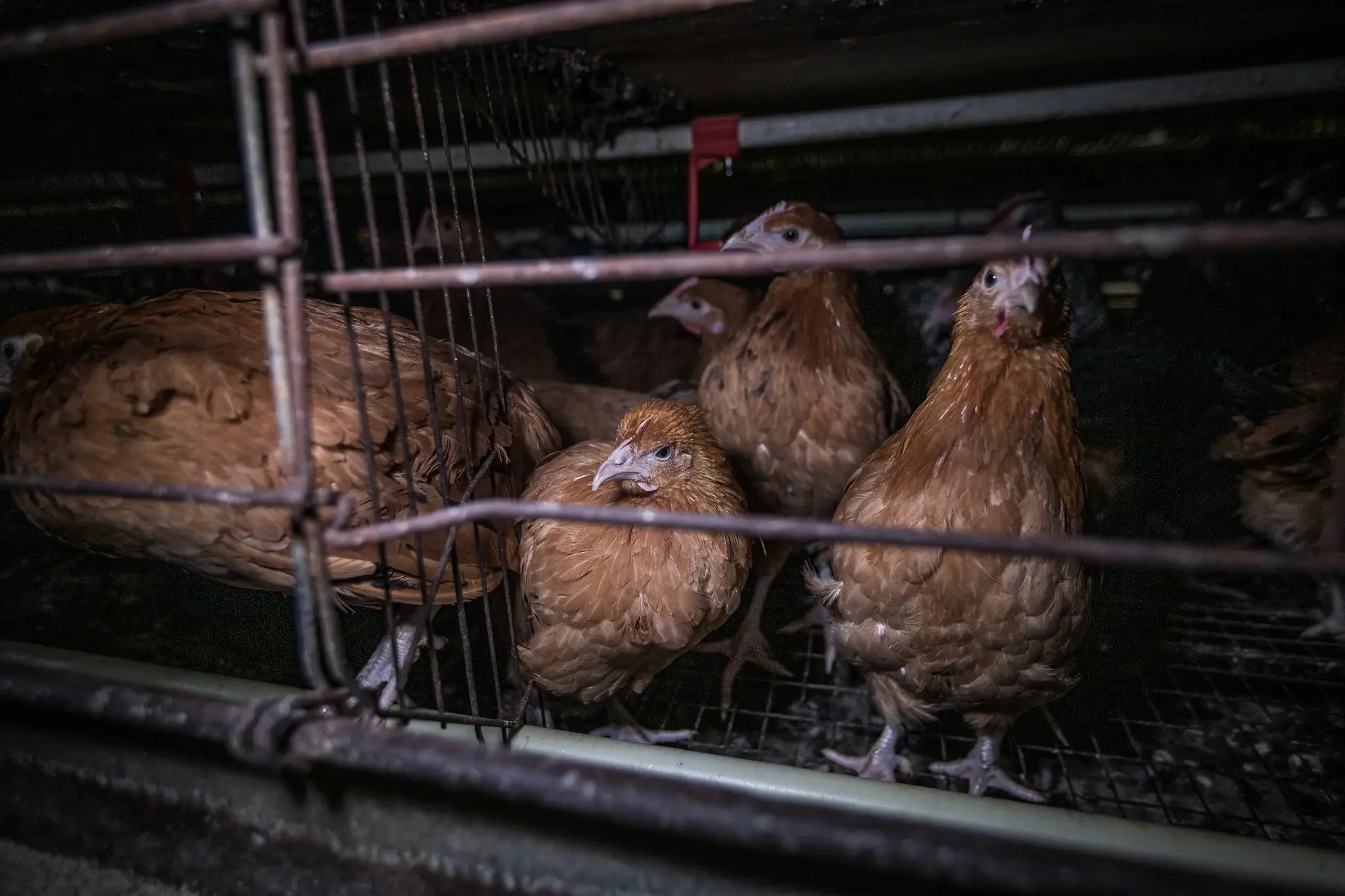
As the birds grew, we separated them into cages with fewer numbers, so eventually each cage was stocked with about 7-8 birds, which is standard in the egg industry. Each hen would have no more than a regular size piece of paper to live out her entire life. As someone who had always felt a deep connection with animals and had done rescue work with battery hens before becoming a whistleblower, it felt truly awful to be in these environments, witnessing so much suffering and cruelty on a daily basis.

A typical battery cage (Australia). Photo credit: Jo-Anne McArthur/We Animals

Occasionally, chicks daringly escape their cages and have a chance to stretch their limbs; they would run around on the barn floors, sometimes in packs of 2 or 3. I would see them scurrying together across the barns, running as fast as they could – for a few moments, maybe they felt free. Eventually, workers caught them and put them back into cages, where there was no space to run around. As the chicks grew, the space in their cages shrunk, until there was barely enough room to stretch their wings.

While working at this egg barn, there was a pre-announced inspection by the provincial egg board. I watched as the inspector walked through a barn of 100,000 chicks in less than 10 minutes and then walked into the office to tell jokes with the barn staff.

A mother hen and her baby chicks.

After about a month of working in the pullet barn, it was time to say goodbye. I remember walking out of the pullet barn and looking back at the hens in cages one last time; I felt a profound sense of sadness that this would be their lives and everything they would ever know. They would never be free; they would never get a chance to feel the sun, walk on grass, be loved, or enjoy life; they were stuck in windowless barns, crammed into cages with no stimulation. When their egg production declined, they would be ripped out of their cages, crammed into transport crates, and mercilessly killed.

In nature, mother hens will sit on eggs until they hatch; she will even sing songs to her unborn chicks. When they hatch, she keeps them close under her wings and protects them. However, that is totally the opposite experience of chicks raised for the commercial egg industry, where they are treated as mere egg-producing machines.

Please, don’t support this animal abuse; the only chance to free hens and other animals from the inherent cruelty of the animal agricultural industry is for people to adopt a compassionate vegan diet. With so many amazing products and support groups available, it’s never been easier to be vegan. Your health, the environment, and most of all the animals, will thank you.

Read More
Egg Industry, Undercover Investigations Nigel Osborne Egg Industry, Undercover Investigations Nigel Osborne

Egg Industry's Shocking Cruelty Exposed!

Animal rights activists in Canada have exposed shocking cruelty and abhorrent conditions on several egg farms in British Columbia, Canada. National media outlets have picked up on this story including CTV News and CBC News.

Animal rights activists in Canada have exposed shocking cruelty and abhorrent conditions on several egg farms in British Columbia. National media outlets have picked up on this story including CTV News and CBC News.

Egg-Truth was granted an interview with one of the animal rights activists involved in documenting conditions on these farms.


Interview with Jeff Rigear

ET: Good evening Jeff, thanks for agreeing to an interview.

Jeff: You're very welcome, my pleasure.

ET: What made you choose this particular farm or was it random?

Jeff: They were completely random. There were actually 3 farms involved. We wanted to get a good sample of the industry because, of course, every time the Canadian public gets a glimpse into the animal ag industry, whether it is egg farming or other types of animal agriculture, they’ll always say this is an isolated incident. So, we selected 3 farms, and all 3 were chosen randomly. There were hen’s dead or dying in the manure pits, dead or dying hens in the cages and in various forms of decay.

ET: So you found hens dead or dying in the manure pits of just one farm or all of them?


Jeff: All of them. Alive and dead in all three.

ET: How many birds do you estimate were in these sheds, roughly? 5, 10, 15,000?

Jeff: I estimate maybe around 20,000.

ET: Per shed?

Jeff: Yes, per barn.

ET: And how many of you were there that entered these facilities?

Jeff: There were up to four people including myself.

ET: From the media reports published thus far or the video that PETA has shared, is there anything that hasn’t been disclosed or documented that you’d like to make the public aware of?

Jeff: I’d want people to be aware that what you see in the videos and images is common practice. I’d want people to know that beyond hens being left to drown in their own excrement hens are dying in other excruciating ways even on the very best egg farms. For example, there were hens dying on these farms from prolapses or from being egg bound – this is not unique to the facilities we documented. I can only imagine how excruciating it would be to die like that. And I can tell you from experience this is extremely common for animals that have been genetically selected to lay 300+ eggs a year. So the issue goes far beyond one farm doing a poor job. The industry is just inherently cruel.

A hen suffering from a prolapse.


ET: And this is the constant refrain that we hear from the egg industry marketing boards and public relations people. They always frame these exposes as being an “isolated incident” that “this is the exception not the rule”, that they “have high standards” and they are “very disturbed and upset by what they’ve seen”. But when whistleblowers constantly choose facilities at random and consistently reveal these conditions without exception, it’s pretty hard to credibly use these excuses. How would you rate this facility relative to others you have been in?

Jeff: Average.

ET: Did the same company own these farms you went in to or were they separate entities?

Jeff: I believe they were separate entities; at least they appeared to be registered under different names. So I assume they all had different owners.

ET: Were these facilities battery cage facilities or enriched cage facilities?

Jeff: They were battery cages or what the industry calls “conventional”.

ET: Looking at those manure pits, how long do you think since they were last cleaned? There were picture of you standing next to 5’ and 6’ mounds of manure?

Image shows accumulated manure in pits are approximately five to six feet high.


Jeff: I feel I don’t have a good handle on how long it would take for what I saw to accumulate. I would guess a year perhaps, but I’m really not sure. I haven’t worked on an egg farm that long to know. I’ve been in lots of egg farms for shorter periods of time.

ET: Are the feces accumulating in these pits accumulating from just the bottom row of cages or is this also coming from those rows stacked on top as well. And if so, are the birds in the upper rows urinating or defecating on the birds below and eventually working its way to the pits?

Jeff: Partially they are. They’re called a-frame battery cages. They are kind of like a stair, so it partially overlaps the cage below. So a bird at the back of the cage may be getting some excrement and urine on them.

ET: How many rows of cages were there?

Jeff: I think there were at least 3 aisles with cages on either side.

ET: Stacked how many rows high?

Jeff: Three.

ET: There was a recent case in the U.S. where the FDA recalled millions of eggs due to a salmonella case from one particular farm. On this farm it was cited that the source of the salmonella was rodent and insect infestation and uncleanliness. From the pictures and video, these farms looked like there was quite an infestation of insects, was that in fact the case here and did you see rodents?

Egg-laying hens routinely endure painful injuries.


Jeff: Oh yeah, there was quite an infestation. It was teaming with maggots and other insects. Rodents were all over the place; you had to be careful not to step on them. It was crazy!

ET: And this was in the manure pits or up above in the barns themselves?

Jeff: Both.

ET: You had a mask and breathing apparatus on during your time in the barns?

Jeff: I did. Once, the breathing mask broke so I was not wearing one when I was at one of the farms. But most of us were wearing something.

ET: How bad was the ammonia in the barns, were there any monitors to keep track of the level of ammonia or toxic gases?

Jeff: I didn’t see any. However, I can tell you that the ammonia is so strong it makes your eyes water in the manure pit and up above where the hens are caged as well.

ET: How do you think the birds got trapped in the manure pits? Was it careless handling when the birds were loaded/unloaded in or out of the cages by workers or did they simply fall out somehow?

Jeff: Careless handling. With the farm that had the highest number of hens living in the manure pit, I believe, had been emptied by chicken catchers from, (according to CTV News), Elite Farm Services. However, some of the hens clearly had been down there before the chicken catchers came because there was a large accumulation of dried manure built up on their legs and feet. So I have to imagine, because there were 50-60 live birds down there that they would have escaped during handling when the catchers emptied the cages.

A dead hen left to decay inside a cage with still living hens.


ET: Do you know of any brands or retailers who carry the eggs harvested from these farms?

Jeff: No I don’t. I believe, however, there is only one egg packing plant here in B.C. called Golden Valley Eggs. I know the same owners of Gray Ridge farms in Ontario own it.  When I worked in the packing plant in Ontario, for example, the eggs come from the farms and get sorted by size, quality and colour and go on to be sold in many places and under different brands. The same is true out  here. So, it is quite possible these eggs end up virtually everywhere out west.

ET: So what you’re saying is that these farms you went in to supply the one packing facility that in turn distributes to a broad variety of brands and retailers?

Jeff: Yes.

ET: Has the BC SPCA or other law enforcement group interviewed you thus far?

Jeff: I filed the complaint. I initially made the call and submitted a witness statement. And I think on that basis they raided one of the farms owned by Jaedel Enterprises the same or next day. But there hasn’t been a formal witness interview yet.

ET: Are you worried about reprisals from anyone for being a whistleblower?

Jeff: No, not really.

ET: Describe the sensory experience of being in these sheds with 20,000 hens. It must have been deafening and the smell overwhelming?

Jeff: It’s loud; you can see the air is just full of particulate matter, mostly dried chicken excrement. The dust is airborne and really thick. There is a really powerful stench of ammonia. This is egg farming, this experience is exactly like the other farms I’ve worked in. 

ET: Were the vents and air circulation systems working in the sheds to mitigate these gases and airborne particles?

Jeff: If they were, they weren’t working very well. However, they may not be on all the time so maybe they just weren’t on during the time I was in there. But if they were working, they weren’t doing a very good job.

ET: Jeff thanks for your time. We really appreciate it!

Jeff: Thank you!


Photo and images courtesy of: Jeff Rigear, PETA

Read More
About Us Nigel Osborne About Us Nigel Osborne

Welcome to Egg-Truth!

Welcome to Egg-Truth! A website designed to educate and inform consumers, and the public at large, about the true nature of: industrialized egg production, it's affect on human health, the environment, and most importantly, the hens who endure one of the most miserable and heavily exploited existences in all of animal agriculture.

Welcome to Egg-Truth! A website designed to educate and inform consumers, and the public at large, about the true nature of industrialized egg production, it's affect on human health, the environment, and most importantly, the hens who endure one of the most miserable and heavily exploited existences in all of animal agriculture.

Some of the images and content on this web site are of a graphic nature - if you are upset by this, we are sorry. However, it is virtually impossible to tell the true story of egg production and its associated horrors without the use of still images and video. As they say, "a picture is worth a thousand words", and by extension, a video could be worth 10,000.

Often, it is human nature to avert our eyes when we see things that are upsetting, violent or graphic in nature. It is our mind attempting to avoid any potential trauma as a result of looking at unpleasant imagery. Unfortunately, given the amount of eggs consumed globally, our appetite for eggs contributes to the suffering of hens on an unprecedented scale. No animal, with perhaps the exception of chickens raised for meat, endures more suffering, qualitatively and quantitatively, than egg laying hens.

Chickens are social, intelligent and sensitive creatures who are capable of exhibiting problem solving, critical thinking, empathy and a host of other cognitive functions we normally associate with the companion animals we keep in our homes like dogs and cats. Despite this, global, industrialized egg production sees hens as merely a means to an end - a limitless supply of a commodity called: the 'egg'.

While it is true that eggs contain some goodness from a nutritional standpoint, there is nothing healthy in eggs that can't be obtained in far healthier forms of other foods where animal welfare is much less of a concern or not at all. And, many of those foods do not contain the constituents in eggs that are unhealthy and contribute over time to various diseases in humans.

Environmentally speaking, the urine, faeces, methane, ammonia and other toxic gases that are a by-product of billions of hens farmed and slaughtered annually, must be remediated. However, the soil, ground water, rivers, streams, ponds, lakes and coastal run-off areas around the world pay the price as the final destination for much of this waste - and this has a negative impact on our health and wildlife as well. Animal agriculture has become under increasing scrutiny for the amount of water and land dedicated to hydrate farmed animals and to grow food to feed billions of animals confined in feed lots, sheds and barns around the world. And this is no less of a concern with egg production as it is with other species farmed and harvested for human consumption.

We hope you find this website informative. We also hope you share it far and wide - our goal is to become the #1 destination on the web for fact-based information on global, egg production. A lofty goal no doubt, but with your help, we hope to get there one day - and the sooner the better! We intend to post regularly on our blog and our social media channels as they come on-line. So please check back with us frequently, and if you have any questions, need additional information or have suggestions for our website, don't hesitate to reach us via our Contact Us page.

Many thanks!

Photo credit banner image: Jo-Anne McArthur / We Animals

Read More