Anonymous Memoir of a Battery Caged Chicken
My eyes are shut. I strain to open them a little but the burning sensation forces them closed again. Perhaps it is better they are shut. When I open them I see things I don’t want to.
“Every chicken here dies. But no chicken here really lived. ”
My eyes are shut. I strain to open them a little but the burning sensation forces them closed again. Perhaps it is better they are shut. When I open them I see things I don’t want to.
My feet ache intolerably. I lift one foot to relieve it for a while, but the extra weight on my other foot is unbearable, so I put both feet down again. Whatever I’m standing on, it’s not stable.
It is hard to breath. I take in a deep breath and my lungs absorb the foul stench around me. My nose burns, as does my throat. The room smells of stale faeces and urine. My lungs feel heavy and wet. The wetness trickles down my throat, irritating my airways. I need to cough up this poisonous phlegm, but I don’t seem to be able to.
I’m hungry. There is food not far away, but I can’t get close enough. It’s hard to move and I’m terrified to try. The others I have been put here with- they have all gone mad. Sometimes they try to hurt me. I still have cuts and sores from the last attack- my last attempt to get closer to the food.
It is useless anyhow. Even when I get to the food my mouth hurts. It is hard to keep the food in my mouth. It just falls out. I have to tilt my head back to keep it there. Depravation, I decide, is easier.
There’s a loud scream that echoes through the darkness.
I open my eyes. Two of the others are fighting in the dark. Perhaps over food, or perhaps they have gone crazy- it only takes a matter of time. I can see across the room another huddled into a corner. She is menstruating and is embarrassed she can’t keep it private. She wants to be alone.
I choose to shut my eyes again.
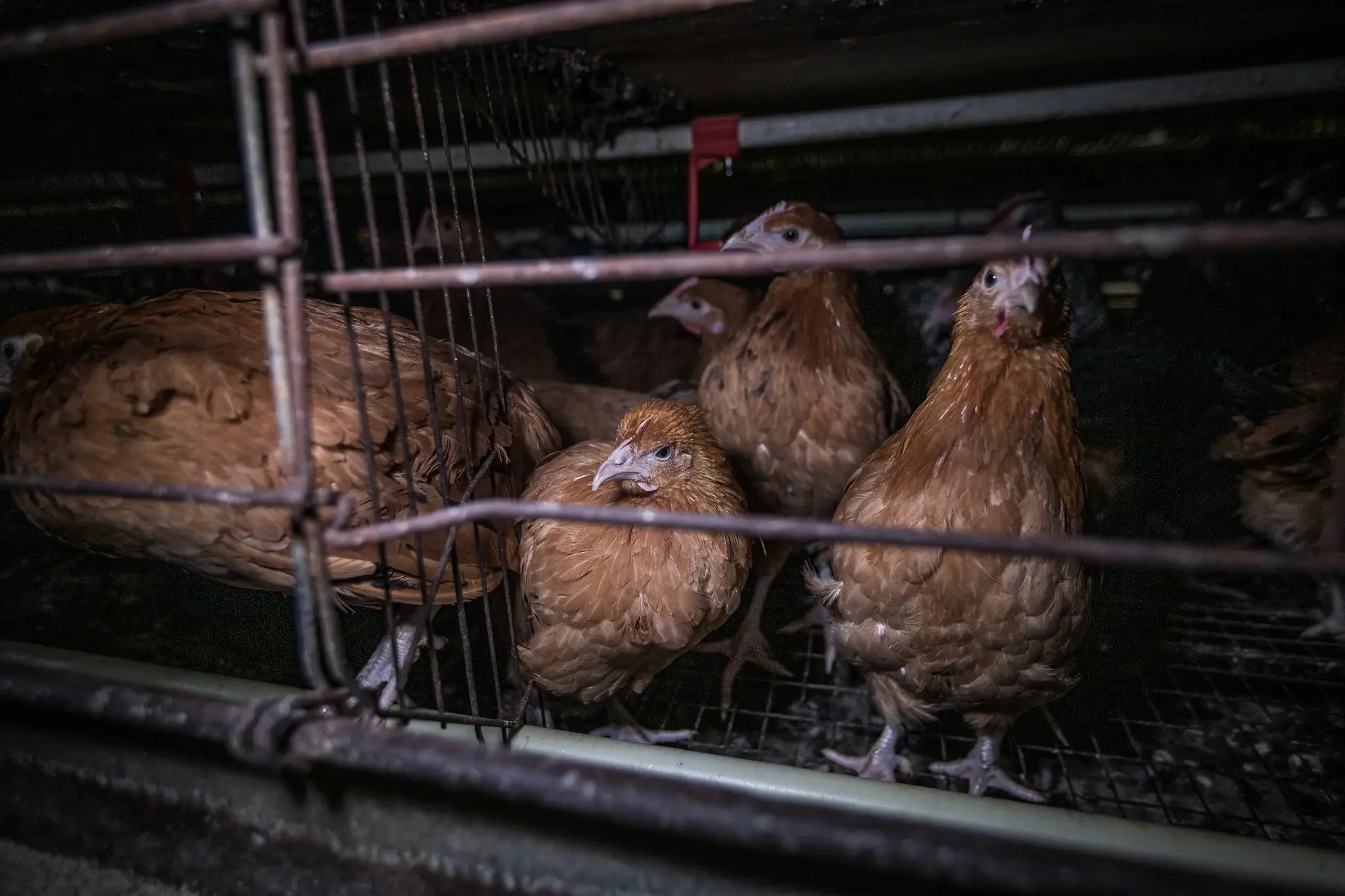
My body aches in every way possible. It’s like a heavy throbbing sensation that starts at my neck and travels all the way down my body. I desperately want to stretch out, to relieve some of the pain, but there is no room. I lean against the cold, rusty metal bars beside me. My skin feels so red raw, and leaning against the wire only distresses my skin more.
The stinging on my skin gets worse as I’m forced to rub against the metal as a cage mate attempts to move to a more comfortable position.
Apparently chickens don’t have dreams.
Perhaps that is true. I don’t dream of a better life, because I don’t know of any other existence. This is everything I know of life. I have not seen, heard or thought of anything different.
But I do have hope.
Sometimes when I shut my eyes, everything goes blank for a while. The pain goes, the smell goes, and I don’t know where I am. This is my nothing. But no matter how long I sleep, my nothing is always broken again by life.
But maybe, just maybe, one day when I go to my nothing, I won’t ever wake up again. One day perhaps everything will disappear. No pain, no smell, no fighting, no cages- nothing.
That is what I hope for. That is all I have.
Do not mourn for me when I die. It is what died inside me while I was still alive that should enrage you.
Every chicken here dies. But no chicken here really lived.
Anonymous memoir of a battery caged chicken.
Emma Hurst, Animal Justice Party MP, elected to the Upper House of NSW Parliament - Emma Hurst's Website
Emma Hurst is the first female Animal Justice Party MP, elected to the Upper House of NSW Parliament in Australia. A former psychologist, Emma has worked tirelessly for the rights of animals for many years with a background in campaigning, political lobbying, and media work.
Since she was elected in March 2019, Emma has used her time in parliament to bring animals to the forefront of political discussion: running inquiries into battery hens and animals in entertainment, preparing legislation to ban puppy farms, securing legislative reform on the link between domestic violence and animal abuse, banning the breeding and importation of captive dolphins, and campaigning against the use of animals in experimentation.
"Which came first the Chicken or the egg?"
Evolutionary biologists think that they have solved the dilemma.
Here is why you couldn't find an answer, yet.
Plutarch, (46 - c. 120)
Most everyone is familiar with the mind teaser, ”Which came first the Chicken or the egg?” While it seems contemporary, the question was first posed 2000 years ago by the Greek philosopher, Plutarch. The question – and its answer - was considered quite serious and important because it deals with whether or not the universe and life have a beginning.
In our worldly experience, everything seems to have a cause and an effect. Something causes something else to happen. The Dog wags her tail which knocks down the vase of flowers which spills water on the floor which causes the Dog’s guardian to slip and fall which causes the second Dog to bark, and so on - a simple chain of causes and effects. But, what came before that? We might be able to keep going back to find earlier and earlier causes but at some point, like the Greeks, we are stuck with the question: What came before the universe?
“Time is a mystery from a scientific point of view. The past is gone and the future has not yet happened, and the present as the point between past and future immediately ceases to exist – or it is possible to question whether it ever existed at all.”
Evolutionary biologists think that they have solved the dilemma. They claim it was the egg who came first and did so through mutation. In other words, a non-Chicken laid an egg that was somehow genetically changed to produce the first Chicken. But, physics says otherwise.
We usually take time as a given, that it is real and flows in succession. But, quantum physicist David Bohm called time a “mystery.” Indeed, he asserted, the passage of time, from past, present, and future only exist as an assumed image or thought. “The world-line (history) of a Chicken in spacetime is comprised of a series of continuous spacetime events. This is called the "block" picture of the universe, “(Perelman, 2020). The Chicken (past) who laid the egg (present) who becomes the Chicken (future) are one and the same. Our perception of time’s directionality, moving from the past towards the future is not grounded in reality, but (mis)informed by our belief in a fixed sense of self. Furthermore, quantum physics’ retrocausality implies that the Chickens and eggs of today can send information to the past thereby changing who their predecessors could be and might have been.
According to Bohm, the world we experience around us, the eggs, Chickens, and ourselves, only appear separate but are actually explicit manifestations of a deeper implicit order. As he describes, “Take for example all the experience of ourselves that we have at the ordinary level, in which I include all the various kinds of thoughts, images and sensations with which we identify. Now ordinarily we say, tacitly, that that is me. But that is really only an explicit image of something much more subtle and enfolded.”
Venn diagrams representing the specific and overlapping proteins identified in the human (during the whole gestation) and chicken (11th day of incubation) amniotic fluid (AF). Human AF data were obtained from the work of Cho et al., (11), which combines results from nine publications (supplemental Data S3, sheet #3).
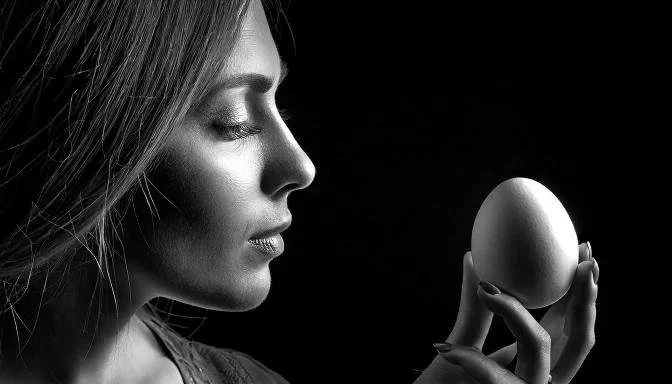
So when contemplating the Chicken-egg conundrum, quantum mechanics frames it in a very different way by demonstrating that we each emerge from life’s intrinsic, implicit wholeness, but are forever entangled, not just connected to each other, but we profoundly affect one and another. The egg that you hold in your hand was generated by the same wholeness from which you were generated. You and the egg are deeply entangled in the universe.
Physics is not the only science to recognize patterns of continuity which underlie and cohere all of us. Neuroscience does not delve into the implicit, invisible realms which quantum physics reveals, however, it describes the continuity in the explicit, tangible world.
Chickens, humans, Fish, and all other Animals possess common brains and capacities to feel, think, and experience the rainbow of emotions that make life so rich. We may look different on the outside, feathered versus naked skin, beaks versus noses and mouths, etc, but inside we share the same brain structures and processes which govern consciousness.
As we have learned from the recent convergence of global crises, to harm or destroy, abuse or kill an egg or Chicken, is the same as abusing and killing ourselves. As Shakespeare’s Danish Prince once admonished his friend, “There’s more to Chickens and eggs, Horatio, than dreamt in your philosophy.”
Gay Bradshaw, PhD, PhD, Executive Director - The Kerulos Center for Nonviolence
Gay holds doctorate degrees in ecology and psychology, and has published, taught, and lectured widely in these fields both in the U.S. and internationally. She is the author of the Pulitzer Prize-nominated Elephants on the Edge: What Animals Teach Us about Humanity, and Carnivore Minds: Who These Fearsome Beings Really Are, both published by Yale University Press. She is also the author of Talking with Bears: Conversations with Charlie Russell (Rocky Mountain Books, 2020). Dr. Bradshaw’s work focuses on trans-species psychology, the theory and methods for the study and care of Animal psychological well-being and multi-species cultures. Her research expertise includes the effects of violence on and trauma recovery for Elephants, Grizzly Bears, Chimpanzees, Parrots, and other species both free-living and in captivity.
Welcome to Egg-Truth!
Welcome to Egg-Truth! A website designed to educate and inform consumers, and the public at large, about the true nature of: industrialized egg production, it's affect on human health, the environment, and most importantly, the hens who endure one of the most miserable and heavily exploited existences in all of animal agriculture.
Welcome to Egg-Truth! A website designed to educate and inform consumers, and the public at large, about the true nature of industrialized egg production, it's affect on human health, the environment, and most importantly, the hens who endure one of the most miserable and heavily exploited existences in all of animal agriculture.
Some of the images and content on this web site are of a graphic nature - if you are upset by this, we are sorry. However, it is virtually impossible to tell the true story of egg production and its associated horrors without the use of still images and video. As they say, "a picture is worth a thousand words", and by extension, a video could be worth 10,000.
Often, it is human nature to avert our eyes when we see things that are upsetting, violent or graphic in nature. It is our mind attempting to avoid any potential trauma as a result of looking at unpleasant imagery. Unfortunately, given the amount of eggs consumed globally, our appetite for eggs contributes to the suffering of hens on an unprecedented scale. No animal, with perhaps the exception of chickens raised for meat, endures more suffering, qualitatively and quantitatively, than egg laying hens.
Chickens are social, intelligent and sensitive creatures who are capable of exhibiting problem solving, critical thinking, empathy and a host of other cognitive functions we normally associate with the companion animals we keep in our homes like dogs and cats. Despite this, global, industrialized egg production sees hens as merely a means to an end - a limitless supply of a commodity called: the 'egg'.
While it is true that eggs contain some goodness from a nutritional standpoint, there is nothing healthy in eggs that can't be obtained in far healthier forms of other foods where animal welfare is much less of a concern or not at all. And, many of those foods do not contain the constituents in eggs that are unhealthy and contribute over time to various diseases in humans.
Environmentally speaking, the urine, faeces, methane, ammonia and other toxic gases that are a by-product of billions of hens farmed and slaughtered annually, must be remediated. However, the soil, ground water, rivers, streams, ponds, lakes and coastal run-off areas around the world pay the price as the final destination for much of this waste - and this has a negative impact on our health and wildlife as well. Animal agriculture has become under increasing scrutiny for the amount of water and land dedicated to hydrate farmed animals and to grow food to feed billions of animals confined in feed lots, sheds and barns around the world. And this is no less of a concern with egg production as it is with other species farmed and harvested for human consumption.
We hope you find this website informative. We also hope you share it far and wide - our goal is to become the #1 destination on the web for fact-based information on global, egg production. A lofty goal no doubt, but with your help, we hope to get there one day - and the sooner the better! We intend to post regularly on our blog and our social media channels as they come on-line. So please check back with us frequently, and if you have any questions, need additional information or have suggestions for our website, don't hesitate to reach us via our Contact Us page.
Many thanks!
Photo credit banner image: Jo-Anne McArthur / We Animals