Eggs Are Bad!
We are very proud to announce the launch of our page regarding the impact of egg consumption on human health: "Eggs and Our Health".
Since late 2017 through early 2018, the public has been bombarded with media reports citing studies claiming that dietary cholesterol does not actually increase cholesterol levels in our blood. And consequently, this has resulted in many nutritionists, bloggers and doctors now promoting egg consumption and informing the public to go ahead and eat as many eggs as you like. Some are even suggesting that egg consumption reduces the risk of heart attack and stroke and those with type-2 diabetes and pre-diabetes are no longer at risk. There have been concerted efforts by the egg industry to have major health organizations drop the limitations of cholesterol intake in place for the last four decades.
This misinformation is insidious and on par with the efforts by the tobacco industry in the 1950's, 60's and 70's seeking to disassociate their products from lung disease, and the sugar industry in the 1960's using deliberate misinformation to cast doubt on evidence that sugar was bad for heart health.
We address all of these issues and more. It is well worth the read and we encourage everyone to bookmark our "Eggs and Our Health" page for quick, future reference.
We'd like to give special thanks to Dr. J. David Spence, head of neurology and clinical pharmacology at the Western University, London, Ontario, Canada. We are also grateful to Dr. Michael Greger for his immensely informational videos from his website Nutritionfacts.org. And a special shout out to our editor, Sheryl Greenspan for her selfless support of our website.
If you have any questions, or require additional information about this or any other topic covered on Egg-truth.com, don't hesitate to reach us on our Facebook page or send us an e-mail via our Contact Us page.
Many thanks,
Nigel Osborne, Executive Director
Egg-Truth
Egg Industry's Shocking Cruelty Exposed!
Animal rights activists in Canada have exposed shocking cruelty and abhorrent conditions on several egg farms in British Columbia, Canada. National media outlets have picked up on this story including CTV News and CBC News.
Animal rights activists in Canada have exposed shocking cruelty and abhorrent conditions on several egg farms in British Columbia. National media outlets have picked up on this story including CTV News and CBC News.
Egg-Truth was granted an interview with one of the animal rights activists involved in documenting conditions on these farms.
Interview with Jeff Rigear
ET: Good evening Jeff, thanks for agreeing to an interview.
Jeff: You're very welcome, my pleasure.
ET: What made you choose this particular farm or was it random?
Jeff: They were completely random. There were actually 3 farms involved. We wanted to get a good sample of the industry because, of course, every time the Canadian public gets a glimpse into the animal ag industry, whether it is egg farming or other types of animal agriculture, they’ll always say this is an isolated incident. So, we selected 3 farms, and all 3 were chosen randomly. There were hen’s dead or dying in the manure pits, dead or dying hens in the cages and in various forms of decay.
ET: So you found hens dead or dying in the manure pits of just one farm or all of them?
Jeff: All of them. Alive and dead in all three.
ET: How many birds do you estimate were in these sheds, roughly? 5, 10, 15,000?
Jeff: I estimate maybe around 20,000.
ET: Per shed?
Jeff: Yes, per barn.
ET: And how many of you were there that entered these facilities?
Jeff: There were up to four people including myself.
ET: From the media reports published thus far or the video that PETA has shared, is there anything that hasn’t been disclosed or documented that you’d like to make the public aware of?
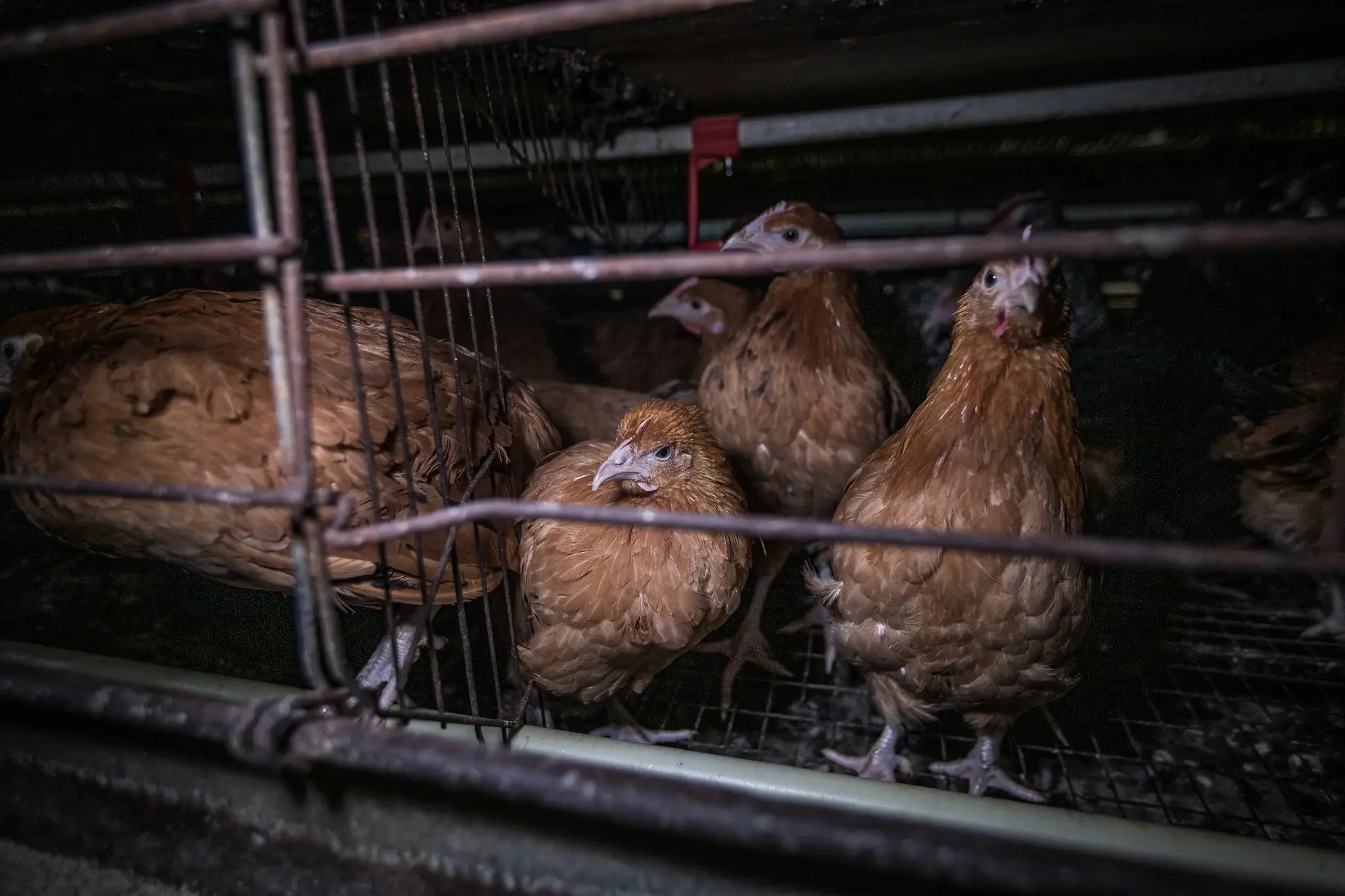
Jeff: I’d want people to be aware that what you see in the videos and images is common practice. I’d want people to know that beyond hens being left to drown in their own excrement hens are dying in other excruciating ways even on the very best egg farms. For example, there were hens dying on these farms from prolapses or from being egg bound – this is not unique to the facilities we documented. I can only imagine how excruciating it would be to die like that. And I can tell you from experience this is extremely common for animals that have been genetically selected to lay 300+ eggs a year. So the issue goes far beyond one farm doing a poor job. The industry is just inherently cruel.
A hen suffering from a prolapse.
ET: And this is the constant refrain that we hear from the egg industry marketing boards and public relations people. They always frame these exposes as being an “isolated incident” that “this is the exception not the rule”, that they “have high standards” and they are “very disturbed and upset by what they’ve seen”. But when whistleblowers constantly choose facilities at random and consistently reveal these conditions without exception, it’s pretty hard to credibly use these excuses. How would you rate this facility relative to others you have been in?
Jeff: Average.
ET: Did the same company own these farms you went in to or were they separate entities?
Jeff: I believe they were separate entities; at least they appeared to be registered under different names. So I assume they all had different owners.
ET: Were these facilities battery cage facilities or enriched cage facilities?
Jeff: They were battery cages or what the industry calls “conventional”.
ET: Looking at those manure pits, how long do you think since they were last cleaned? There were picture of you standing next to 5’ and 6’ mounds of manure?
Image shows accumulated manure in pits are approximately five to six feet high.
Jeff: I feel I don’t have a good handle on how long it would take for what I saw to accumulate. I would guess a year perhaps, but I’m really not sure. I haven’t worked on an egg farm that long to know. I’ve been in lots of egg farms for shorter periods of time.
ET: Are the feces accumulating in these pits accumulating from just the bottom row of cages or is this also coming from those rows stacked on top as well. And if so, are the birds in the upper rows urinating or defecating on the birds below and eventually working its way to the pits?
Jeff: Partially they are. They’re called a-frame battery cages. They are kind of like a stair, so it partially overlaps the cage below. So a bird at the back of the cage may be getting some excrement and urine on them.
ET: How many rows of cages were there?
Jeff: I think there were at least 3 aisles with cages on either side.
ET: Stacked how many rows high?
Jeff: Three.
ET: There was a recent case in the U.S. where the FDA recalled millions of eggs due to a salmonella case from one particular farm. On this farm it was cited that the source of the salmonella was rodent and insect infestation and uncleanliness. From the pictures and video, these farms looked like there was quite an infestation of insects, was that in fact the case here and did you see rodents?
Egg-laying hens routinely endure painful injuries.
Jeff: Oh yeah, there was quite an infestation. It was teaming with maggots and other insects. Rodents were all over the place; you had to be careful not to step on them. It was crazy!
ET: And this was in the manure pits or up above in the barns themselves?
Jeff: Both.
ET: You had a mask and breathing apparatus on during your time in the barns?
Jeff: I did. Once, the breathing mask broke so I was not wearing one when I was at one of the farms. But most of us were wearing something.
ET: How bad was the ammonia in the barns, were there any monitors to keep track of the level of ammonia or toxic gases?
Jeff: I didn’t see any. However, I can tell you that the ammonia is so strong it makes your eyes water in the manure pit and up above where the hens are caged as well.
ET: How do you think the birds got trapped in the manure pits? Was it careless handling when the birds were loaded/unloaded in or out of the cages by workers or did they simply fall out somehow?
Jeff: Careless handling. With the farm that had the highest number of hens living in the manure pit, I believe, had been emptied by chicken catchers from, (according to CTV News), Elite Farm Services. However, some of the hens clearly had been down there before the chicken catchers came because there was a large accumulation of dried manure built up on their legs and feet. So I have to imagine, because there were 50-60 live birds down there that they would have escaped during handling when the catchers emptied the cages.
A dead hen left to decay inside a cage with still living hens.
ET: Do you know of any brands or retailers who carry the eggs harvested from these farms?
Jeff: No I don’t. I believe, however, there is only one egg packing plant here in B.C. called Golden Valley Eggs. I know the same owners of Gray Ridge farms in Ontario own it. When I worked in the packing plant in Ontario, for example, the eggs come from the farms and get sorted by size, quality and colour and go on to be sold in many places and under different brands. The same is true out here. So, it is quite possible these eggs end up virtually everywhere out west.
ET: So what you’re saying is that these farms you went in to supply the one packing facility that in turn distributes to a broad variety of brands and retailers?
Jeff: Yes.
ET: Has the BC SPCA or other law enforcement group interviewed you thus far?
Jeff: I filed the complaint. I initially made the call and submitted a witness statement. And I think on that basis they raided one of the farms owned by Jaedel Enterprises the same or next day. But there hasn’t been a formal witness interview yet.
ET: Are you worried about reprisals from anyone for being a whistleblower?
Jeff: No, not really.
ET: Describe the sensory experience of being in these sheds with 20,000 hens. It must have been deafening and the smell overwhelming?
Jeff: It’s loud; you can see the air is just full of particulate matter, mostly dried chicken excrement. The dust is airborne and really thick. There is a really powerful stench of ammonia. This is egg farming, this experience is exactly like the other farms I’ve worked in.
ET: Were the vents and air circulation systems working in the sheds to mitigate these gases and airborne particles?
Jeff: If they were, they weren’t working very well. However, they may not be on all the time so maybe they just weren’t on during the time I was in there. But if they were working, they weren’t doing a very good job.
ET: Jeff thanks for your time. We really appreciate it!
Jeff: Thank you!
Photo and images courtesy of: Jeff Rigear, PETA
Welcome to Egg-Truth!
Welcome to Egg-Truth! A website designed to educate and inform consumers, and the public at large, about the true nature of: industrialized egg production, it's affect on human health, the environment, and most importantly, the hens who endure one of the most miserable and heavily exploited existences in all of animal agriculture.
Welcome to Egg-Truth! A website designed to educate and inform consumers, and the public at large, about the true nature of industrialized egg production, it's affect on human health, the environment, and most importantly, the hens who endure one of the most miserable and heavily exploited existences in all of animal agriculture.
Some of the images and content on this web site are of a graphic nature - if you are upset by this, we are sorry. However, it is virtually impossible to tell the true story of egg production and its associated horrors without the use of still images and video. As they say, "a picture is worth a thousand words", and by extension, a video could be worth 10,000.
Often, it is human nature to avert our eyes when we see things that are upsetting, violent or graphic in nature. It is our mind attempting to avoid any potential trauma as a result of looking at unpleasant imagery. Unfortunately, given the amount of eggs consumed globally, our appetite for eggs contributes to the suffering of hens on an unprecedented scale. No animal, with perhaps the exception of chickens raised for meat, endures more suffering, qualitatively and quantitatively, than egg laying hens.
Chickens are social, intelligent and sensitive creatures who are capable of exhibiting problem solving, critical thinking, empathy and a host of other cognitive functions we normally associate with the companion animals we keep in our homes like dogs and cats. Despite this, global, industrialized egg production sees hens as merely a means to an end - a limitless supply of a commodity called: the 'egg'.
While it is true that eggs contain some goodness from a nutritional standpoint, there is nothing healthy in eggs that can't be obtained in far healthier forms of other foods where animal welfare is much less of a concern or not at all. And, many of those foods do not contain the constituents in eggs that are unhealthy and contribute over time to various diseases in humans.
Environmentally speaking, the urine, faeces, methane, ammonia and other toxic gases that are a by-product of billions of hens farmed and slaughtered annually, must be remediated. However, the soil, ground water, rivers, streams, ponds, lakes and coastal run-off areas around the world pay the price as the final destination for much of this waste - and this has a negative impact on our health and wildlife as well. Animal agriculture has become under increasing scrutiny for the amount of water and land dedicated to hydrate farmed animals and to grow food to feed billions of animals confined in feed lots, sheds and barns around the world. And this is no less of a concern with egg production as it is with other species farmed and harvested for human consumption.
We hope you find this website informative. We also hope you share it far and wide - our goal is to become the #1 destination on the web for fact-based information on global, egg production. A lofty goal no doubt, but with your help, we hope to get there one day - and the sooner the better! We intend to post regularly on our blog and our social media channels as they come on-line. So please check back with us frequently, and if you have any questions, need additional information or have suggestions for our website, don't hesitate to reach us via our Contact Us page.
Many thanks!
Photo credit banner image: Jo-Anne McArthur / We Animals